Author: Paul Constant

  • What i’ve been reading and writing: June 2023

    What i’ve been reading and writing: June 2023

    Howdy,

    Earlier this month, Apple unveiled their Vision Pro headset, ending years of wild speculation about Apple’s strategy for virtual/augmented reality. I haven’t had access to the headset, but I have read just about every review written by tech journalists who have.

    Most of the reviews rave about the fact that Apple has gone to ridiculous lengths to perfect and simplify what it has termed “spatial computing.” Apparently, the headset can create a dinosaur in the middle of your living room that looks so real that your basal ganglia tells you that you should run away before the giant reptile eats you. It can project multiple enormous screens in your room, or throw you into three-dimensional photographs that make you feel like you’re wandering around in a memory. In fact, most of the reviews I’ve read have expressed frustration at the fact that they can’t fully express in words how holistically pleasing the experience of using the Vision Pro is. 

    When they’re finally available for sale next year, the Apple Vision Pro will be about $3500 each, and it will cost even more for glasses-wearers like myself to have special lenses crafted in order to use the device. In other words, I’m defnitely not getting one. But I’m sure that future versions of the device will be more affordable for mass-market use (probably the Apple Vision Air™, coming to engulf your head in 2027 or so) and so I’m certainly not going to vow that I’ll never buy one of their headsets.

    I can’t help but notice how lonely most of Apple’s use cases for the Vision Pro are. Almost all of the examples in their press materials show people sitting or standing alone in stylish, airy living spaces: They’re doing work, video chatting, watching movies, and looking through photographs alone. All alone. 

    And even though the headset projects an image of your eyes onto the front of the headset when another person is around, and even though the first ad for the Vision Pro goes out of its way to show a dad wearing the headset while horsing around with his kids in the kitchen over breakfast, those lonely figures are what really stand out to me as the most likely use-case for the device in its current form.

    I just can’t see myself sitting down to watch a movie in the same room with friends and family like this, with each of us wearing our own Vision headset. But when I said this to a friend of mine recently, she pointed out that teenagers absolutely will do that. She’s right, of course. Younger people will absolutely wear the Vision Pro (or, more likely, the more affordable next versions of the Vision Pro with better battery life) in public. Young tech workers who live in tiny but expensive studios will love the ability to watch IMAX-scale movies from the comfort of their own futons. 

    But unless there’s a massive societal shift—and never bet against Apple when it comes to creating massive societal shifts—I would feel too embarrassed to ever let strangers see me wearing this thing. This is the first time in my life that I can feel a technology passing me by, aimed over my head at the generation behind me. And I’m pretty okay with that. You kids go on ahead and strap a teevee to each eyeball. Maybe I’ll hop in later, after my nap. 

    An Update on AI and Writing

    Here is a completely real interaction I had with the ChatGPT iOS app yesterday:

    Man, it is scary how smart this thing is getting.

    I’ve Been Writing

    For the Seattle Times, I wrote about Ballast Book Co, the independent bookstore in downtown Bremerton. The charming little shop, which changed ownership a little while back, just went through a small renovation process and is back open with a huge slate of book clubs that meet all around Bremerton. I learned in the process of writing this piece that Bremerton has a huge and very committed nerd community, with lots of arcades and board-game bars sprinkled throughout the area. 

    And I also profiled Washington author Dave Neiwert, who is a leading expert on far-right and white nationalist organizations. His latest book, The Age of Insurrection, is a harrowing read explaining how regional clusters of militias and whitessupremacists have become a legitimate threat to American democracy. It’s an essential read for people who want to defend our country against neo-Nazis and other Trump-enabled creeps

    For the Pitchfork Economics podcast, Goldy and I discussed the economics and politics books we’re looking forward to reading this summer. I enjoy being mean to Goldy, and I’m glad that some of my bullying of him has been recorded and preserved for posterity.

    I’ve Been Reading

    The best new book I read this month, by far, was Yellowface, a novel by R.F. Kuang. It’s a satire of the publishing industry tucked into the framework of a literary thriller about a white woman stealing her Asian-American friend’s novel after a fatal accident and passing it off as her own. If you’re currently trying to sell a debut novel to a major publisher, I encourage you to read this book’s warts-and-all portrait of the publishing industry before you sign on the dotted line. It’s a clever story about someone trying to get away with a con, only to learn that she’s just a tiny part of a much bigger scam. I can’t guarantee you’ll feel great about the world when you finish this book, but I sure did tear through this one in an afternoon because I couldn’t wait to see what happened next.

    I re-read Jonathan Raban’s travel memoir Passage to Juneau this month. This was one of the first books I read when I moved to Seattle and got a job at the Elliott Bay Book Company 23 years ago, and revisiting it as an older man offered a different kind of experience. When I was younger, I loved the book for its dazzling tour of the history and geography of the region, but this time I deeply felt for Raban’s experience of loss and discovery. He was one of the finest writers ever to live in Seattle, and this one holds up beautifully.

    I listened to the audiobook version of Tom Hanks’s novel The Making of Another Major Motion Picture Masterpiece, and I had a great time with it. Hanks reads a large portion of the story, but he brings in guest readers to handle the monologues that are specifically from the perspective of important side-characters. This is not a ground-breaking or brilliant novel, but it is a charming and cheery overview of the process of making a movie. When I heard that the film featured in the novel is an adaptation of a Marvel-like comic book, I thought Hanks was going to publish more of a satire of the money-grubbing side of the film industry, but he happily treats the movie-making process as art, and every person involved in the process of making the art—from the writer/director on down to the lowliest production assistant—is treated as an artist, with dignity and compassion. Is it cheesy? Sure, a little. But that means it’s also a perfectly pleasant diversion for film-lovers who enjoy meandering solo summer walks on the beach. 

    I was a teenager when the Branch Davidian compound at Waco went up in flames, and I was fascinated by the story, devouring every morning’s newspaper for new developments. (My parents didn’t have cable, thank God, or else I would have been glued to CNN.) I was surprised when I read Koresh, by Stephan Talty, to learn how little I actually knew about David Koresh and the Branch Davidians. I didn’t realize exactly how much abuse and criminality Koresh had been allowed to get away with before the raid, for instance, and I wasn’t aware of the rush to make a TV movie of the Waco seige before it reached its conclusion. It’s not a must-read unless you’re weirdly fascinated by the story, but it’s a good overview.

    In my quest for something light after that dip into true crime, I read both of Blythe Roberson’s nonfiction books, How to Date Men When You Hate Men and America the Beautiful? Of the two, the latter has much more to recommend—it’s a book-length account of Roberson’s quest to visit national parks from coast to coast. Roberson has worked as a standup comedian and a writer for The Late Show with Stephen Colbert, and I have to say she’s currently more of a comedian who writes than a comedy writer, if that makes sense. While her books are full of funny jokes, they’re not as witty as my most preferred comedy writing—think Wodehouse, Sedaris, Crosley, Adams, Ephron, Parker. I think she has it in her to really ratchet down the writing so that every line sparkles, but she’s not quite there yet. 

    Night Fever, the latest comic by Ed Brubaker and Sean Phillips, is a weird noir novel about an ordinary guy on a business trip who’s struggling with insomnia and wanders into a secret underground society that leads him toward a criminal double life. I love all of Brubaker and Phillips’s comics, but this one is special. It has the feel of an early David Lynch film, or a much more successful investigation of the gossamer-thin veil between the supernatural world and real life that Kubrick seemed to be going for in Eyes Wide Shut. If you like Jim Thompson novels and/or Lee Marvin movies, this one won’t let you down. 

    The Lois Common Denominator 

    Superman comics and Charlie Brown comic strip collections were my pathway to literacy, and in return I have developed a deep and lifelong affection for both of those characters. While there have been many great Superman comics produced in my lifetime, the last half-dozen or so movies with Superman in them have been….Very Not My Bag. Brandon Routh and Henry Cavill both looked the part of Superman, and they both conjured the earnest farmboy heart of the character at certain points in their movies, but Superman Returns, Man of Steel, and all the attendant Zach Snyder-driven Justice League films completely failed to understand Superman as a character.

    I’m cautiously optimistic about the Superman: Legacy casting news that came out earlier this week. It remains to be seen if James Gunn has written a good Superman movie, but David Corenswet certainly looks like Superman and Clark Kent, and both his sleazy character in the film Pearl and his tragic turn in the show The Politician have somehow convinced me that he has the range to play an alien god who is raised on a Kansas farm by the most decent Americans in the history of the world. 

    But the news that I’m most excited about is the casting of Rachel Brosnahan as Lois Lane. Lois is the most important character in Superman comics because she’s Clark Kent’s tether to humanity. She’s an ambitious, empathetic, brilliant journalist—but she’s also impetuous and prone to jealousy and anger, and even though she’s the best reporter on the planet, she can’t spell to save her life. Superman both looks up to her and is terrified of her. She’s perfectly imperfect—in other words, human. Margot Kidder doesn’t get enough credit for the work that she did opposite Christopher Reeve in Superman. She dug through some of the pretty clunky Superman comics that were being produced at the time to find the heart of Lois—and through Lois’s heart, she found the heart of the movie.

    Neither Amy Adams nor Kate Bosworth had enough to work with in their turns as Lois, so I can’t fault them for not getting the character right. But Brosnahan proved in The Marvelous Mrs. Maisel that she has the charisma to steal a scene from some of the world’s best actors, and she can make them fall in love with her while she does it. Her portrayal of Midge Maisel is a world-class mess—she’s selfish, oblivious to the sacrifices that everyone makes for her, and willing to step on anyone in her quest for fame—but Brosnahan somehow convinces the audience to cheerfully follow her every step of the way. The only other actor who I’ve seen pull off that particular trick in a somewhat similar role is Bryan Cranston in Breaking Bad.

    It’s frankly a crime that Brosnahan hasn’t been in four or five incredible movies at this point in her career, but this role could be the one that puts her over the top. Because if James Gunn got the script right, Lois Lane will run away with this movie and everyone will leave the theater talking about how great Brosnahan was. 

    That’s a huge if, I realize. But Gunn has one of the best records when it comes to writing and directing modern comics adaptations. I loved the first and third Guardians of the Galaxy movies, and The Suicide Squad was a pretty great superhero movie too. He will have to switch tones for this movie; I don’t think Superman is the right vehicle for dick jokes and gross-out comedy. But I think Gunn also understands that. He’s no one-trick pony. 

    I realize it’s a little ridiculous to be talking about my anticipation for a superhero movie that is scheduled for 2025 and has yet to film a single frame. But I think it’s a crime that out of the dozens of superhero movies we’ve seen over the last 15 years the first and greatest superhero has yet to get his due. A lot of people claim that Superman is boring, or too powerful, or too much of a goody two-shoes for modern audiences. I disagree. A person who can shatter planets with his bare hands but instead makes a conscious choice to be gentle, kind, and useful is one of the best stories that there is.

    I hope your summer is going well!

    Paul
  • What I’ve been writing and reading: May 2023

    What I’ve been writing and reading: May 2023

    Hi there!

    In the last post, I wrote about my fears that AI would replace a lot of writers relatively quickly. Within a week of sending that email, I heard from two different readers of this very newsletter who had, in fact, recently been laid off from their writing gigs and (in one case, presumably) replaced by artificial intelligence. The corporate shift away from human writing and toward AI writing is real, and it’s happening right now. 

    Wow, That’s a Dark Way to Open a Newsletter. Let’s Start Over.

    Hi there! 

    Hope this finds you well, and that you haven’t heard any terrifying news about technological advances recently. 

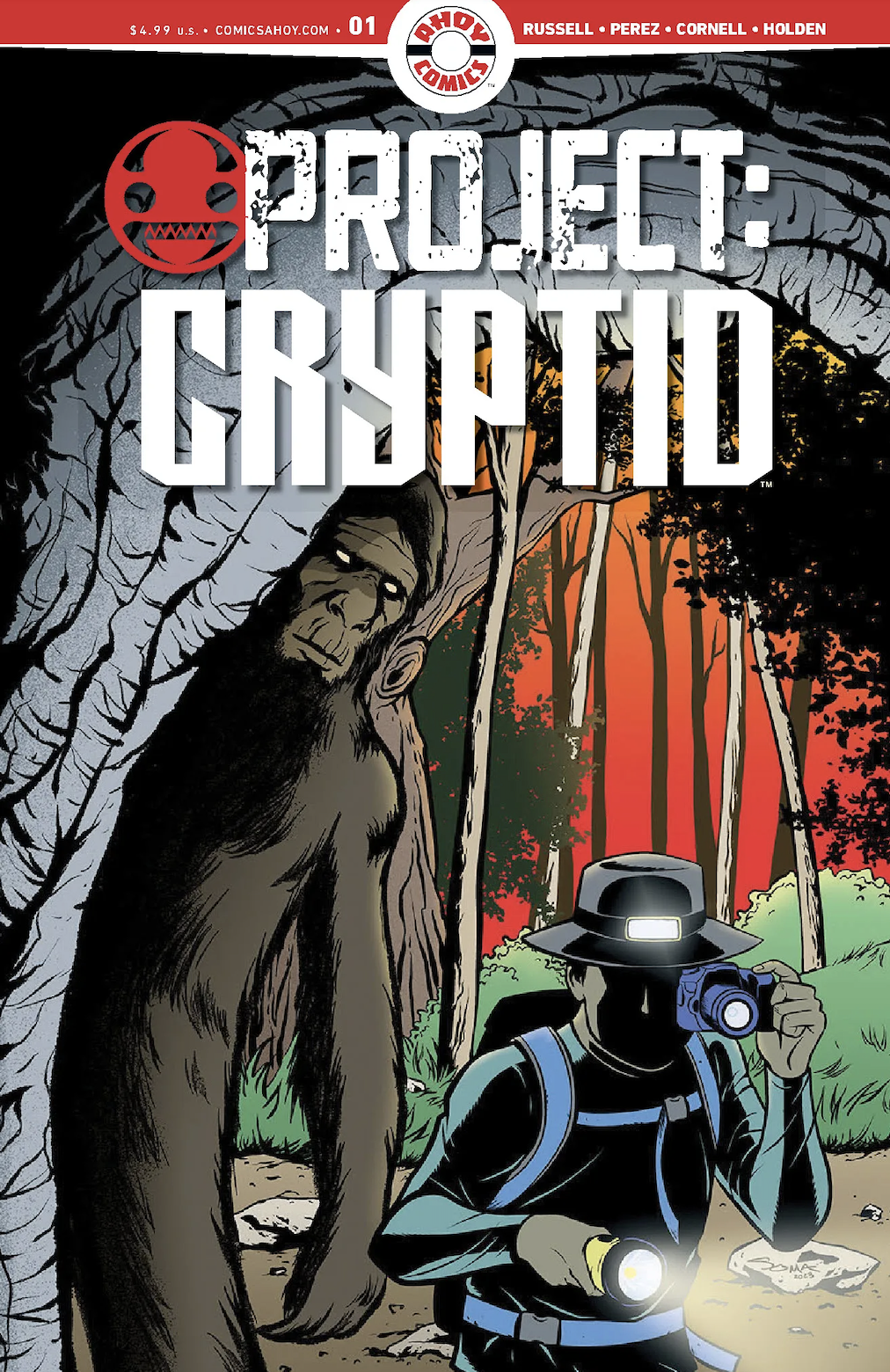
    I have some exciting news! Last week, AHOY Comics announced a new anthology miniseries coming this September, and I’ve contributed a comic to it! The book is called Project: Cryptid, and it’s a five-issue miniseries collecting stories about mythical creatures like Bigfoot, the Jersey Devil, and the Loch Ness Monster. 

    I can’t share too much about my story except to say that the artist is the amazing Peter Krause, I shared some of Peter’s gorgeous preview art last month, and it’s a weirdly personal story set in the Pacific Northwest. 

    I’m not yet sure which issue our story will be in, but you’ll want to read this whole miniseries because it’s packed with stories from some of the best comics writers in the world today including Mark Russell, Paul Cornell, Alex Segura, and Alisa Kwitney, and the stories are illustrated by some amazing artists including Gene Ha, Zander Cannon, Jamal Igle, and Richard Pace. The first issue’s cover looks like this:

    So if you’re the kind of person who buys monthly comic books at your local comic shop, I’d appreciate it if you subscribed to this one. I’ll also let you know when the issue with my story is set to be released, and hopefully there’ll be a collected edition to buy sometime down the line. I’m excited to read everyone else’s stories in this series, and I’m thrilled to be a part of this weird, wonderful comic that was written, drawn, colored, and lettered 100% by human beings.

    I’ve Been Writing

    For almost 20 years now, I’ve been a fan of autobiographical cartoonist Julia Wertz. Her online comic strip, Fart Party, was an early viral sensation and she now publishes regular strips with The New Yorker. She’s since expanded into full-length books about her life, and her newest one, Impossible People, is her most ambitious yet: A big book about awful relationships, recovery from alcoholism, and the awkwardness of becoming an adult. For the Comics Journal, I interviewed Wertz about her whole life and career. It is thousands of words long—we talked on the phone for two hours, with both of us walking around our respective neighborhoods—and I’m very happy with how it turned out. We discussed earnestness, regrets, and the idea of whether you ever feel like you’ve earned your life accomplishments. (It’s extremely weird talking to someone at length about their life when you’ve never spoken before.) I used to read the Comics Journal as a kid and their long interviews with comics professionals were always the epitome of cool to me, so I’m thrilled to be published by the Journal.

    I’ve been reading Josh Feit’s writing, I think, for about two decades now. As the news editor at The Stranger and as a founder of Publicola, Josh has helped shaped my understanding of urbanism and what it means to live in a city. Over the past five years or so, Josh has gotten into reading and writing poetry, and he’s published two books of urban-planning-themed poems in the last year. I interviewed him about his poetic education and his poetry practice for Poetry NW. His enthusiasm for poetry is so enviable, and a reminder that it’s never too late to stretch your writing in new ways, which I find really inspiring.

    For the Seattle Times, I profiled used bookstore Ophelia’s Books, which has been a steady presence in Fremont for 25 years. This story actually breaks some news: Ophelia’s has just recently brought on a new co-owner, and among other improvements the shop is going to carry a small selection of new books for the first time in its history. It’s always exciting to see booksellers adapt and try new things, and I have great faith that Ophelia’s will be even stronger for these changes.

    I’ve Been Reading

    Friends, I was absolutely charmed by Bea Wolf. It’s a comic book adaptation of Beowulf for and about kids, written by Zach Weinersmith and drawn by Boulet, who only has one name. The title character is a fearsome warrior in a suburban neighborhood full of children who are terrorized by a boring old man who hates youth. And it’s written in a riff on the old English of Beowulf. Here’s the first few lines: “Hey, wait! Listen to the lives of the long-ago kids, the world-fighters, the parent-unminding kids, the improper, the politeness-proof, the unbowed bully-crushers, the bedtime-breakers, the raspberry-blowers, fighters of fun-killers, fearing nothing, fated for fame.” Yes, it’s all written like this and it is glorious. I have no idea if kids would enjoy this book or if they’d find it impenetrable and frustrating. But for me, it’s the most joyous reading experience I’ve had in a long while.

    Lone Women is not my favorite Victor LaValle novel, but “not my favorite Victor LaValle novel” is a category that still ranks above most other novels. It’s about a woman who moves to Montana as a homesteader. She’s got a mysterious past and she’s carrying a weird secret in a large locked trunk—and bad things happen when that secret gets loose. This one paired well with the book I read immediately after—Noah Van Sciver’s Joseph Smith and the Mormons, which is one of the best long nonfiction narratives I’ve ever read in comic book form. It takes a somewhat dispassionate, objective look at Smith’s life and the earliest days of the Mormon faith, and Van Sciver’s handling of the subject matter is nothing short of masterful. 

    I came across two titles on the staff recommendation wall at Third Place Books Ravenna that immediately spoke to me. The first, Sam Wallman’s Our Members Be Unlimited, is a comic-book history about the history and importance of labor unions. I really dug the way Wallman presented information in comics form (with the unfortunate exception of two early chapters in the book that took a more abstract turn and which were for whatever reason incredibly difficult for me to follow) and it’s a stirring argument for organized labor. The second staff recommendation was Hourglass, a novel by Keiran Goddard about a maladjusted man who completely falls apart when a romantic relationship ends. I didn’t enjoy this one as much, but that might be because it was an incredibly dark book and I didn’t want to spend that much time in the dark this month. It’s well-written, but it’s a rough trip.

    So naturally, I accidentally read another incredibly dark book almost immediately after: Hanna Bervoet’s novel We Had to Remove This Post. Bervoet is a Dutch author and this is her first book to be translated to English. It’s easy to understand why: It’s a novel about a young woman working as a content moderator at a social media company, and it’s based on journalism about the hellish duties of a content moderator. Basically, the narrator and her coworkers are exposed to horrendous filth posted online all day, every day, and they have to apply the social network’s esoteric and always-evolving moderation rules to determine what should be deleted and what should stay. It’s a dark novel about the junction between technology and despair, and I enjoyed it more than  Your Driver Is Waiting, which I read last month and which is kind of in the same lane. But don’t read it if you’re in a sensitive place. I mean, yeesh.

    Hernes is a real change of pace for Ursula K. Le Guin. It’s a collection of very short stories about the residents of a coastal Oregon town—kind of like a more ambitious prose version of Spoon River Anthology. Hernes is a very airy, experimental read—it’s easy to understand why this one is published in a limited edition by a small press rather than one of the big publishers that puts out Le Guin’s sci-fi novels—but I’m glad to meet this side of Le Guin and to know there’s more like it out there in the world.

    From the delightfully named Portland publisher University of Hell Press, 2020: The Year of the Asterisk is a collection of personal essays written in and about the first year of the coronavirus pandemic. It’s fascinating to me now that those first lockdowns already feel like history, like a thing that happened, and reading this book marked the first time I really thought of the moment as history, as opposed to something that happened a while back.

    After a whole bunch of false starts in which I’d wildly pick up and abandon books, I encountered a cheesy 1970s mystery paperback called The Running of Beasts in a local Little Free Library at exactly the right moment. Bill Pronzini and Barry Malzberg’s novel is a multi-perspective thriller about a community that’s terrorized by a serial killer, and I tore through it. Not groundbreaking, but a lot of fun.

    The Longest Walk

    On Sunday, May 28th, I decided to make an attempt at my fourth annual walk around Lake Washington. I usually try to circumnavigate the lake at the beginning of summer, when the days are long but before the weather starts to get too hot (and/or smoky, PNW summers being what they are in the age of climate change.) I wrote about last year’s hike for the Seattle Times, and I mentioned then that after walking for 103,000 steps, I felt like I had another hour or two in me. 

    This year, I put that hypothesis to the test. After leaving the house at 4:28 am I followed the same route as last year for most of the way—north to the Burke Gilman Trail, over the top of the lake, south through Kirkland, Bellevue, and Factoria—but then I cut over to Newcastle and down through Renton before circling back north to home. It added a little less than two hours to the trip—so, roughly six miles.

    In the end, I walked 112,004 steps, arriving home at 11 pm sharp. I barely sat down or stopped walking for the entire day, except for bathroom breaks, picking up food to walk on the trail, or changing my shoes and socks halfway through the walk. 

    It was the most I’ve ever walked in a single day, and it will probably be the most I’ll ever walk in a single day. I can’t recall ever feeling quite as tired—mentally and physically—as I was by the time I walked in the door to my house that night. If I kept going for much longer, I think that I would have collapsed. But those ill effects weren’t long-lasting. Remarkably, I had no blisters (I credit this Foot Glide anti-blister balm that you spread on your feet like deodorant) and I wasn’t really sore the next day, just a little stiff in the hips when I woke up.

    I’ve always been the kind of person who tends to extremes. I smoked a lot of cigarettes, until I quit cold turkey. I liked to drink beer a lot, until I stopped drinking entirely. I’m curious to see what happens now that I’ve hit this physical extreme. Now that I’ve done the most walking I can do in a day, does that mean my relationship to walking will change? Will my weekly long walks feel a little less compulsive than they have in the past, knowing exactly what I’m capable of doing? Maybe! But it’s honestly kind of fun to be at this point—to hit a milestone in a long-running obsession, and to find out what’s on the other side. 

  • What i’ve been writing and reading: April 2023

    What i’ve been writing and reading: April 2023

    Just about every writer I know has lost their mind over ChatGPT and other AI language models this year. And for good reason! AI has become very good at producing passable text almost instantaneously, and it’s practically free. Now that Amazon has gotten into the generative AI language model game, I think the entire field of professional writing is about to change for the worse. Amazon’s greatest talent isn’t e-commerce—it’s the relentless devastation of entire industries through the clever application of hyper-efficient technology. 

    In the short term, a lot of professional writers are going to be out of work. When I state this belief anywhere online, a lot of writers get mad at me. Don’t get me wrong—I don’t think that AI is better at writing than most human professional writers. I believe that good writing is important to a functioning society, and I don’t believe that AI will ever be able to produce truly great writing.

    But it’s like that old punchline: “I don’t need to run faster than the bear; I just need to run faster than you.” AI doesn’t have to be better at writing than most professional writers; in most corporate settings it just has to be good enough to satisfy middle managers. And most middle managers have a very low bar for what constitutes serviceable writing. The problem is that excellent writing and editing is an invisible art, and the people in charge of hiring writers don’t, as a rule, have the ability to understand what makes a piece of writing excellent.

    This is dark stuff, and I hope I’m wrong. But it feels like I’ve been here before. As a bookseller in the late 1990s and early 2000s, I sat in many rooms where older booksellers proclaimed that nobody wanted to buy books from faceless online stores, or that nobody wanted to read a book off a screen. Today, independent bookstores are still thriving in many parts of the country, but a whole lot of bookstores went out of business over the last twenty years, and great swaths of the country—mainly poor and rural areas—are now book deserts. 

    I think a similar kind of devastation is about to happen to writers. Writing is about to become (even more of) a boutique profession that is only supported in fields and locations with great wealth. Pretty much every non-boutique copywriting or content production job—clickbait blogs, cheap public relations firms, etc.—will be farmed out to AI, with maybe one overworked and underpaid human contractor on hand for quality control purposes.

    This is bad for the written word. Soon our inboxes will be choked with floods of personally targeted AI-produced spam emails that cost fractions of pennies to create. Press releases written in bland AI language will flood the inboxes of media professionals. News sites will fill up with blandly written crap that will then swarm social media with the help of bots. Sloppy but mostly serviceable writing will be everywhere, to the point that we’ll begin to perceive the written word as radio static, an obnoxious background hum to be ignored. We’ll recruit AI bots to weed out the AI-written emails in our inboxes, and billions of documents will be composed and deleted by artificial intelligence every hour without one human eye ever seeing them.

    I expect that in the short run, AI will finally inspire the “pivot to video” that Facebook tried to kick off (through outright fraud) a decade or so ago. We’ll become so exhausted by the wall of bland, meaningless text weighing down our phones that we’ll only trust news or opinions if they’re delivered by a real human being—and the only way to confirm that a real human being is sharing the news and opinions will be if we can actually watch the words escaping their mouths. (Of course, we’re also not too far away from anyone being able to create cheap and convincing AI video newsreaders that look and sound like real human beings, but that’s a problem for a few years down the road.)

    And I think that fiction writers are still safe, for at least a while. I’ve asked Google’s Bard to write a story, and the results are as boring and weightless as a stranger trying to explain a dream to you on an airplane. But I also don’t think we’re that far away from being able to ask Disney’s Storyteller AI™ to write us an officially sanctioned fanfic novel about Spider-Man meeting and falling in love with Princess Leia, and I think many fans would be thrilled enough by that experience to forgive the uninspired AI prose.

    In the past, automation has largely taken jobs from blue-collar, working-class professions. And the response from leaders has largely been underwhelming—they tell 45-year-old factory workers to get retrained or move, and then they’re shocked when those laid-off workers resent them for being out of touch. I’m interested to see how leaders respond when automation comes for a job that’s traditionally been a white-collar profession. 

    In a just world, humans would be able to enjoy leisure and play while the robots took over work in our stead. But I just asked Google’s Bard AI model to tell me a story about that kind of utopia, and the story the computer told me included societal unrest due to widespread unemployment. I guess even artificial intelligence can’t imagine a happy ending for this particular situation. 

    I’ve Been Writing

    For the Seattle Times, I wrote about Nook & Cranny Books & More, a new shop on Capitol Hill’s 15th Ave. It’s in the space formerly occupied by “bibliotherapy” bookstore Oh Hello Again, and browsing this tiny shop is a delight. 

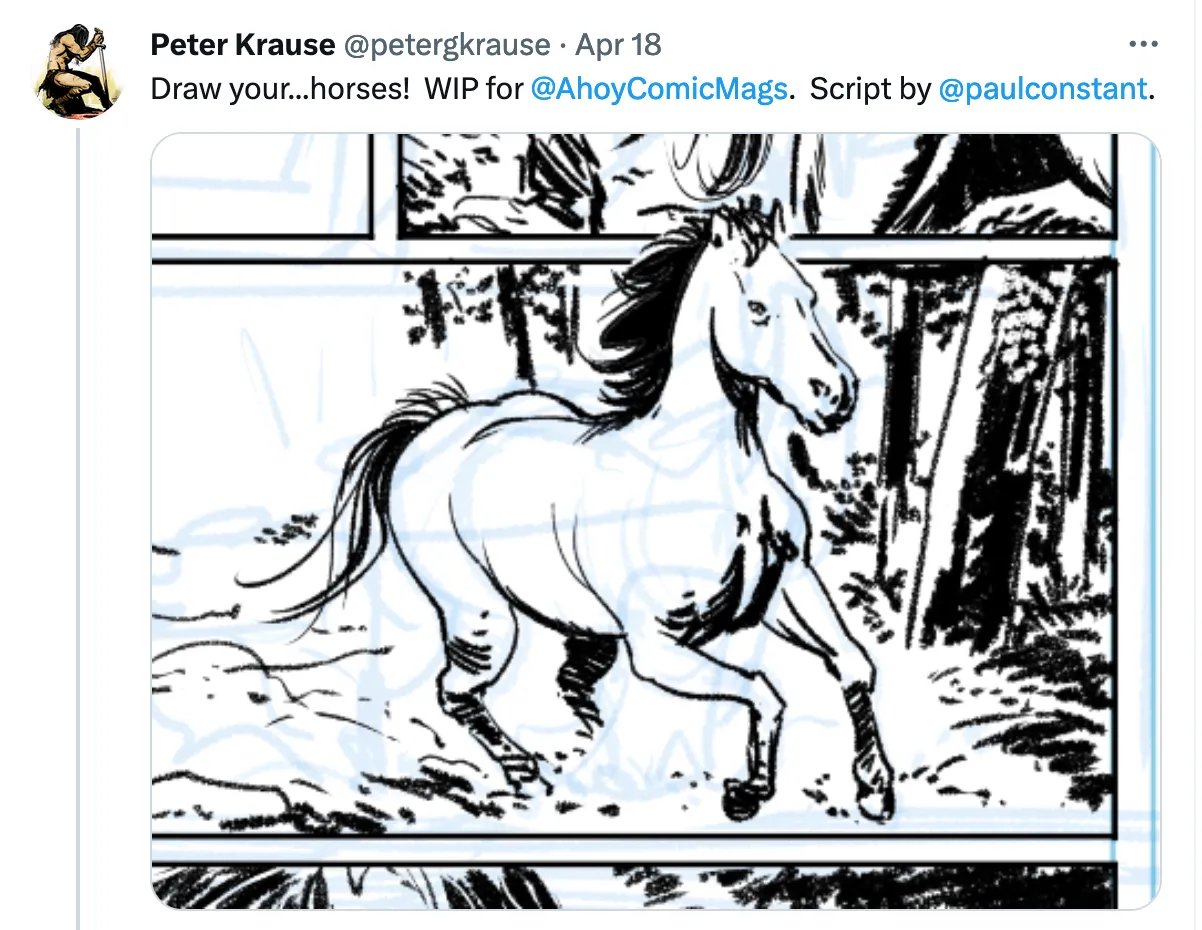
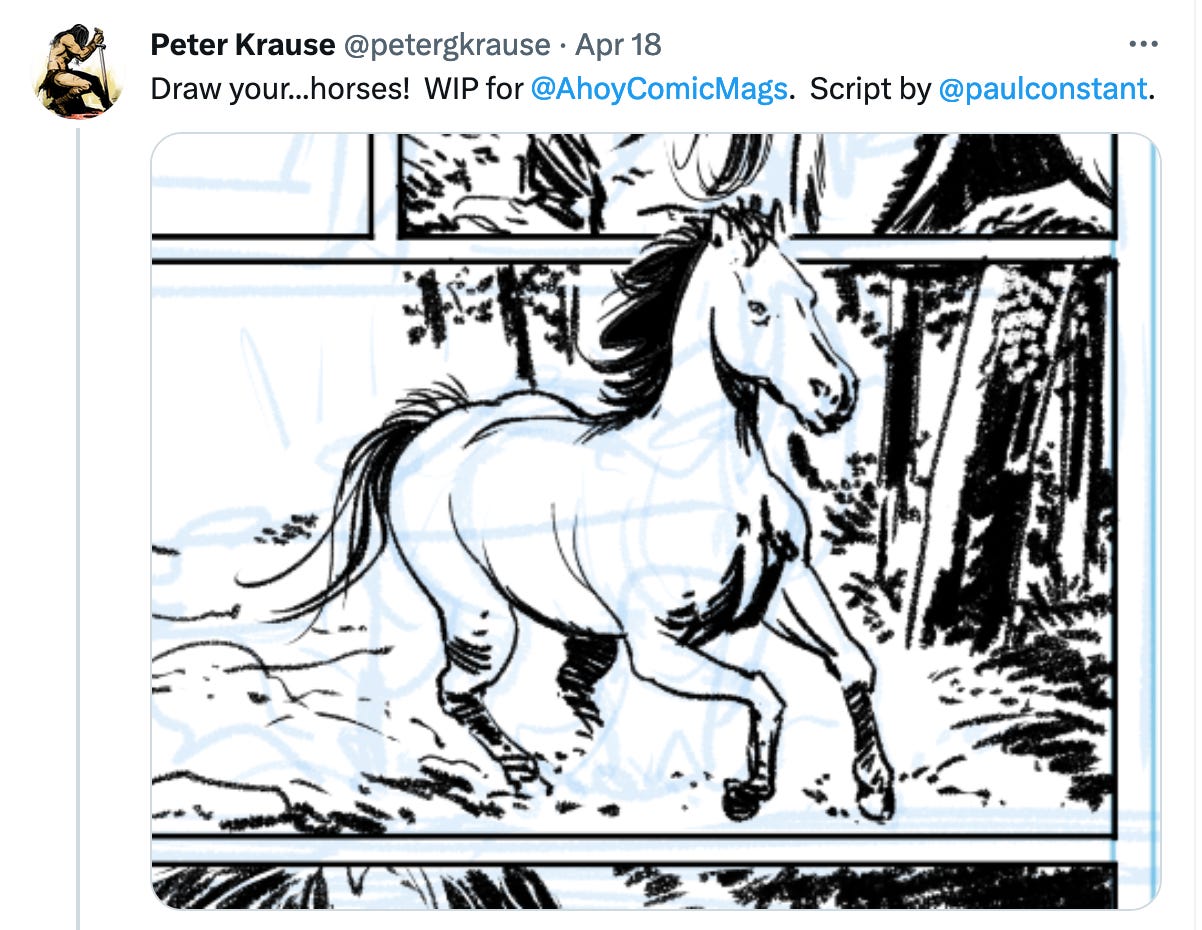
    On Twitter, the great comic artist Peter Krause posted three wonderful previews of a project I wrote that he’s currently drawing. 

    (Link to tweet, because Elon Musk is breaking Twitter embeds.)

    (Link.)

    (Link.)

    I’ve been reading Peter’s comics since the 1990s—his Power of Shazam! is a favorite, and it’s currently being reprinted by DC. So getting the pages for this story in my inbox is a dream. It’s a story that feels very personal to me, and it just couldn’t be in better hands with Peter on art. I’m excited to tell you more about it later this year!

    I’ve Been Reading

    The Laughter by Seattle author Sonora Jha is a satirical novel told from the perspective of an old white professor who stalks a young Pakistani Muslim professor. It’s a dark comedy about cancel culture, and Jha manages to freshen up the exhausted campus satire genre with her sharp sense of satire.

    Jen Beagin’s Big Swiss is another novel that takes place in an exhausted genre—the misanthrope’s complaint. It’s a story about a medical transcriptionist who becomes obsessed with the woman in therapy sessions she’s transcribing. She eventually seeks out the patient and tries to insinuate herself into her life using knowledge culled from the recordings. In the 1990s, this book would have been written by Martin Amis, it would have starred a male protagonist who was portrayed as a hero, and it would have been half as good.

    I read a couple of gossipy nonfiction books featuring behind-the-scenes drama this month. The Fight of His Life is Chris Whipple’s account of the first two years of the Biden presidency, and it’s got plenty of office drama and political tension. One of Whipple’s scoops in this book is the fact that President Biden doesn’t necessarily trust all the members of his Secret Service team to be loyal to him over Trump, which is a truly horrifying fact if you spend more than three seconds contemplating the ramifications. Not an essential read, but if you like to learn how the political sausage is made, there’s plenty of interesting stuff here. And Michael Schulman’s Oscar Wars reveals the backstage drama in several of the most high-profile Academy Awards campaigns in history. Perhaps it’s because this was one of the first Oscars that captured my attention as an adult, but I loved the section about how Miramax’s Shakespeare in Love essentially stole the Best Picture Oscar from Saving Private Ryan. It’s somehow refreshing to hear that Steven Spielberg, who’s been Hollywood’s dad for pretty much my entire life, was full-on pissed at Harvey Weinstein for the way he manipulated the Academy. 

    Speaking of Hollywood, Sarah Polley has evolved from one of my favorite actors to one of my favorite filmmakers, so I was virtually guaranteed to love her memoir-in-essays, Run Towards the Danger. But I think it surpassed even my inflated expectations. Her accounts of growing up as a child actor, learning how to work within a system full of sexual harassment and gender inequality, and overcoming several health crises under the watch of uncaring medical professionals are well-written and full of the anger and introspection that makes her films stand out to me. 

    Before the Coffee Gets Cold is a cozy time-travel novel by Toshikazu Kawaguchi about a coffee shop that enables people to travel through time. The problem is that the time travelers are subject to a number of constraints while they’re traveling: They can only travel through time on one seat in the cafe, for one thing, and they can’t leave the seat while they’re traveling. Further, the travelers have to return to the present before the coffee in their cup goes cold. The rules, which are repeated in the narrative a bit too often for my tastes, keep the story grounded and the stakes low. 

    Priya Guns essentially admits in the acknowledgements of her novel Your Driver Is Waiting that the book is is unabashedly intended to be a Taxi Driver for the age of Uber. I enjoyed both Drivers, but the elements that I liked least about the novel were the scenes that were clearly most influenced by the Scorsese film. Damani, the protagonist, deserves more than to be a modernized, gender-flipped response to Travis Bickle—I really felt for her desperation to make ends meet by ferrying customers everywhere in her beater of a car, and I wish the book stuck with those stakes rather than escalating into an exploration of obsession and alienation. 

    Social Media Update: Social Media Still Sucks!

    This month, Substack introduced its Twitter clone, which it calls Notes. Notes is probably most, uh, noteworthy because Substack CEO Chris Best embarrassed himself by basically refusing to say he’d kick Nazis off the platform in an interview with The Verge. I’m messing with Notes a bit, but it feels like if LinkedIn and Medium had a baby: Everyone on it is too slick, too professional, too eager to sell you something. (And yes, I am thinking about leaving Substack for the second time because it’s owned by people who refuse to say that hate is bad.)

    So what’s the state of social media? I very occasionally post work-related stuff to Facebook and Twitter, but I’ve stopped visiting both platforms and I don’t miss either of them. I do have a profile on Post, but I barely ever go there because it has all the cultural vibrance of a Daily Kos comment thread on Thanksgiving weekend. I watch videos on Tik Tok, but I will never be comfortable making or being in videos. 

    The social media platform I spend the most time on, by far, is Mastodon. It’s still only a fraction of the time that I used to spend on Twitter, but I enjoy the weirdos and nerds I follow there, and they introduce me to new perspectives, which was my favorite part of Twitter. 

    That said, the Mastodon experience is janky as hell. It’s hard to follow people, the app can sometimes take two or three minutes to update, and the first instance I joined disappeared due to drama so I had to basically wipe out my profile and start over. There’s no network-wide search, so you have to use hashtags for discovery, which is such an ugly and clunky way to navigate the internet. Worse still, Mastodon is full of technically astute computer people who are incredibly eager to explain to you in great detail why all of the above is Good, Actually—a feature and not a bug—even though it makes for a really awkward and frustrating experience for casual users like me.

    So for now you can find me on Mastodon. I post little wrapups of my weekly long walks every Saturday or Sunday, and I’ll engage in conversations with other users because those interactions don’t usually turn into bar brawls the way every interaction on Twitter does. But I can also picture myself just drifting away from the platform one day and never coming back. It’s quite possible that no social media site will ever enthrall me the way Twitter did back in the day—and that’s okay. 

    I can’t argue that social media has been a net negative in my life. I’ve made lots of friends and been introduced to all kinds of perspectives that have expanded my understanding of the world. But it’s time to move on. The foundational idea of social media, of broadcasting our thoughts to as wide an audience as possible, was broken from the start. We can and will have better conversations in smaller rooms. 

  • What i’ve been reading and writing: March 2023

    Last weekend, I suffered a catastrophic collision with a box of Girl Scout cookies that left me awake in the middle of the night suffering from what I believe a medical professional would diagnose as “a widdle bit of an upset tummy.” Lying there in the throes of a low-level pain of my own creation, I vowed to cut sugar out of my diet for a while, and to start ramping up my Saturday long walks again. 

    The plan has been going well so far. It’s remarkable what a week or two without sugar can do for your mental health, andmy most recent 33-mile walk to Everett awakened my appetite for more long-distance walks this spring and summer.

    The thing that I’ve realized over the last couple of weeks, though, is that I literally do this every year. Every single spring I fabulously overdo it on candy or cookies or ice cream or some other sugary treat, and the resulting sense of contrition leads me to decide that I have to buckle down, stop eating garbage, and instead prepare for another season of long walks. 

    I don’t mind seasonal repetition. One of the things you learn as you get older is that years are cyclical, and you’re not necessarily the same person in December that you are in July. 

    What I do resent, though, is the fact that I have to learn the same lesson every single year—I have to wind up on the coach moaning my way through a pint of Full Tilt’s Thai Iced Tea ice cream or a box of Tagalongs before I resolve to gear up for longer walks. I’ve done this dance well over a dozen times before, but I somehow never learn the lesson. Every year I have to Augustus fucking Gloop myself into a coma before spring smacks me in the face and I feel ready to get active again.

    Friends, I’m turning 47 years old this year. 

    I’m not angry with myself for never anticipating and getting in front of this yearly behavioral pattern. I’m just disappointed.

    But Enough About You, Paul—How Are Your Dogs?

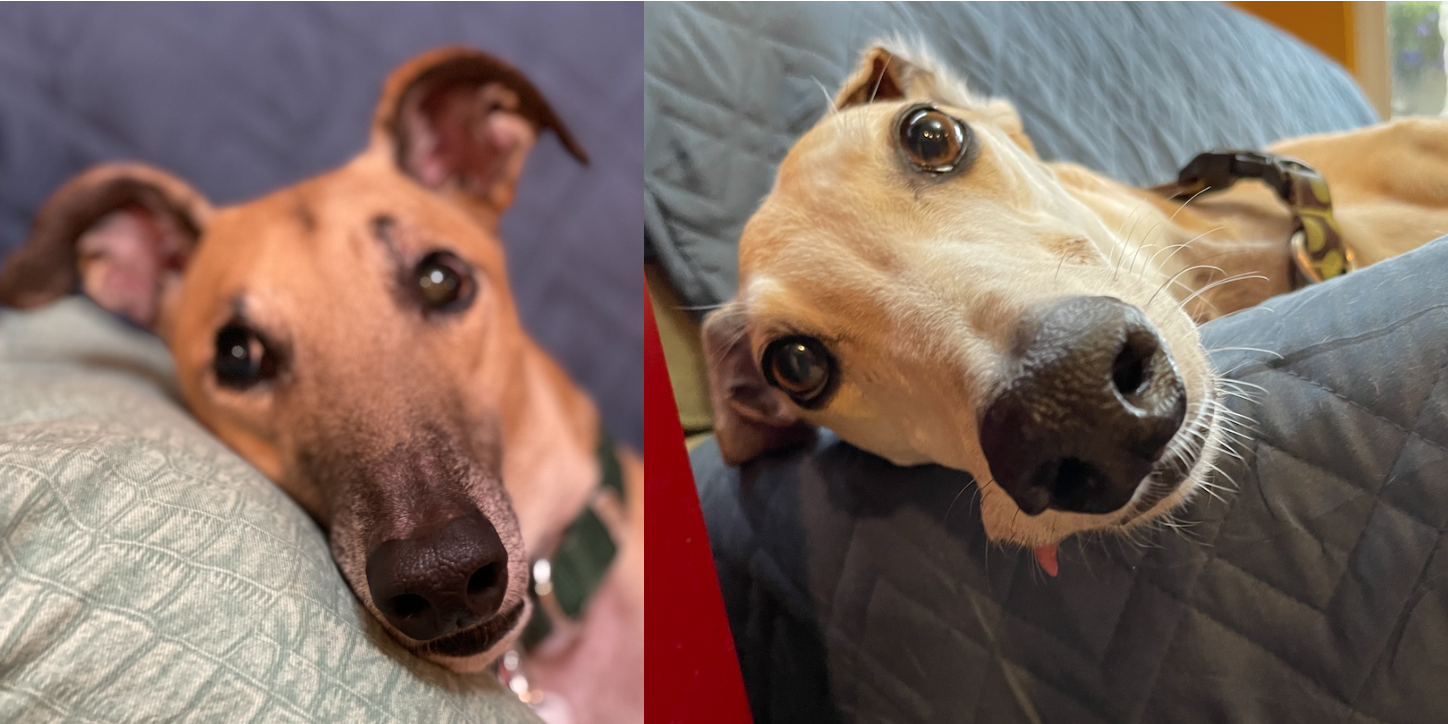
    Wally is doing just fine, thanks for asking. Sometime in the next few months, he will hit the milestone of being with us longer than he was on the track—he’ll have been a pet longer than he was a competitive racing greyhound. And he’s a very fine pet indeed.

    Obie is definitely feeling his age a little. Nine is getting up there in greyhound terms, and he’s got arthritis that requires him to take a daily doggy aspirin. The other week, he was sore and limping from jumping in and out of the car a few too many times in a single day, which was truly heartbreaking to see. But over the last few years, Obie has also transformed into one of the happiest dogs I’ve ever seen. 

    Wally, on the right, is exponentially happier than he was in the first few months after we adopted him. But Obie is positively ecstatic. This is a dog who knows he’s a dog—and loves the ever-loving shit out of every minute of the experience.

    I’ve been writing

    For the Seattle Times, I wrote a preview of the Association of Writers and Writing Programs conference that was in town earlier this month. I had a great time at my many AWP events, and I enjoyed seeing local authors out and about in the world. I did not enjoy the Covid exposure alert that popped up on my phone several days after AWP, but a series of negative tests indicate that I seem to have dodged that particular bullet. 

    Also at the Times, I wrote about Drink Books, a Phinney Ridge bookstore that pairs reading experiences with natural wines. I was a little nervous about covering this one because I don’t drink, but store owner Kim Kent provides a fantastic curatorial experience—the store only carries 80 to 100 titles at any given time, but she’s read all of them and she’s excellent at connecting the right book to the right person. (And my favorite taste tester said the wine was delightful, so there’s that, too.)

    I still have a couple of secret comics projects in the works, and we saw some big progress on one of them this week. I’m working with an artist who I’ve been following since I was a kid, which is super-exciting and a little bit intimidating. Hopefully you’ll hear more about that one soon.

    I’ve been reading

    Who Will Make the Pancakes is a collection of five short fictions from Seattle cartoonist Megan Kelso, and it was a highlight of my month. I especially loved the first story, “Watergate Sue” which was originally published in serial form in the New York Times, and “The Golden Lasso,” which is a quiet and viscerally upsetting story about a young girl going rock climbing. Kelso is uncategorizable, but there’s a sense of magical realism to her stories—the idea that even in her most naturalistic scenes an angry gnome could wander in and put a curse on the protagonist. I’d put her short fiction against any of the best prose short story writers in the business today.

    A couple of non-fiction comics really worked for me this month: Cheeky: A Head to Toe Memoir by Ariella Elovic is a guided tour of the author’s body, and her changing relationship to her body. If you like the comics of Aline Kominsky-Crumb, you’ll probably really enjoy this one. And Grace Ellis’s Flung Out of Space is a biography of Patricia Highsmith’s brief early career as a deeply unfulfilled author of comic books. I had heard that Highsmith went on a kind of date with Stan Lee—the mind boggles—and so I was excited to read this elaboration on that anecdote. I appreciate how Ellis is willing to let Highsmith be unlikable—she’s ambitious and wildly talented, but also misanthropic and unwilling to make any room for anyone else in her plans. This one is a powerful little character study.

    I recall going to the grocery store with my mom when I was 9 or 10 (it was the Shop N Save in Gorham, which is now known by the more respectable Hannaford name.) I saw a woman in a ratty dress who was muttering to herself and giggling as she shopped up and down the aisles of the store—an unusual sight in rural Maine at the time, where people deeply cared about appearing normal. She was a compelling figure to me—and not a little bit scary, like a witch from a storybook. I asked my mom what her deal was. “She’s a writer,” my mom said, explaining that it was Carolyn Chute, who had recently become a bestselling author with her novel The Beans of Egypt, Maine. I often mark that as the moment when I decided I wanted to be a writer, too. I read and enjoyed Beans later on in life, but hadn’t read any other Chute books until this month. The Recipe for Revolution is a mammoth undertaking of a novel, the kind of thing which, if was written by a young man and not a 70-something-year-old-woman, would be called “ambitious” or “a magnum opus.” Which is to say that it’s very long and it took me the better part of a month to read. It’s got dozens of narrators—one of whom is The God of Mammon, meaning that parts of the book are narrated by money itself—and it’s about corporations, greed, militias, small town life, what it means to be a person in a community, and much more. I can’t recommend it with my whole heart to general audiences, but I can absolutely recommend it to anyone who likes ambitious, wild and unruly fictions that require a diagram or two to follow.

    Terry Miles’s novel Rabbits is apparently an adaptation of a popular narrative podcast series that I’d never heard of—I’m a podcast fan, but fiction podcasts have never really spoken to me. It’s a book about a mythical elaborate secret game that unfolds across the world, like a conspiracy theory that has been laid out by a committee, with a single winner earning a huge (and also secret) prize. As a bonus, the book takes place in Seattle, and I loved discovering all the local landmarks sprinkled through the narrative. (At least once a month I think about how much I miss the Kingfish Cafe, so I was thrilled to discover that the restaurant and its closure figures into the plot here.) The story doesn’t pull together in an especially satisfying way, but I enjoyed the ride as the narrator tried to figure out what the hell was going on—if anything was in fact going on at all.

    Rebecca Makkai’s recent breakout bestseller I Have Some Questions for You is a novel about the decades-old murder of a girl at a boarding school, and the true crime cottage industry that erupted from the soil of that murder. I see that it’s being billed as a “mystery” in several bookstores, and that doesn’t feel right—the only real mystery that Makkai seems interested in solving is why society is so enthralled with dead white girls. It’s a compelling novel, and beautifully written, but those who go into the book expecting the next Secret History—or even the next Gone Girl—are likely to be disappointed.

    Bear with Me On This One

    I had a dream a few days ago that I was attending a press conference promising to unveil a piece of technology that would change bookselling forever. I was expecting to see an algorithm or a virtual reality bookstore or something. But the technology was actually a giant robot suit that would allow booksellers to shelve books much faster than they ever have before.

    The suit was ridiculously complicated—so complicated, in fact, that two booksellers had to climb inside it to operate it, with one of them riding on the other booksellers’ chest like they’re wearing a Baby Bjorn. When they were both in the suit, they were, in fact, superhuman booksellers—unpacking, categorizing, and alphabetizing books with speed and accuracy that the world has never before seen. 

    But there was a serious design flaw: The suit was so complicated to put on that there was no way to take it off for bathroom breaks, so the booksellers just had to relieve themselves in the suits. Over the course of a day, they sprayed excrement and pee all over the floor of the bookstore. 

    Then the next night, I dreamed I was watching a documentary about a world-famous literary editor. She was a tiny little woman with a German accent who only worked one month a year. Every September, she’d rush into the offices of her publisher and frantically edit a full slate of books to be released the next fall. The books she edited were always blockbuster bestsellers, and her success rate was so strong that nobody could argue with her eccentricities. Then October 1st would arrive and she’d disappear until next September came around.

    The documentary uncovered the secret of why the editor only worked one month a year: She was born into tremendous wealth, and she spent most of her life traveling the world. But every September, she’d load her giant pet potbellied pig onto a container ship and it would sail across the Atlantic without her for a solo vacation. Without her pig, she was despondent. So she threw herself into her work editing books. When the ship returned, on October 1st, she’d go and pick up her pig and they’d continue their jet-setting lives together. 

    I ordinarily don’t talk about or share my dreams in public spaces like this because I tend to think that dreams are meaningless and dumb—mental flatulence, I believe Stephen King once called them. But those two dreams really say more about my complicated feelings after attending AWP this year than any essay I could ever write. The publishing industry continues to use technology in precisely the wrong way, and America’s literary culture exists largely because a few enormously wealthy people happen to think books are cute or whatever.

    I love books and writers and bookstores and book people. But it’s precisely because I love all those things that I feel really bummed out about the state of the publishing industry, which has (with a few notable exceptions) basically given up on the promotion, editing, and cultivating of great books. Many of the biggest publishers in the country just toss new authors into the void and expect them to learn how to fly before the next seasonal volley begins. The only people who make real money off this dispiriting endeavor are exactly the wrong people, and that inequality only seems to be getting worse.

    I left AWP feeling happy for the authors and small publishers who are managing to make it work, but I am not hopeful for the long-term health of the monolithic American publishing industry—especially in a time of unprecedented book bans. I simply don’t trust these corporate publishers to do what’s right and defend free expression when things get really hairy. 

    Happily, I do believe that authors and booksellers and librarians will continue to fight the good fight against book bans and crass commercialism. I just wish they didn’t have such an uphill battle. In other countries, it’s possible for authors to make a good, middle-class living out of writing. In America, it seems, you either have to be a John Grisham-level success to make a living at writing, or you have to have a billion hustles running at all time—and you’re still likely to be living on the cusp of poverty. 

    In short, everything about publishing doesn’t have to be so big, loud, and dumb all the time. I’d rather have 50 small publishers than one Hachette, and I’d rather have 500 working-class novelists than one George R. R. Martin. A better literary world is possible.

    Anyway, I hope you either are or are not elbow-deep in a box of Girl Scout cookies as you read this—depending on your preferences, of course. I’ll see you next month.

    Paul 

  • What i’ve been reading and writing: February 2023

    Next week, the annual Association of Writers and Writing Programs (AWP) conference is happening in Seattle. There will be a ton of panels, parties, and readings, and much of the evening programming is free and open to the public in venues around the city. I’m participating in a couple of AWP events this year—one at the conference that you need to be a badge-holder to attend, and one free evening event open to all.

    At AWP, I’m hosting a panel with representatives from four great Canadian independent publishers—Book*hug, Coach House, Drawn & Quarterly, and Invisible—to talk about what it’s like being in the book business when the country next door is home to the largest corporate mega-publishers in the world. That’s happening Saturday March 11th at 9 a.m. in rooms 440-442 in the Convention Center. If you’re attending AWP, I hope you’ll start your day off with us; these publishers are doing great work and I can’t wait to talk to them about it.

    And I’m taking part in an AWP offsite event that’s free and open to the public: A celebration of Seattle poet Denise Levertov at Elliott Bay Book Company on Wednesday, March 8th at 7 p.m. Local poets Claudia Castro Luna and Jan Wallace will join Elliott Bay readings coordinator Rick Simonson and me in sharing some of our favorite poems by Levertov, who is in my opinion one of the most underrated poets of the 20th Century. If you’re a Levertov fan, we’d love to have you come and share a story about her life, or one of your favorite Levertov poems. If you’ve never heard of her before, I hope you’ll come and learn about her. The event is intended to be a celebration of her life, and a reminder to the poets and writers visiting Seattle for AWP that they’re walking in the footsteps of giants.

    That’s right—I’m doing two events in one month! Not bad for a bitter recluse. (And last month, I also took part in a panel at Winter Institute, the annual bookseller education conference, which I think already makes 2023 the most action-packed year I’ve had since 2019.) Things don’t feel “back to normal” yet—I don’t think they ever will, honestly—but I’m excited to talk with people and get out into the world a little bit. If you’re able to attend, I hope to see you at either or both of those events.

    I’ve been writing

    This month, I contributed to the Seattle Times’s weeklong celebration of the city’s many museums with a piece exploring the literary programming of Ballard’s National Nordic Museum. This piece also doubles as a sneak preview of an interesting AWP offsite event—a reading of Icelandic-themed poetry happening at the museum at 6 p.m. on March 8th. Maybe it’s just an aftereffect of the pandemic, but many of Seattle’s museums seem to be pulling back on literary programming. It’s good to see the National Nordic Museum flip the script and lean even harder into books, readings, and other literary events. 

    I don’t say this often, but I’m very fond of my piece in the Seattle Times this month profiling Peter Miller, who has been selling design and architecture books at Peter Miller Books in Pioneer Square and Belltown for over 45 years. Miller is an absolute genius, and he has very strong opinions about what it means to own and operate a shop. His love of design has subsumed every inch of his beautiful storefront, from the gorgeous cheese graters and dishtowel holders to the world-class collection of architecture and design titles that he sells. He’s a Seattle original. I was so pleased to talk with him, and honored to write about his shop.

    And on the Pitchfork Economics podcast today, Goldy and I interview author Rick Wartzman about Walmart’s long internal push-and-pull about raising employee wages. Wartzman’s new book, Still Broke, documents how Walmart moved from an exploitative employer to a slightly less exploitative employer in an exploration of the benefits and drawbacks of socially conscious capitalism. At the top of the episode, I also reveal a piece of my sordid past by discussing my brief history as a Walmart employee in Colorado Springs. 

    I’ve been reading

    I fell head-first into the early work of George Schuyler this month. Schuyler was a Black novelist who used science fiction—specifically, what we now call Afrofuturism—to explore race and racism in America. First, his 1931 novel Black No More imagines what might happen when a scientist invents a device that can turn Black people white. And second, originally published as a serial in the mid-30s, Black Empire is an adventure novel about a super-genius who decides to fight against racism and inequality by creating a global Black revolution and establishing a nation in Africa—kind of a Black Atlas Shrugged, only way more entertaining. If you’re only going to read one book by Schuyler, I recommend Black No More over Black Empire, because it’s a better-written book and the satire in Empire gets a little rough. (You can easily spot the seams of the serialized chapters of Black Empire, making it kind of a bumpy narrative ride when read as a novel.) But happily, you don’t have to choose. Schuyler deserves credit as a clear trailblazer for the social sci-fi writers who followed several decades later—writers like Kurt Vonnegut, Philip K. Dick, and Ursula K. LeGuin. 

    I suspect that a big reason why Schuyler hasn’t stayed in the public eye is that he held a lot of controversial, and frankly wrong, views. He refuted his early socialist leanings and became more and more conservative throughout his life, dismissing the Harlem Renaissance early in his career and arguing against the end of segregation later on—to the delight of the John Birch Society, who published many of his later columns. He denounced both Malcolm X and Martin Luther King Jr, and white racists loved to use Schuyler as an ideological shield when they protested the civil rights movement. But I think the progression of Schuyler’s life is a fascinating one that is well worth studying, and even though I don’t agree with all the ideas and perspectives in these two books, I still believe that they’re great American novels. 

    On the lighter side of sci-fi, Seth Fried’s The Municipalists is a buddy-detective novel set in a utopian future—and one of the detectives happens to be an artificial intelligence. Given that the whole world is losing its collective mind over AI right now, the story felt a little more like a speculative documentary than it probably did when it was published. It’s a funny book, with some great worldbuilding around the utopian sci-fi city and its culture.

    A Heart That Works is comedian Rob Delaney’s short memoir about losing a very young child to cancer. It’s heartbreaking, but, like much of Delaney’s writing and standup, it’s also bracingly honest and angry and weirdly cheerful. I don’t recommend reading this one if you’re currently Going Through It—and by It I mean anything from depression to grief to even mild heartbreak—but if you’re in an emotional place to consider things like grief and the random cruelty of the universe, Delaney has many worthwhile insights to offer.

    Because President Biden’s Chief of Staff Ron Klain stepped down this month, I’ve been thinking a lot about what it means to be a president’s chief of staff. It seems to me to be possibly the most difficult job on the planet—all the emotional and intellectual turmoil of being president with almost none of the perks—and I wanted to learn more about the men who’ve held the job (and, yes, they’re all men to date.) Chris Whipple’s The Gatekeepers profiles every White House chief of staff from the Nixon administration through the Trump administration, and it’s a good overview of the position and the personality traits necessary to thrive as a chief of staff. At times, the book just falls back into rote recounting of modern presidential history, but there’s enough access and insight to make the book worthwhile.

    Heather Radke’s Butts: A Backstory is a bestselling history and critical examination of society’s attitudes toward female butts that’s been on the Peaks Picks shelf of my local library for months. I enjoyed it! The book explores the racism, misogyny, and self-loathing that has been centered around women’s bodies, through a butt-centric lens. Radke’s history begins with the horrifying story of Sarah Baartman, the African woman who was paraded around Britain in the early 1800s as an object of curiosity, derision, and scorn, and it ends with the rise of Jennifer Lopez and pop culture’s newfound appreciation for large butts. Some of the social criticism feels dated in a very 1990s, let’s-impress-the-cultural-studies-professor kind of way, but the book is a fast and informative overview of a subject that until recently would have been considered too frivolous or prurient for a whole book.

    Yeong-shin Ma’s graphic novel Artist is a satire about three middle-aged artists who find varying degrees of commercial success. The story covers a lot of ground, from cancel culture to criticism to the idea of selling out, and the book develops all three protagonists into fully rounded characters when it would have been easy to simply mock them. I’m intrigued by Ma’s decision to render one of the artists with a giant head that resembles the Elephant Man—you can see him on the right of the cover, above. While Ma’s art is definitely cartoony, the other characters in the book are portrayed more or less with realistic proportions and characteristics, and I have to say the choice pulled me out of the story a little bit. I’d love to ask Ma for the reasoning behind the decision, because it’s a bold choice.

    I’m currently obsessed with Charles Soule and Ryan Browne’s comic book 8 Billion Genies, which imagines what might happen if everyone on earth suddenly was given a genie who granted them a single wish. The book is coming out in periodical form, so the story is not over yet, but it’s definitely been a highlight of my comic-reading life over the past year. I’ve enjoyed Genies so much that I decided to try Soule and Browne’s previous comic, which has been collected in a thick omnibus titled Curse Words: The Hole Damn Thing. It’s an urban fantasy about a wizard named Wizord who escapes a mystical realm and tries to take up residence in the real world, and while it’s not as elegant and provocative as Genies, it’s definitely a big old fun slab of imaginative adventure comics. 

    A few notes on the care and feeding of writers

    A little while ago, I posted a link on Mastodon to a piece that I wrote in the Seattle Times. In the replies to the post, someone complained about the Times’s paywall and linked instead to another piece about the same subject, written by someone else, in a publication that doesn’t have a paywall. (I don’t want to publicly shame this person, so please don’t go looking for him.)

    I tried to gently point out that it was rude to link to another story in the replies to my post, and that the paywall helped to pay for the labor that it took to write my piece, and the person replied with another anti-paywall screed. At that point, I just blocked him and moved on because arguments on social media are pointless.

    This interaction did make me want to send a Public Service Announcement out into the world, though: Try to remember that writers are people, too.

    Look, I get that paywalls can be frustrating. For publications, paywalls are possibly the most successful way to pay for overhead. Online advertising has basically become worthless thanks to Google and the other big tech companies, while subscriptions are fairly reliable and ensure a consistent base of regular readers. So everyone is doing a paywall model, and every paywall has a different and confusing set of rules about how many “free” stories you can read over a certain period of time.

    For decades, the internet has operated under the concept that “information wants to be free”—that people will share information and art that they love, and that the best stuff will spread widely. I think the last 7 or 8 years has proven the lie behind that expression. Information doesn’t want to be free—gossip wants to be free. Misinformation wants to be free. Propaganda wants to be free. True and meaningful information costs money and takes time to produce. You have to commit to reading good information. A shitty anti-vaxx meme will circle the globe thirty times before some reporter atVox manages to source, collate, and publish a cogent and thorough refutation of the lies in the meme, and their story will enjoy a fraction of the meme’s reach. Nothing about the creation and dissemination of information is free or easy.

    With all that said, I do jump paywalls—and I feel perfectly morally fine about doing so because nobody could reasonably expect me to shell out for an annual subscription to a newspaper in Minneapolis in order to read a single story. (If the paper asked for some pocket change via Apple Pay in order to read a single story, I’d happily pay that, but micropayments are for whatever reason a nut that the internet hasn’t managed to crack over the span of 30 years.) Financially speaking, I simply can’t afford to subscribe to every publication that I read in the span of year. You have to pick the outlets that you read and care about the most, and that’s where you have to put your subscription dollars to work.

    But it’s a basic human kindness to not respond to a writer with someone else’s story and launch into a high-minded conversation about whether paywalls are legit or not. Many of us jump paywalls out of necessity. But because paywalls pay the bills for thousands of writers, we should at the very least shut up when talking to the writers whose labor is funded by the paywall. 

    And I know someone might try to extrapolate my “jumping a paywall is okay now and then as long as you don’t brag about it to the writer” stance into an admission that it’s okay to pirate my comics. But that analogy doesn’t track, because you can right now take my comics out for free from your local library, or you can request copies via interlibrary loan. (And in fact, I frequently use my Seattle Public Library card to gain online access to newspapers and magazines that I don’t subscribe to, which I consider to be just as morally sound as taking a book out from the library.)

    I love to hear from people who take my books out from the library. Hell, I encourage you to borrow my comics from the library. But if you tell me that you pirated one of my comics, all I hear is that you stole money from my friends—the artist who spent months crouched over their drawing boards, the publishers and editors who care enough about comics to devote their whole lives to bringing them into the world. 

    In short, what I’m saying is that writers (and editors, and publishers, and everyone else involved in writing and publishing words) are people, too, and you should always try to treat people at least as well as the way you’d want to be treated if the roles were reversed. If you don’t follow that rule, I’m not going to interact with you. Some (idiots) might call that cancel culture, but really it’s just the basic requirement for being a person who lives in a society.

    Hope this finds you well, and maybe I’ll see you out in the world this month?

    Paul

  • What i’ve been reading and writing: January 2023

    Just one month in, and 2023 already feels more action-packed than 2022. I attended a big birthday party and a literary happy hour—each of which would have been a highlight of any of any month last year.

    Perhaps most startlingly, I started 2023 off with a last-minute day-job business trip to the east coast, and I carved five hours out of that whirlwind weekend to walk around Philadelphia. Even though I grew up on the east coast, I’d never spent any time in Philly. I always unconsciously dismissed it as a blend of Washington DC and Boston—a city obsessed with the past, and a population too interested in sports and silly accents to be interesting.

    Friends, I was entirely wrong. I loved Philadelphia and I want to return posthaste. The food! The walkability! The friendliness! The density! True, the public transit is named Septa, which sound way too close to “septic” for my liking. But the transit is frequent and useful! Yes, the sports culture is obsessive. But the hockey team’s mascot is Gritty, the Socialist Icon™! 

    I walked about twelve miles. Along the way, I zipped through the historic district, grabbed lunch at the Italian Market, and visited the art museum. In just that short amount of time Philadelphia became one of my favorite American cities. And while I’m never going to move there—west coast is the best coast—I do wish I could snap my fingers and make Seattle as dense as Philly, with its attractive stands of townhouses lining alleys and streets. 

    And density is written into Philadelphia’s source code. At my Philly-native friend Goldy’s recommendation, I visited Elfreth’s Alley, the oldest residential street in America. It was a fantastic reminder that Americans have been living in dense urban environments from the very beginning:

    So January has been quite the adventure after the three-year blur that was 2020. And while not every month will include business travel to new cities, I already have two AWP-adjacent events scheduled for March—more on those in next month’s newsletter—in addition to a couple of literary events in my calendar for later on in the year and a couple comics projects in the works. 

    Is it already time to worry about overextending myself? Probably not. But that’s never stopped me from worrying before!

    I’ve been writing

    For the Seattle Times, I wrote about Elliott Bay Book Company. This was a challenging one to write about because I worked there for eight years. I handled that by telling my story about working at Elliott Bay to open the piece, and then I had to make sure I didn’t make it all about me. I’m pretty happy with how this one turned out, and I’m looking forward to the store’s 50th anniversary celebration, which will take place in June of this year.

    I’ve been reading

    The first book I read this year was María José Ferrada’s How to Order the Universe, a novella about a 7-year-old girl who takes up her father’s job of door-to-door sales and proves to be quite the prodigy. It’s a gorgeous little fable, told simply but with all sorts of weird magic underneath the words. A good start!

    Last month, I read and mostly enjoyed the Clewiston Test by Kate Wilhelm. This month, I read Wilhelm’s The Killer Thing, a potboiler about a soldier trapped on an alien planet with a killer robot. I much preferred Killer to Clewiston, and I’m kind of shocked nobody has adapted this lean little monster of a story into a movie.

    Novels about music don’t usually do it for me, and hardcore punk music usually bores me to tears. So it’s fair to say that I only read No One Left to Come Looking for You because it’s the new novel from Sam Lipsyte, and I’m a diehard Lipsyte fan. I wound up really liking it! It’s sort of a mystery novel about a young punk trying to figure out where his friend’s disappeared to, but it’s really about the 1990s, the youthful quest for authenticity, and everything that’s gone wrong in the decades since punk rock finally rolled over and died. 

    I picked up Claire Keegan’s novella Foster because it’s a Peak Pick selection at the Seattle Public Library. It’s a book about a young Irish girl who finds the family she really needs but wasn’t born into, and it definitely pulled all my Anne of Green Gables orphan-girl heartstrings—which is to say: reader, I cried. 

    In case you can’t tell from all the novellas, I had a hard time focusing on prose this month. So I read more book-length comics than usual—most of which I borrowed from the Seattle Public Library’s impressive comics collection. Smahtguyis a comic book biography of Congressperson Barney Frank, illustrated and written by former Frank staffer Eric Orner. While Orner doesn’t shy away from covering Frank’s scandals, the book is a little too hagiographic to be a truly great biography. But I still really enjoyed it. 

    The first volume of Chip Zdarsky’s new comic Public Domain is really excellent—a funny and big-hearted slice-of-life story about a comic artist who’s been screwed out of the rights to a popular superhero character he helped create. It’s not a preachy anti-corporate-comics tirade, but it does have some interesting things to say about creativity and ownership. If the next volumes keep up this level of quality, Public Domain is destined to be my favorite comic by Zdarsky, which is saying something. And because it’s mostly about family tensions but it’s set in the superhero comics publishing world, I bet you could probably trick some of your superhero-obsessed pals into reading it!

    In 1949, Charles Biro founded a comics anthology magazine for a grown-up audience called Tops. It was supposed to be a kind of New Yorker in comics form, with mature genre comics and comics journalism about a wide variety of topics including what it’s like to be a fashion model. They only published a handful of issues before the endeavor failed, but I read this gorgeous oversized collection from Fantagraphics while trying to imagine what the world would be like if Biro had succeeded and general adult audiences embraced comics as a medium 50 years before graphic novels finally broke into the mainstream. It’s positively utopian.

    Eat the Rich is written by Echo Wife novelist Sarah Gailey and drawn by Pius Bak. It’s a dirty little genre thriller about a woman who goes to visit her boyfriend’s wealthy family, only to get sucked into a dark family secret. It’s an over-the-top parody of all the violence that goes into the accrual of enormous intergenerational wealth, and I had a good time with it.

    Some other newsletters you might enjoy

    Since Newsletters Are the New Social Networks™, and since you (hopefully) enjoy reading newsletters, I thought I should recommend a few newsletters that I enjoy. 

    My friend Davida’s newsletter, the slow and unyielding march of time, is the biggest direct influence on what I’m doing here: She writes about books that she’s read (Davida has great taste in books) and shares a little bit of what’s been on her mind lately. (Look at fancy old me, calling her an influence when really I just shamelessly ripped off her formula. What I’m saying is if you hate this newsletter, blame Davida.) 

    Fred Harper was my partner on my most recent comic, Snelson: Comedy Is Dying. He’s a brilliant artist and an all-around swell guy and I’m so thrilled that he started a newsletter recently. His travels around Greece have been fun to follow, and every issue is packed with art.

    Hmmm That’s Interesting is a newsletter by a woman named Clara who also posts very funny Tik Tok videos imagining exasperated PR professionals’ reactions to celebrity meltdowns. Clara writes about books and celebrity gossip. Her perspective is deeply humane and smart, and her voice feels true and is crystal clear.

    I follow a bunch of comics newsletters, but the truth is that most of them are just nakedly promotional vehicles and I can’t in good conscience recommend them to anyone who’s not already a fan of the creators’ work. The one comics newsletter that I absolutely rave about to anyone who’ll listen is ND Stevenson’s memoir vignette comics series, I’m Fine I’m Fine Just Understand. I have no doubt that these strips will one day be collected in a book and the world will swoon over them, and I’m thrilled to get an advance peek at the work as it’s being created.

    (One caveat to the above paragraph: I’m hopelessly biased because they’re my publisher, but I do recommend the AHOY Comics monthly newsletter because it usually contains contributions from AHOY creators ruminating on seasonal topics. It’s literally the only publisher email that I read from front to back every time a new edition lands in my inbox.)

    My two favorite newsletters about internet news and culture are Today In Tabs and Garbage Day. Tabs is consistently funnier and more interested in momentary online trends as they bubble up, curdle, and die.  Garbage Day publishes real, opinionated investigations of internet culture’s top stories, and provides some important real-world context to those stories. 

    And last but not least: every weekday, Flow State sends out an email with new recommendations for vocal-free music that’s perfect for writing and studying and thinking. If you find inspiration in instrumental music of all kinds—from around the world, in different genres, from throughout history—this newsletter is a priceless resource.

    And that’s my January! I hope your year started off with exactly as much activity as you want and need.

    —Paul

  • What I’ve been reading and writing: December 2022

    What I’ve been reading and writing: December 2022

    In my memory, 2020 and 2021 have merged into one hazy blur—a pandemic, chaos in the world, and lots of quiet nights at home. The holidays have all blurred together, too—2021 Christmas is indistinguishable from 2020 Christmas, I have to think hard to separate my memories of 2021 Halloween from 2020 Halloween, and so on.

    And I suspect that 2022 is about to fall into that same misty space and melt together with the two previous years. When all is said and done, I’ll forever recall three years of my life as having one single summer, a single winter, a single fall. 

    This feels unsustainable. I can’t imagine that 2023 will join the fog of the past three years. I expect that I will get out more in 2023, and will have more experiences to make the year distinctive from the past three. But maybe that just represents a failure of my imagination—maybe this monoyear is just a product of getting older, and it’s what my older relatives were trying to explain to me when they described the hastening of years that occurs with age.

    In any case, this might sound like a complaint but it’s really not—I’ve been lucky enough to have stable housing, continuous employment, and a very enjoyable social life during the three most tumultuous years in recent history. But becoming aware of the monoyear definitely feels like a first tentative step outside of the monoyear. You can only live in the darkness of March 2020 for so long, after all. Right?

    I’ve been writing

    I wrote about three of my favorite reading experiences of 2022 for the Seattle Times. If you’re desperate for a great book, I advise you to click through to this one—there are some great book recommendations, both Seattle-centric and not, from Times critics like Moira MacDonald.

    Also for the Times, I wrote about Magus Books, which is the quintessential Seattle used bookshop. There’s something ineffable about Magus Books, and I was very intimidated to profile the shop just because that majesty is so hard to document in print. Happily, I spent a good portion of the piece focusing instead on the Magus Books Annex, a new used bookshop that just opened in the old Open Books space in Wallingford. (Fun fact: Before Magus Books was founded in the 1970s, the space was home to an anarchist bookshop called, delightfully, The Id. If anyone has any information about that shop, I’d love to hear it—very little documentation of The Id exists online.) 

    For Insider, I wrote about Professor Scott Galloway’s latest book and his appearance on the Pitchfork Economics podcast. Galloway has developed a reputation as a bomb-thrower on the Pivot podcast with Kara Swisher, and I don’t agree with everything he says. (He’s ridiculously wealthy, for instance, and I think his thoughts on taxation are way too conservative because he’s more interested in staying ridiculously wealthy than he is in solving some of society’s biggest problems.) But I agree with the thesis of Galloway’s new book, Adrift, which argues that growing inequality is unmooring America from the economic foundations that built the middle class. 

    I’ve been reading

    I read the first installments in two long-running mystery series this month: One for the Money, the charming first novel in Janet Evanovich’s Stephanie Plum series; and The Deep Blue Good-By, which is the introduction to John D. MacDonald’s Travis McGee character. I had more fun with the Evanovich novel—Plum’s introduction to the world of bounty hunting is breezy and cheeky—but MacDonald’s book stunned me with its great writing and sheer literary quality. I can see why the Travis McGee novels are a favorite of wildly popular writers like Stephen King—they combine pop sensibilities with serious writing craft in a way that elevates the mass-market mystery format. 

    Another pair of books accidentally aligned themselves in my reading life this month: As a young man, I idolized both Haruki Murakami and Quentin Tarantino, and they both released autobiographical books this fall. I enjoyed Cinema Speculation, Tarantino’s account of his informal education from the great films of the 1970s, but it did feel a little tiresome—like the charming dinner guest who repeats a handful of stories a little too often. Murakami’s latest novels have failed to emotionally move me, and his latest non-fiction release, Novelist as a Vocation, has inspired me to actively dislike the man. Murakami devotes a whole chapter to explaining how little he cares about literary awards, and he demonstrates his lack of concern by writing at length about an award that he has never won and which he definitely never thinks about on a daily basis. Tarantino often lacks humility, but Murakami now feels hopelessly high on his own supply.

    One of the readers of this newsletter suggested that I read Oregon sci-fi novelist Kate Wilhelm’s The Clewiston Test, but for the life of me I can’t seem to locate the name of the person who recommended it. Thank you, whoever you are! The novel, about a married pair of scientists whose research takes on a new importance when the wife is badly injured in an accident, feels dated and sexist and homophobic in the way that many 1970s novels do. But I’d never read Wilhelm before and now I’m enthralled by her ability to craft a taut psychological thriller. I look forward to learning more about her life and work.

    I ended the year with a fantastic book: Brian Jay Jones’s Jim Henson: The Biography. I believe that Henson was a generational talent, but at the same time I acknowledge that he must have been a challenging human being to love. Jones recognizes Henson’s faults, but he doesn’t dwell on them. Instead, he tries to pack all of Henson’s unbelievable achievements into a brisk 500 pages while also contextualizing his impact on culture, the technology of puppeteering, and his growing entertainment empire. This book accomplished everything I wanted it to—it made me feel closer to Henson’s warmth and genius without reducing itself to empty hagiography. 

    My favorite movies and TV shows of 2022

    There were lots of interesting movies this year, but only two movies knocked me flat on my ass: I was happily blown away by Everything Everywhere All at Once at the beginning of this year, and I was overwhelmed by Tár at the end of this year. Both of these are movies that I will watch and watch again for very different reasons—EEAaO made me feel great about the world, and Tár was more about encroaching paranoia and darkness. But in both films, the sheer film-making on display is breathtaking.

    Tár, for what it’s worth, also has my favorite movie poster of the past few years:

    While those two movies are way up at the top of my yearly pantheon, lots of other movies kept me entertained. I believe I like Glass Onion even more than Knives Out, because its thesis statement is so timely it could have been ripped from the headlines of this morning’s paper. The Banshess of Inisherin was enthralling, though I felt that it had a bit of a problem coming to a graceful conclusion. Catherine Called Birdy impressed me with its charming young protagonist, and Three Thousand Years of Longing wrapped me in a warm blanket of romance and magic. Emily the Criminal was a nasty little crime story, but a great showcase for Aubrey Plaza. 

    For TV, I loved the second seasons of The White Lotus and Reservation Dogs. Better Call Saul somehow constructed a great and satisfying conclusion not just for the series but for the Breaking Bad universe as a whole. I thought Apple TV’s Bad Sisters was probably the best debut series I watched all year—a funny and weirdly cozy story about family and murder and murdering your family. And Amanda Seyfried’s performance as Elizabeth Holmes in The Dropout was so brilliant that it single-handedly elevated a so-so miniseries into high art. 

    For someone who hates year-end lists, I have to admit that I’ve grown to enjoy compiling these little reminiscences of art that moved me over the past year. If you uncovered any hidden gems or were unexpectedly moved by some art this year, I hope you’ll let me know. And I hope your 2023 builds upon your successes and excitements of the last few years while somehow being a completely distinct experience. It’s time to make room for the new. 

    Happy New Year,

    Pau

  • What I’ve been reading and writing: November 2022

    What I’ve been reading and writing: November 2022

    Can we bear one more conversation about social media? I am pleased to report that Twitter has started sending me panicked emails to point out tweets that I may have missed because I’m not spending any time on the site anymore. Facebook has been sending me these emails for years, since I basically left my FB profile to rot in the wake of the 2016 election, and Twitter’s reminder emails are exactly as enticing as Facebook’s emails—which is to say, not at all. 

    I’m still futzing about with Mastodon, I’ve posted a little bit on Post, and I’ve followed the comics community to the alarmingly rickety Hive, but I’m in no hurry to establish a permanent online home. I’m just reveling in the liberating feeling of unmooring from a service that not so long ago felt as essential to my being as my typing fingers. 

    Looking back, my theme for 2022 has been saying and doing less. I’ve written fewer public-facing pieces than any other year since I started working at The Stranger in 2008. I’ve done almost no public events this year, aside from an author introduction or two. And I’ve basically shut up more than any time in the last 14 years.

    I understand that being quiet is a privilege. I have a full-time job that means I don’t have to be continually hustling the way most freelance writers do, and I have a few gigs that give me a regular outlet for freelance pieces. But I’ve basically been sprinting with my writing since 2008—writing quick responses to current events, synthesizing immediate opinions on art, interacting with Seattle’s cultural community in real time in the form of interviews, previews, and reviews. This year feels like the first time I was really able to get off the merry-go-round, take a look at my surroundings, figure out how I feel, and say no to experiences that don’t feel right.

    Hopefully, 2023 will be a rebuilding year. I’m looking forward to trying new things with my writing, publishing more comics, and finding different ways to interact with the world that don’t feel as disposable as my old prolific blog-happy job. But it’s become clear in the last month that getting rid of Twitter was the final, and perhaps most important, step in slowing my brain down and setting my mind to thinking about what I really want to do as a writer.

    I’ve been writing

    My bookstore profile in this month’s Seattle Times is of Moonraker Books, a gorgeous bookstore on Whidbey Island that is celebrating 50 years of continuous operation under the same owner. This is one of the greater Seattle area’s bookstore gems, and owner Josh Hauser is a world-class bookseller. I’m glad she’s getting so much recognition this year.

    For Insider, I did a deep dive into the proposed Kroger-Albertsons merger, and why virtually every big corporate merger should be shot down. The Biden Administration is doing something very exciting right now by rewriting corporate merger rules, and they have the opportunity to unspool a lot of the greed that has controlled the economy since the Reagan Administration made it easy for corporations to swallow each other up.

    Few conversations in life are as satisfying as talking to booksellers about the new books they love. Also at the Seattle Times I interviewed four incredible local booksellers to learn more about the books they’re excited to sell this holiday season. I’ve read three of these ten books, and I’m excited to read the other seven now. 

    Post.News is one of the social media sites that has popped up in the disastrous collapse of Twitter, and it’s a very appealing idea: A community centered around journalism and conversation. I was accepted to a very early beta version of the site, and writing on it feels a little like a cross between Twitter and Medium. I especially like that you can use micropayments to pay to read individual articles from contributing news sites. Anyway, on Post.News, I wrote a…well…a post about my personal moderation policy. I don’t think I’ve ever written about this anywhere else, but to sum up: My social media policy is block early and block often. You don’t owe your attention to anyone. 

    I’ve been reading

    Ducks, Kate Beaton’s memoir about working for two years on a remote Alberta oil refinery, is a miracle of comic-book storytelling. It’s a story that couldn’t be told as well in any other medium. Beaton captures the all-encompassing monotony of working a menial job, but the visual aspect of comics, and the fact that a comics reader can move forward at their own pace, makes it work. As a movie or a novel, this would be deadly dull, but Beaton’s charming art and masterful pacing transform this into a page-turner. And I was pleasantly surprised by another comic memoir this month: Zoe Thorogood’s It’s Lonely at the Centre of the Earth. This memoir, about a young cartoonist struggling with depression at the exact moment that she began to experience professional success as a cartoonist, is one of the most masterful books I’ve seen from a young artist—the way Thorogood employs a variety of styles to depict her shifting mental state is absolutely breathtaking.

    Andy Campbell’s We Are Proud Boys is an incredibly depressing, but very important, work of journalism—a history of the white supremacist organization from its unlikely origins at Vice Magazine up to the aftermath of the January 6th insurrection. I haven’t read a better book-length explanation of the rise of the alt-right, and it helped me understand exactly how a bunch of scattered misanthropes could become a democracy-threatening movement. As an antidote to the darkness, I recommend following this one up with John Keane’s The Shortest History of Democracy, an excellent (and brief) book that reveals the durability of democracy as a concept through human history. Individual democracies may be snuffed out by fascists not unlike the Proud Boys, but the ideal of democracy itself seems, happily, to be almost as old as humanity. 

    Embarrassing admission: I’ve never read a Marilynne Robinson novel before this month. As a bookseller, and then as a book critic, I tended to skip over the hugely popular books that enjoyed universal acclaim—Robinson’s books sold themselves, and they were praised in outlets around the world, so the chorus hardly needed my voice. I finally read a copy of Gilead that I found in a Little Free Library in Seward Park, and my instincts were correct: I honestly don’t have much to add to the conversation. It’s a big-hearted, intelligent, elegantly constructed novel about the human spirit, I’m glad I read it, and I’m excited to read the rest of her books.

    I read a variety of nonfiction books this month including the anthropological exploration of rituals and their use for human life, Ritual: How Seemingly Senseless Acts Make Life Worth Living, by Dimitris Xygalatas, and a trilogy of books about consciousness in animals: How to Be Animal by Melanie Challenger, The Mind of a Bee by Lars Chittka, and When Animals Dream by David M. Pena-Guzman. Ever since I started sharing my home with dogs, I’ve been fascinated by their perceptiveness and intrigued by what’s going on in their heads. And the more I read about animal consciousness, the thinner the line between humans and animals becomes. Anyone who argues that humans are uniquely special or above the rest of nature is, in my estimation, an idiot.

    Speaking of the dogs, it’s been a bit since I’ve shared a photo. That’s Wallace on the left. Since he turned four this summer, he’s really chilled out and relaxed into a friendly pup. Oberon, on the right, is still excited for three-mile walks despite his arthritic hip, and he’s entering old age with a boundless enthusiasm for cuddling.

    Putting meat on the bones

    One of the things I love about writing comics is the fact that there is no standard format for a comic script. Pretty much every comic book writer formats their script differently. I’m sure this is a nightmare for editors and, sometimes, for artists. But to me it feels fun and casual—a reminder that none of this is a science and it’s all intuition at heart. And it’s caused me to experiment with my writing in ways that would never have occurred to me with my prose. 

    For instance, I have never successfully been able to outline a piece of writing before. Something about working from an outline drains all the fun out of writing for me—it turns the exploratory art of writing into a boring game of connect-the-dots.

    But I’m working on a short comics story for an anthology, and I decided to try a new technique with this script:

    • First, I write a brief sentence explaining what happens on each page.
    • Then, I write a short sentence for every panel on the page, explaining the action in each panel in really simple terms.
    • Then, I do another pass to fill out the visual detail in each panel.
    • Finally, I write the dialogue.

    I think of this like the brilliant scene in Moore and Gibbons’s Watchmen, in which Dr. Manhattan explodes to atoms in a nuclear disaster and then reassembles himself from basically nothing over the span of days:

    Something about this process feels uniquely suited for writing comics. It melts down each page and panel to its essential action, while also leaving space for all the details, allowing me to add them in as the story deepens. Comics are a visual-first medium, and this method allows me to think of the art in a cartoonier, more action-oriented way.

    The previous method that I used—just writing the whole script from beginning to end, like a piece of prose—felt a little too writerly, a little too obsessed with the language over the art. This way feels more respectful of both the artist and the medium. It’s exciting to be experimenting with the fundamentals of writing in a medium like this—to admit that I don’t know anything and to try techniques that previously never worked. 

    Above all else, I’m just happy to still be learning. 

    I hope you’re learning, too.

  • What i’ve been reading and writing: October 2022

    What i’ve been reading and writing: October 2022

    I’m very pleased to report that Snelson: Comedy Is Dying, the graphic novel that artist Fred Harper and I recently published with AHOY Comics, was featured on the New York Public Library’s list of Best New Comics for Adults for 2022.

    This one means a lot to me. While many year-end and best-of lists are loaded with pay-to-play advertorial content, this list is assembled by librarians with no other motivation than to promote the books that they love. I’m honored that they chose to highlight our work, in a year that saw the publication of so many great comics.

    There’s such great company on this list! I’ve written about how much I enjoyed Ram V and Filipe Andrade’s Sandman-esque The Many Deaths of Laila Starr in this newsletter, The 6 Sidekicks of Trigger Keaton is one of the funniest comics I’ve read in a long time, and I can’t wait for the second printing of Kate Beaton’s long-awaited memoir Ducks to drop so I can finally get my hands on a copy.

    Everybody is making so much stuff all the time that publishing new work can occasionally feel like tossing yourself into the Grand Canyon. This kind of recognition is a reminder that it does exist in the world, and that people do respond to it. And not just any people—book people. My people!

    In a year that has been tough on librarians and libraries, I just want to express my thanks to, and admiration for, the good people of the NYPL. Everyone who helped create Snelson and send it out into the world was deeply moved by this recognition. Thank you for all your work. It means the world to us. What a thrill, what an honor, what fun!

    I’ve been writing

    As part of a big special celebration of the West Seattle Junction in the Seattle Times, I profiled Pegasus Book Exchange, an amazing used-and-new bookstore that has been an anchor of the Junction for four decades but which still has recently managed to become a bit of a local star on TikTok. On one of my visits to the store in writing this piece, I discovered a novel written by comic writer Steve Englehart that has been on my want list for decades. Pegasus is that kind of place—a bookstore where you casually stumble upon books that have haunted you for years.

    And for Insider, I wrote about how the housing market is making income inequality worse, and why it’s a hugely bad idea to treat housing like an investment.

    I’ve been reading

    I really dug A.M. Homes’s The Unfolding, which could technically be described as a Franzen-esque novel about a wealthy family falling apart in 2009 but is actually a book about how white American men absolutely lost their minds when a Black man became president. There is a scene in this book that is so absolutely insane, so wild, that I can’t believe Homes managed to insert it into this story without breaking the narrative. (The scene involves prehensile toes. You’ll know it when you read it.) It’s funny, it’s weird, it’s excellent satire about a recent time that somehow feels like ancient history.

    Speaking of President Obama, one of my favorite observations of his presidency comes from someone—I think an anonymous source, but I can’t recall for sure—who told a journalist that Joe Biden and Barack Obama’s relationship worked so well because each believed that they were the wise counsel in the friendship, giving the other one much-needed advice and insight. The Long Alliance, Gabriel Debenedetti’s account of the Obama-Biden partnership, doesn’t contain that particular observation, but it is a thoughtful history of one of the most successful president-vice-president working relationships in American history. I especially appreciated a story about Biden inviting the newly elected Senator Obama out to dinner—Biden suggested an Italian restaurant in DC that he liked because it was good and cheap. Obama got offended because he thought Biden was suggesting he couldn’t afford an expensive restaurant, and then Biden got offended by Obama’s offense because he thought Obama didn’t appreciate his reputation as the poorest senator. It all feels so wholesome, in retrospect.

    Aside from its cheesy soundtrack, I really enjoyed Confess, Fletch, the Jon Hamm-starring reboot of the popular Chevy Chase mystery-comedy film series. The dialogue was sharp, the mystery felt substantial, and the movie didn’t insult its viewers’ intelligence. I dug it so much that I went back and read Gregory McDonald’s very first Fletch mystery, Fletch. It’s not as outright comedic as Confess or either of the Chevy Chase adaptations, but it is a sharp little thriller set in the burnout world of the 1970s. And there’s a neat trick in the middle of the novel where Fletch sits down and reads everything he knows about the case into a tape recorder, which is a clever way to remind readers of everything and everyone they’ve encountered so far. As someone who has a hard time remembering character’s names, I really appreciated the expository handholding.

    Ongoingness is Sarah Manguso’s nonfiction literary collage about keeping a diary. I’ve come to love these short, contemplative books that focus deeply on a subject in a kaleidoscopic burst of brief observations—Maggie Nelson’s Bluets is a great example, and Claudia Rankine’s Citizen is probably my absolute favorite because it takes the form further than anyone. As someone who has never successfully managed to keep a journal for more than two days at a time—honestly, this newsletter might be the closest I’ve ever managed to a diary, come to think of it—I appreciated Manguso’s deep thinking on the subject.

    I’ve read every one of Charles Portis’s novels, so I thought I would never again read a new book with his name on it. But then a couple months ago I found a big chunk of unread Portis at Mercer Street Books, in the form of a collection of his journalism, short fiction, and plays called Escape Velocity. The big surprise for me was how much I loved Portis’s journalism, in which he documents the death of Elvis’s mother and the dawn of the civil rights movement of the 1960s. It’s not flashy gonzo journalism, but there’s so much of Portis’s self in those stories that you feel like you’re inhabiting his body, watching those events unfold. I was disappointed by Portis’s full-length play, which was too talky and fairly uninteresting, but then I learned when I read Vonnegut’s play Happy Birthday Wanda June that there is not necessarily a great playwright waiting to burst out of every great novelist.

    I haven’t read very many good prose novels about superheroes—broadly speaking, I think the interiority of a novel tends to clash with the visual appeal of superhero stories, which is why superheroes excel in comics and movies. But Natalie Zina Walschot’s novel Hench is the exception that proves the rule—it’s the story of a gifted and talented young henchperson who is wounded in a crime gone wrong, and then finds herself at the center of an even larger conflict between heroes and villains. The author is great at imagining the banal day-to-day existence of people who do superheroics and villainy for a living, and there are real bursts of genius—one passage in which the protagonist learns how to see the world with ultraviolet vision will stick with me for a long, long time.

    Richard Stone’s Mammoth: The Resurrection of an Ice Age Giant opens with a survey of all the people who are currently racing to use excavated mammoth DNA to bring the extinct species back to life. It’s only about halfway through the book that Stone really digs into the question of whether we should bring mammoths back from extinction. (And while everyone’s talking about bringing extinct giant animals back to life, I’m personally kind of rooting for scientists to bring back the dodo. I’ve always felt bad for those poor little guys.) I liked this book, but I honestly would’ve been happy just reading an article about the subject.

    I found Lucy Knisley’s early travel memoir French Milk in a Little Free Library in West Seattle. I love Knisley’s autobiographical comics, but had never even heard of this particular book, a pleasant and slight account of Knisley’s six-week trip to Paris with her mother—they eat pastries, walk around, get annoyed with each other, and have trouble navigating the fact that Knisley, fresh out of school at 23, is becoming her own person. It’s not so much a comic as a heavily illustrated journal, so it felt a little like eavesdropping on someone’s account of a relatively uneventful, but emotionally consequential, vacation.

    Tweet less, read more

    Well, Elon Musk bought Twitter. Within hours of the deal closing, various heinous slurs were trending on the site as the worst people in the world celebrated Musk’s supposed free-speech absolutism. I’m not saying that Musk should be personally held responsible for all that hate, but I am saying that if literal Nazis thought I was a pretty cool guy, I’d immediately investigate every single choice I ever made in my life.

    Musk celebrated his first few days in charge of Twitter by spreading false conspiracy theories about the attack on Nancy Pelosi’s husband, essentially calling the New York Times fake news, and accusing the Guardian of being a “far left wing propaganda machine.” Those attacks on news organizations have consequences: I’ve already noticed that emboldened bigots are brigading prominent journalists on Twitter, and I don’t want to participate in that kind of an environment. I’m leaving my account open for work purposes—I’ll retweet stuff, as kind of an automated signal, for as long as Twitter retains its influence—but I obviously can’t and don’t want to spend time on the site.

    I’m still trying to figure out my new routine. I tried to return to Tumblr, and I love some of the artists and unabashed fans of nerdy stuff that have flourished on the site, but there’s absolutely no news or immediacy on there. I reserved placeholder @paulconstant accounts on all the networks that people are talking about as Twitter replacements: Mastodon, Counter Social, Cohost. But none of them have reached the kind of velocity that I liked about Twitter.

    One thing I have done, though, is beef up my RSS feeds. I’m a big fan of NewsBlur, which became my RSS reader of choice when Google Reader closed down. And I recently found an app called Unread that turns my hundreds of RSS feeds on Newsblur into a very readable, chronological stream of what’s happening in the world. This seems to have scratched my reading-Twitter itch. I used to scroll through Twitter while standing in line, or waiting for a train, and now I read articles from sites like the Washington Post, Vox, and all the comics and culture news blogs I follow, as soon as they’re published. It feels like a positive change.

    So that’s the reading part of Twitter sorted. I’m less concerned about where I’ll post my thoughts. I was posting less on Twitter over the last year, anyway, and I’ve grown to appreciate not forming and broadcasting an immediate opinion on everything. 

    But as recently as last month my monthly newsletter was hosted through Revue, the newsletter service owned by Twitter. I appreciated at the time that Revue was linked so tightly to Twitter’s service, but the emails were a nightmare to format and the writing experience was awful. So because the end of the month was looming, and a decision had to be made, I just moved the whole operation, archives and all, over to Substack. 

    Of course, Substack has its own problems. They platformed some of the biggest TERFs in media, using the typical Silicon Valley “free market of ideas” bullshit as cover—spend any time reading about economics and you’ll learn that unregulated free markets are a terrible idea—and I expect they’ll be at the center of even more controversies as the service continues to expand.

    I don’t know how to ethically navigate any of this. If this was a paid newsletter, I’d donate a hefty portion of my monthly profits to transgender health and equity nonprofits. But this is a free newsletter and will remain a free newsletter. I’ll keep assessing my options and trying to find a service that’s more ethically sound. Or hopefully I’ll at least come to a conclusion that doesn’t feel like I’m exploiting others in exchange for a buttery-smooth user experience. 

    Nobody can deny the good that social media has done in the world—it’s given a voice to people who have historically been locked out of mainstream media. But all of these networks, from Twitter to Substack to the ancient, dessicated husk that was once known as Facebook, are just too goddamned big. You can’t appeal to an audience of billions without stepping on people every time you move.

    Well. That’s an appropriately spooky place to end on Halloween, I think! Hope this finds you well.

  • What i’ve been reading and writing: September 2022

    What i’ve been reading and writing: September 2022

    For those of you who follow my comics writing, I’m happy to report that there’s a new arrival in comics stores and bookshops this fall: I wrote a story in an anthology called Edgar Allan Poe’s Snifter of Death from AHOY Comics. It’s a comedy/horror anthology series by some of the best comics writers and artists in the business today (and me,) adapting classic Edgar Allan Poe stories in irreverent ways.

    My story in this book is a riff on the lesser-known (and very druggy) Poe story “Silence: A Fable.” In my version, a demon drags Poe to the present day and introduces him to various modern horrors: Amazon reader reviews, Twitter, Mark Zuckerberg—that sort of thing. I’m proud of this one because it’s a stylistic reach for me, a. little more abstract and packed full of callbacks to the original Poe text. I really wanted to keep the spirit and the theme of the original story intact, even as I riffed on the intersection of Poe and internet culture.

    Best of all, the story is illustrated by Joltin’ Johnny Lucas, and he delivered just the right blend of MAD Magazine comedy and EC Comics terror. The brilliance he brought to my script transformed me from an admirer into a hardcore Johnny Fan 4 Life™.

    And this book has plenty of other stories written by Mark Russell, Stuart Moore, and Tom Peyer, and illustrated by artists including Frank Cammuso and Peter Sneibjerg. It’s easy to be enthusiastic about self-promotion when there are so many other talented writers and artists—many of whom I’ve adored since I was a teenager—between the same covers. I hope you’ll pick up a copy in time for Halloween. There’s no other comic quite like it.

    i’ve been writing

    Speaking of stories I’m proud of, I published a piece in the Seattle Times about walking around Lake Washington in a single day. At least once a year, usually around the solstice, I try to schedule a walk that goes from sunrise to sunset—and in the Pacific Northwest, our summer days stretch out to 18 or 20 hours or so of daylight. In the piece, I talk about what it’s like to walk 56 miles in a day, why anyone would possibly want to walk 56 miles in a single day, and how I became the kind of person who would walk in 56 miles in a day. There’s also a map detailing all my pee breaks and meals, and some pictures I took of the route. It’s been years since I published something so personal and voice-y, and I received quite a few nice emails from readers in response to the story, which was fun.

    Also at the Times, I interviewed Gail Vaughn, the owner of the Walls of Books bookstores in Issaquah and Covington. Some Times readers alerted me to Vaughn’s Issaquah store—they said it filled a very important gap in the community that was left after the local Barnes & Noble closed at the beginning of the pandemic. In this piece, I talk a lot about how people’s attitudes toward chain bookstores have changed since the 1990s, and what it means now that Barnes & Nobles are closing and leaving bookstore deserts in their wake.

    At Insider, I wrote about why it’s so important for the Biden Administration to restore the overtime threshold. Salaried Americans used to get time-and-a-half pay for every hour they worked over 40 hours per week, but the demands on our time have only increased as the threshold has been allowed to languish for the last four decades. Restoring the overtime threshold is a great way for American workers to get back a little bit of their free time or take home a little bit more pay—or a mix of both.

    And at Crosscut I previewed a new book festival at Town Hall. Please be advised before you click through that the festival has already happened. But the piece digs into why Seattle hasn’t had a big, citywide book festival since the old Northwest Bookfest rolled over and died almost 18 years ago—and why now might be the time for a new book festival to take its place. In short, the publishing industry ain’t what it used to be, and the glory days of three or four touring authors visiting town and doing readings five nights a week might be a thing of the past. Many of Seattle’s independent bookstores are thriving right now, but our readings scene simply ain’t what it used to be in the pre-pandemic days. Now is the time to come together and figure out what we want the literary culture in Seattle to become.

    I’ve been reading

    At the beginning of this month, I was in the middle of a weeklong vacation at the beach. So I’ve read a lot more than I usually do, which means this is going to be a long one.

    I revisited a pair of pulpy mystery authors I read a lot of in my 20s—Rex Stout’s Nero Wolfe mystery Over My Dead Body and Ed McBain’s thriller Downtown. They were both really entertaining books with crackling dialogue, sharp plot twists, and some unfortunate casual racism. The agoraphobic genius Nero Wolfe is, I believe, one of the most underrated great fictional detectives, and Dead Body introduces a character who may be his long-lost daughter. McBain is best known for his excellent 87th Precinct series of novels—a big, connected universe of police stories he published over the course of decades—but Downtown is a standalone comic novel about a normal guy who gets swept up into a ridiculous criminal underworld after being conned in a bar. Anyone interested in writing witty dialogue that doesn’t feel overdone could do worse than picking up either a McBain or a Stout story—I laughed out loud a couple times at both of these books, and Dead Body, in particular, is one of the best-written outings for Wolfe’s assistant and emissary, Archie Goodwin.

    Jane Smiley’s novel The All-True Travels and Adventures of Lidie Newton is intended, I think, to be a kind of feminist parallel to Huckleberry Finn, and it certainly kept my attention. But the way race was addressed in the book, while undoubtedly forward-thinking for the white, late-1990s audience Smiley was writing to when the book was published, feels awkward and ill-considered to me in 2022. Given that the book is set in Kansas in 1850, race is a huge part of the book and so the novel just didn’t work for me. I hope to read another Smiley novel soon, because I feel like I did her a disservice by choosing this one.

    I sat on the beach and re-read Tove Jansson’s The Summer Book on a single sunny afternoon. The novel, about a prickly young girl and her prickly old grandma spending the summer on an island while also navigating an unspeakably huge loss, has become a summertime ritual for me. It’s a story about the sadness and ephemerality of summertime—how every gorgeous day has a little bit of chill on the air, a reminder that nothing is permanent. Every year this book becomes a little more important to me, and every year I find something new to love about it.

    Several of you recommended Ursula Le Guin’s The Left Hand of Darkness, which I’d somehow never read. I’m sure there’s nothing I can say about Le Guin’s genius that hasn’t been said before. But this book, about an earthling who must navigate an alien world where gender is fluid, is a stone-cold classic. Something I noticed, though, is that our language in the year 2022 is so much better equipped to talk about people whose genders don’t fit the standard male-female binary. The narrator in this book describes their companion, who is at the time of the story presenting as male, as “he” throughout when a modern author would more likely use “they.” The non-binary usage would absolutely change the reader’s perception of that character, and I’m sure Le Guin would have used it had she written the book today. Isn’t it great that our language evolves to better suit our more nuanced understanding of the world?

    And Frances and Ivan recommended Bohumil Hrabal’s Too Loud a Solitude, which is a brilliant short novel about the power of books written from the perspective of a man who destroys books for a living. This one is something special—a masterful book about books by an author with a phenomenal sense of humor.

    Vladimir by Julia May Jonas is a novel about college professors and washed-up writers and affairs and complicated marriages. It’s a pretty sleazy, although beautifully written, novel about pretty terrible people. If you’re looking for a recent novel about sexual politics that won’t leave you feeling like you binge-watched a whole season of a smarmy prestige-TV soap opera, I’d instead recommend Patricia Wants to Cuddle, Samantha Allen’s novel about a Bachelor-like reality TV show that is filming its final episodes in the San Juan Islands. A monster gets involved in the reality TV drama, and people start to die. My two biggest problems with this book have nothing to do with the writing—first, the title is a huge spoiler; and second, the cover depicts a King Kong-like ape that is nowhere in the book. The marketing department fell down on this one in a huge way, which is a real shame.

    Bill Schutt’s Cannibalism: A Perfectly Natural History is a non-fiction account of the history of cannibalism—humans eating humans, yes, but also frogs eating frogs and other intra-species dining options. It’s not nearly as sensational as you might expect a book like this to be—instead, it’s a clear-eyed scientific and historical account of what leads someone to eat their own.

    I greatly enjoyed Becky Chambers’s second Robot and Monk book, A Prayer for the Crown-Shy. In it, a monk who performs tea ceremonies travels around an alien world with a curious robot and they talk about what it means to exist in the world. Not much happens in the book, really—it’s just a running dialogue between two characters who are deeply interested in existence while simultaneously feeling outside of existence, in very different ways. I’ll follow these characters for as long as Chambers wants to write them.

    I also read a standalone novella published a few years ago by Chambers titled To Be Taught, If Fortunate. It’s about a crew of four space travelers who journey to strange worlds. They’re a science-minded exploratory crew, and they try not to leave any damage in their wake. While they’re on their years-long mission, messages from Earth become more mysterious and sporadic. I loved this book—like the Robot and Monk series, Chambers is using sci-fi tropes to explore ethics, kindness, and togetherness. While some might be turned off by the conclusion of the book, I loved it—it felt just right, and true to everything that came before. These two books turned me into the kind of person who will seek out and read every Becky Chambers book on publication. It’s always exciting to find a new author whose career you’re excited to follow, regardless of whatever their next book is about.

    That’s all for this month

    This is a weird thing to write in an email, but there’s a good chance that I might owe you an email.

    I’ve been really bad about responding to emails lately. I think the expanse of summer and its boundless possibilities for outdoor interactions left me feeling paralyzed and overwhelmed. And then as you may know, the guilt of not replying to emails only compounds with each passing day until each individual email weighs the emotional equivalent of six pickup trucks. They become dense and immovable objects, impossible to ignore but also impossible to address.

    Emails are opportunities, and I’ve been allergic to opportunities, lately. I’ve turned down multiple public events in the last few months—onstage interviews, readings, the type of thing I used to happily do six to eight times a month in the pre-pandemic days. Part of the reason behind my repeated refusals was that the majority of Seattle-area bookstores and readings venues do not have mask mandates, and I’d feel pretty dumb if I got my first Covid infection while asking a novelist where she got her ideas from.

    I’m not consumed with fear of Covid, but I definitely wanted to reduce my risk by masking in big indoor groups of people. I’m still not eating in restaurants, and I’m masking on public transit and in stores. Going maskless in public spaces felt particularly reckless, given that a new (and hopefully more effective) round of boosters was on the way.

    Well. As I type this, I have Band-Aids on my left and my right arm because I got my bivalent booster and my flu shot earlier this afternoon. This means I have one less excuse holding me back from getting out there and interacting with the world. We’ll see how that goes.

    In the meantime, if I owe you an email, I hope you understand that it’s not at all about you, or what you mean to me, or what I think of you. It is entirely about me. Believe me when I say I’m working on it, and trust that one day soon I will send you an email that you can ignore and feel increasingly guilty about. Emotional labor is so much easier when it’s shared, don’t you think?

    Take care of yourself,

    Paul