Hi!
Here’s a factoid that hit me like a cricket bat: Forbes recently reported that “for the first time in the internet’s history, machines now generate more web traffic than people.” In fact, internet traffic analysis shows that bots now average “57.5% of all HTTP requests to HTML content, humans at 42.5%.”
Those numbers are guaranteed to get worse. Over the last few weeks, Google switched from its traditional blue-link results page to an AI chat-formatted response that makes it hard to actually find a webpage—or even a sentence that was written by a human and not AI.
The five or so giant corporations that run the internet are trying to railroad us into Web 3.0, an internet that takes place almost entirely in a chat field, with robot-generated text and images serving us whatever the algorithms think we want.
Say what you will about the algorithm-heavy social media of Web 2.0, but at least the possibility of discovery was there. People could occasionally bump into life-changing posts or websites. But 3.0 is not an algorithm pointing out at the world. It’s an offer to step inside the algorithm, to be entombed inside an AI capsule that promises to bring you only what it thinks you need and desire.
I’m not convinced that Google and Meta will win this round, honestly. I think anti-AI sentiment is calcifying within the general public at a rate that none of the Silicon Valley set anticipated.
Maybe there’s something wrong with me, because when I read that human traffic on the internet is declining, it just makes me want to post more writing on the internet. I’m thinking about retooling this website at paulconstant.com and turning it more into an old-school weblog, a journal of all the books and movies and art that I encounter, published in real time. At the moment, it’s just serving as an archive of newsletters, which is fine but feels like kind of a waste.
Anyway, I’m only vaguely just starting to think about this. But I can tell you that nothing will change with my newsletter. I will routinely link to my writing from there and you can choose to read it or not, like always. But if you’re following me here at paulconstant.com via its newsletter function or the RSS feed, at some point soon it might become something more like an old-fashioned LiveJournal, with multiple posts published at different times.
In the meantime, if you recently found something on the internet that you treasure because it’s a labor of love made by one or two humans, I hope you’ll share it with me. I’m looking for blogs and podcasts and art written by humans for humans. For a while, at least, that kind of stuff is going to get harder to find online.
I’ve Been Writing
For the Seattle Times, I wrote about Grit City Books, an “unapologetically queer-owned and queer-positive” general-interest bookstore in Tacoma that I learned about because Seattle booksellers can’t stop raving about it. If you shop for books regularly in Seattle, there’s a good chance that Grit City is your favorite booksellers’ current favorite bookstore. It’s easy to see why: The shop is beautiful and very thoughtfully designed.
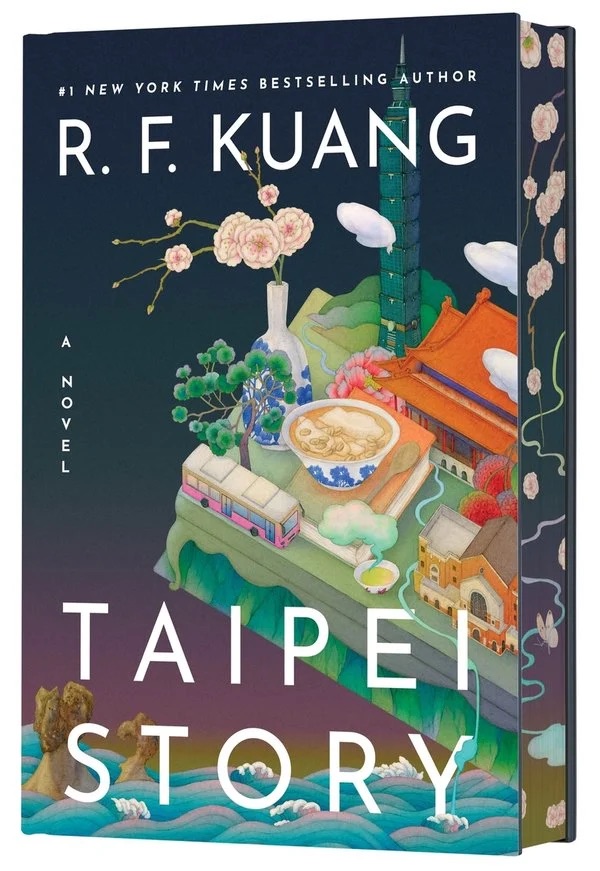
I also wrote about June’s excellent array of new paperbacks, including the latest R.F. Kuang novel.
I’ve Been Reading
I’ve been reading cartoonist Julia Wertz’s books for the better part of two decades. She’s a little younger than me, but her autobiographical comics have sort of grown up with me. I was coming out of my 20s party years when Wertz was reveling in hers, and we’ve both matured at roughly the same pace, eventually moving away from cosmopolitan socialization and into a more sedate home life. Bury Me Already is Wertz’s latest cartoon autobiography, and it documents her rocky path into parenthood and her struggles with learning how to be a mom. I got to interview Wertz three years ago for the Comics Journal, and in many ways that interview was a preview for this book—it’s about how a detached, ironic young artist learns to live with the aching sincerity of parenthood. Like all of Wertz’s books, I laughed out loud at several points, which is not common for me as a reader. I like that her books don’t feature epiphanies for the sake of epiphanies, or any false narrative structures slapped onto the events of her life. For Wertz, life happens and you adjust to it, even if you really have no idea what the hell you’re doing. So far as artistic statements go, I can for sure vibe with that.
Somehow, I had gone 50 years without reading a J.M. Coetzee novel. Thanks to a Little Free Library on Beacon Hill, I found myself in possession of a copy of Waiting for the Barbarians at the exact same time that Steven Metcalf of the (sadly soon-to-be-ending) Slate Culture Gabfest started raving about his late-in-life discovery of Coetzee, so I decided to give it a try. Friends, this book is so of-the-moment that I’m having a hard time believing it was written in 1980. It’s set in a tiny frontier town that is slowly going mad over the just-past-the-next horizon threat of foreign barbarians who are presumably going to lay waste to everything they encounter. If an American tried to publish this novel for the first time in 2026, I would have called it too on-the-nose because it so closely resonates with the headlines.
I read Nicholas Enrich’s memoir of his time working at USAID while Elon Musk’s DOGE ripped the agency to shreds, Into the Wood Chipper, at the same time that Scott Pelley was protesting the hackification of management at his job at 60 Minutes. Like with Pelley’s post-firing interview, this book left me a little mortified that smart people who were very good at their jobs just completely failed to recognize what was happening when the fascists came for them. Pelley seems genuinely astonished that new CBS owner David Ellison might have gone back on his word to maintain 60 Minutes’s independence, and Enrich couldn’t begin to fathom that Elon Musk would want to murder hundreds of thousands of (mostly non-white) children on the other side of the globe. The expectation of civility left both of these men woefully unprepared for the fight that was coming to them. When will we stop being surprised by the powerful oligarchs doing exactly what they threatened to do?
Somewhere on social media, someone praised sci-fi author Clifford D. Simak’s City, a novel-in-stories set in the far future, about the end of humanity and the rise of dogs as the world’s dominant, intelligent species. It’s an entertaining book that is very clearly stitched together from a handful of short stories that were obviously never intended to work together as a piece. I deeply disagree with Simak’s initial premise for the dystopia. The basic idea is that cheap, fast, and affordable transportation led to the wholesale rejection of cities as humankind retreated to solitary rural life and society fell apart. But just because an old sci-fi writer’s prediction didn’t come exactly true doesn’t mean the book is worthless. On the contrary, I enjoyed the thought experiment, even if it wasn’t the most satisfying novel.
And finally, I read a couple of short books that I picked up on a recent trip to Peter Miller Books.
First, even if I hate the author and think their advice is absolute shit, I find myself magnetically attracted to how-to-write books. I am unfamiliar with the author Verlyn Klinkenborg so I can’t tell you how I feel about his work. But Klinkenborg’s writing book, Several Short Sentences About Writing, might be my favorite how-to-write book of all time, replacing Stephen King’s On Writing after two decades as the reigning champ. What’s most appealing about this book is that the advice is almost entirely at odds with every other writing book.
Klinkenborg urges the writer to write in very short sentences. No, You should write even shorter sentences than that. No, you should make them even shorter. Like this, then? Maybe, yes. And while most writing books urge quantity over quality, Klinkenborg also urges the writer to focus on making every sentence perfect before moving on to the next one.
Most writing books make me want to read more, with an eye for the choices that the author made while writing. I’ll say this for Several Short Sentence About Writing: It really made me want to write fiction. That’s rare.
And Bruno Munari’s Drawing a Tree is exactly that: A short, profusely illustrated book showing how to draw trees. The styles range from hyperrealistic to cartoony, with tutorials for different types of trees throughout. The book is just as inspiring in its own way as Klinkenborg’s writing guide. There’s a real pleasure in being able to do something really well—even if that something is just knowing how to draw a tree in a pinch.
And Here’s a Bald Eagle I Saw at Seward Park the Other Day

That’s it for now. I’ll see you again at the end of the month!
Paul