Hi!
Slightly different format this month, starting with three random points:
- I’m thinking about changing the frequency of this email, from monthly to biweekly or weekly. It would still be free, of course, but each individual email would be a lot shorter rather than one big one at the end of the month. I sometimes miss the cadence of blogging and being able to write about something immediately—writing shorter pieces about politics, movies, news, art, Seattle stuff. I’m curious what those of you who receive this email think about that. Too much? Don’t mind? Let me know if you have any opinions.
- For you poets out there, I wanted to let you know that the excellent crew at Expedition Press will open submissions to their broadside contest from October 1st to 31st. The winner will receive 20 letterpress broadsides of their poem and $100 cash. I’m sharing this because Expedition Press does gorgeous work printing literary works by hand, and even if you’re not a poet you should be aware of them.
- And you should get excited for this year’s edition of the Short Run Comix Festival, which features comics and art from around the country and the world. This year’s festival happens on Saturday, November 1st, and it will be Short Run’s first outing in a new venue: The Seattle Design Center in Georgetown. You can learn about riso printing, watch some hand-drawn animation, and even hear from the Pulitzer Prize-winning political cartoonist Ann Telnaes, who recently resigned her job at The Washington Post after they axed one of her cartoons that was mildly critical of Post owner Jeff Bezos. This is, for my money, continually the most important (and fun) arts festival in Seattle, and I’m excited to see how it grows and changes in its new home in Georgetown.
I’ve Been Reading
Seattle author G. Willow Wilson’s latest comic with artist M.K. Perker, The Stoneshore Register, is a quiet little masterpiece. It’s about a young journalist who gets a job writing at a tiny newspaper in a coastal Washington state town where weird things happen. It’s a perfect mix of Our Town and Twin Peaks, and a hopeful refugee narrative. It’s right up there with my favorites of Wilson’s work.
Ken Bruen’s The Guards is about a disgraced alcoholic former police officer in Ireland who tries to become a private investigator, even though Irish law doesn’t recognize private investigators as a thing. The mystery in this book takes a back seat to the protagonist’s beautiful observations about addiction and depression—a lyrical and funny and thoroughly Irish novel. I loved it and I’m looking forward to reading more in the series.
Jordan S. Carroll’s short book-length-essay Speculative Whiteness: Science Fiction and the Alt-Right got my attention when it won the Hugo Award earlier this year. It’s a scholarly work that looks at the close relationship between white supremacy and science fiction, and it just may forever change the way you think of the genre.
Celine Saintclare’s Sugar, Baby is a novel about a poor young woman who begins flirting with and dating wealthy older men in exchange for favors. It’s a sharp and sad novel about class, power, and sexuality.
My favorite thing about Richard Russo is that he writes amazing smartasses. Unfortunately, there aren’t any smartasses to be found in his novel Chances Are. Instead, it’s the story of three young men and their friendship with (and lifelong obsession over) a young woman who disappears soon after they graduate. It’s a very readable novel, but I missed the wiseass spark that Russo brought to his novels Empire Falls and Nobody’s Fool.
Gifts of the Crow is a super-interesting book from local authors about crow behavior, but in the decade-plus since it’s been published a lot of its most interesting factoids have been chopped and channeled and shared on the internet, so it felt like I had read about 65% of this book already.
William Sloane wrote two short novels of Lovecraftian cosmic horror. They’ve been collected under one cover by the New York Review of Books and titled The Rim of Morning, with a new introduction by Stephen King. Unfortunately, these are hardly lost classics. Sloane slowly builds the terror in his stories and then fails to pay them off in any meaningful way, resulting in one long build to nothing much at all.
On vacation this month, I embarked on my annual re-read of Tove Jansson’s The Summer Book, a collection of short scenes about a grandmother and her granddaughter spending a bittersweet summer on an island off the coast of Finland. It’s an incredibly special book for me, and I always find something new in it every year. This year, the sequence that most stood out for me centered around a filthy old semi-haunted bathrobe. The week that I read The Summer Book, a movie adaptation of the book starring Glenn Close opened in a few theaters. I’m still not sure if I’m going to watch it or not—I think my relationship to the book is strong enough that my relationship to the characters won’t be changed by seeing them onscreen, but I’m not entirely sure I want to risk it.
I’ve Been Writing
My bookstore profile column this month focuses on Haunted Burrow Books, a horror-centric bookstore on Capitol Hill. It’s in a temporary space that’s planned to be torn down, so the future of the shop is uncertain. But I hope it picks up enough fans in the meantime to ensure its continued survival.
I wrote about the most interesting new-in-paperback debuts for the month.
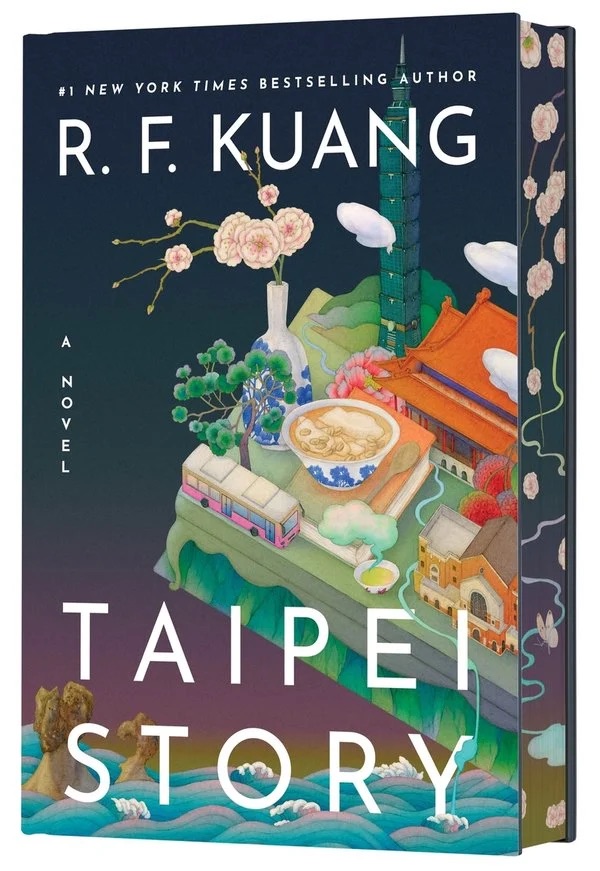
And I also interviewed RF Kuang, who’s one of my favorite young authors, about her very funny new dark academia novel Katabasis. She was so smart and forthcoming in her conversation with me. She admitted that her novel Yellowface was probably too mean—it was written during the pandemic, when she mostly was seeing the world through Twitter scrolling—and that she would probably never write another book like it again.
In one part of the conversation that didn’t fit in the published piece, Kuang also explained why she hasn’t taken to Bluesky in the same way that she used to post on Twitter. “People just aren’t as funny on Bluesky,” she explained. “When Twitter was funny, the humor was amazing. People could be hilarious on Twitter. There’s just not a public commons where people can be that funny anymore.”
She also talked about art that’s in conversation with her latest book, including the movie Whiplash and the novel Jonathan Strange & Mr. Norrell.
Kuang also gently corrected me when I referred to the protagonist of her novel The Poppy War as a hero. “I just don’t really believe in singular heroes, solving widespread social problems,” Kuang said. “I think it takes collective action and a tremendous amount of solidarity” to make lasting change, “and that is antithetical to this very neoliberal idea of the singular hero.”
This is something I’ve wrestled in with my few attempts at writing fiction—the idea of one person changing the world has always felt hollow and childish to me, and maybe that’s why Kuang’s fiction appeals to me on such a fundamental level. She’s struggling with real ways to change the world in her novels, and as I age that becomes, more and more, my favorite kind of fiction.
That’s all for this month. Maybe I’ll see you a little sooner than next month. I hope you’re doing well.
Paul