Category: Uncategorized

  • What i’ve been reading and writing: January 2023

    Just one month in, and 2023 already feels more action-packed than 2022. I attended a big birthday party and a literary happy hour—each of which would have been a highlight of any of any month last year.

    Perhaps most startlingly, I started 2023 off with a last-minute day-job business trip to the east coast, and I carved five hours out of that whirlwind weekend to walk around Philadelphia. Even though I grew up on the east coast, I’d never spent any time in Philly. I always unconsciously dismissed it as a blend of Washington DC and Boston—a city obsessed with the past, and a population too interested in sports and silly accents to be interesting.

    Friends, I was entirely wrong. I loved Philadelphia and I want to return posthaste. The food! The walkability! The friendliness! The density! True, the public transit is named Septa, which sound way too close to “septic” for my liking. But the transit is frequent and useful! Yes, the sports culture is obsessive. But the hockey team’s mascot is Gritty, the Socialist Icon™! 

    I walked about twelve miles. Along the way, I zipped through the historic district, grabbed lunch at the Italian Market, and visited the art museum. In just that short amount of time Philadelphia became one of my favorite American cities. And while I’m never going to move there—west coast is the best coast—I do wish I could snap my fingers and make Seattle as dense as Philly, with its attractive stands of townhouses lining alleys and streets. 

    And density is written into Philadelphia’s source code. At my Philly-native friend Goldy’s recommendation, I visited Elfreth’s Alley, the oldest residential street in America. It was a fantastic reminder that Americans have been living in dense urban environments from the very beginning:

    So January has been quite the adventure after the three-year blur that was 2020. And while not every month will include business travel to new cities, I already have two AWP-adjacent events scheduled for March—more on those in next month’s newsletter—in addition to a couple of literary events in my calendar for later on in the year and a couple comics projects in the works. 

    Is it already time to worry about overextending myself? Probably not. But that’s never stopped me from worrying before!

    I’ve been writing

    For the Seattle TimesI wrote about Elliott Bay Book Company. This was a challenging one to write about because I worked there for eight years. I handled that by telling my story about working at Elliott Bay to open the piece, and then I had to make sure I didn’t make it all about me. I’m pretty happy with how this one turned out, and I’m looking forward to the store’s 50th anniversary celebration, which will take place in June of this year.

    I’ve been reading

    The first book I read this year was María José Ferrada’s How to Order the Universe, a novella about a 7-year-old girl who takes up her father’s job of door-to-door sales and proves to be quite the prodigy. It’s a gorgeous little fable, told simply but with all sorts of weird magic underneath the words. A good start!

    Last month, I read and mostly enjoyed the Clewiston Test by Kate Wilhelm. This month, I read Wilhelm’s The Killer Thing, a potboiler about a soldier trapped on an alien planet with a killer robot. I much preferred Killer to Clewiston, and I’m kind of shocked nobody has adapted this lean little monster of a story into a movie.

    Novels about music don’t usually do it for me, and hardcore punk music usually bores me to tears. So it’s fair to say that I only read No One Left to Come Looking for You because it’s the new novel from Sam Lipsyte, and I’m a diehard Lipsyte fan. I wound up really liking it! It’s sort of a mystery novel about a young punk trying to figure out where his friend’s disappeared to, but it’s really about the 1990s, the youthful quest for authenticity, and everything that’s gone wrong in the decades since punk rock finally rolled over and died. 

    I picked up Claire Keegan’s novella Foster because it’s a Peak Pick selection at the Seattle Public Library. It’s a book about a young Irish girl who finds the family she really needs but wasn’t born into, and it definitely pulled all my Anne of Green Gables orphan-girl heartstrings—which is to say: reader, I cried. 

    In case you can’t tell from all the novellas, I had a hard time focusing on prose this month. So I read more book-length comics than usual—most of which I borrowed from the Seattle Public Library’s impressive comics collection. Smahtguyis a comic book biography of Congressperson Barney Frank, illustrated and written by former Frank staffer Eric Orner. While Orner doesn’t shy away from covering Frank’s scandals, the book is a little too hagiographic to be a truly great biography. But I still really enjoyed it. 

    The first volume of Chip Zdarsky’s new comic Public Domain is really excellent—a funny and big-hearted slice-of-life story about a comic artist who’s been screwed out of the rights to a popular superhero character he helped create. It’s not a preachy anti-corporate-comics tirade, but it does have some interesting things to say about creativity and ownership. If the next volumes keep up this level of quality, Public Domain is destined to be my favorite comic by Zdarsky, which is saying something. And because it’s mostly about family tensions but it’s set in the superhero comics publishing world, I bet you could probably trick some of your superhero-obsessed pals into reading it!

    In 1949, Charles Biro founded a comics anthology magazine for a grown-up audience called Tops. It was supposed to be a kind of New Yorker in comics form, with mature genre comics and comics journalism about a wide variety of topics including what it’s like to be a fashion model. They only published a handful of issues before the endeavor failed, but I read this gorgeous oversized collection from Fantagraphics while trying to imagine what the world would be like if Biro had succeeded and general adult audiences embraced comics as a medium 50 years before graphic novels finally broke into the mainstream. It’s positively utopian.

    Eat the Rich is written by Echo Wife novelist Sarah Gailey and drawn by Pius Bak. It’s a dirty little genre thriller about a woman who goes to visit her boyfriend’s wealthy family, only to get sucked into a dark family secret. It’s an over-the-top parody of all the violence that goes into the accrual of enormous intergenerational wealth, and I had a good time with it.

    Some other newsletters you might enjoy

    Since Newsletters Are the New Social Networks™, and since you (hopefully) enjoy reading newsletters, I thought I should recommend a few newsletters that I enjoy. 

    My friend Davida’s newsletter, the slow and unyielding march of time, is the biggest direct influence on what I’m doing here: She writes about books that she’s read (Davida has great taste in books) and shares a little bit of what’s been on her mind lately. (Look at fancy old me, calling her an influence when really I just shamelessly ripped off her formula. What I’m saying is if you hate this newsletter, blame Davida.) 

    Fred Harper was my partner on my most recent comic, Snelson: Comedy Is Dying. He’s a brilliant artist and an all-around swell guy and I’m so thrilled that he started a newsletter recently. His travels around Greece have been fun to follow, and every issue is packed with art.

    Hmmm That’s Interesting is a newsletter by a woman named Clara who also posts very funny Tik Tok videos imagining exasperated PR professionals’ reactions to celebrity meltdowns. Clara writes about books and celebrity gossip. Her perspective is deeply humane and smart, and her voice feels true and is crystal clear.

    I follow a bunch of comics newsletters, but the truth is that most of them are just nakedly promotional vehicles and I can’t in good conscience recommend them to anyone who’s not already a fan of the creators’ work. The one comics newsletter that I absolutely rave about to anyone who’ll listen is ND Stevenson’s memoir vignette comics series, I’m Fine I’m Fine Just Understand. I have no doubt that these strips will one day be collected in a book and the world will swoon over them, and I’m thrilled to get an advance peek at the work as it’s being created.

    (One caveat to the above paragraph: I’m hopelessly biased because they’re my publisher, but I do recommend the AHOY Comics monthly newsletter because it usually contains contributions from AHOY creators ruminating on seasonal topics. It’s literally the only publisher email that I read from front to back every time a new edition lands in my inbox.)

    My two favorite newsletters about internet news and culture are Today In Tabs and Garbage DayTabs is consistently funnier and more interested in momentary online trends as they bubble up, curdle, and die.  Garbage Day publishes real, opinionated investigations of internet culture’s top stories, and provides some important real-world context to those stories. 

    And last but not least: every weekday, Flow State sends out an email with new recommendations for vocal-free music that’s perfect for writing and studying and thinking. If you find inspiration in instrumental music of all kinds—from around the world, in different genres, from throughout history—this newsletter is a priceless resource.

    And that’s my January! I hope your year started off with exactly as much activity as you want and need.

    —Paul

  • What I’ve been reading and writing: December 2022

    What I’ve been reading and writing: December 2022

    In my memory, 2020 and 2021 have merged into one hazy blur—a pandemic, chaos in the world, and lots of quiet nights at home. The holidays have all blurred together, too—2021 Christmas is indistinguishable from 2020 Christmas, I have to think hard to separate my memories of 2021 Halloween from 2020 Halloween, and so on.

    And I suspect that 2022 is about to fall into that same misty space and melt together with the two previous years. When all is said and done, I’ll forever recall three years of my life as having one single summer, a single winter, a single fall. 

    This feels unsustainable. I can’t imagine that 2023 will join the fog of the past three years. I expect that I will get out more in 2023, and will have more experiences to make the year distinctive from the past three. But maybe that just represents a failure of my imagination—maybe this monoyear is just a product of getting older, and it’s what my older relatives were trying to explain to me when they described the hastening of years that occurs with age.

    In any case, this might sound like a complaint but it’s really not—I’ve been lucky enough to have stable housing, continuous employment, and a very enjoyable social life during the three most tumultuous years in recent history. But becoming aware of the monoyear definitely feels like a first tentative step outside of the monoyear. You can only live in the darkness of March 2020 for so long, after all. Right?

    I’ve been writing

    I wrote about three of my favorite reading experiences of 2022 for the Seattle Times. If you’re desperate for a great book, I advise you to click through to this one—there are some great book recommendations, both Seattle-centric and not, from Times critics like Moira MacDonald.

    Also for the TimesI wrote about Magus Books, which is the quintessential Seattle used bookshop. There’s something ineffable about Magus Books, and I was very intimidated to profile the shop just because that majesty is so hard to document in print. Happily, I spent a good portion of the piece focusing instead on the Magus Books Annex, a new used bookshop that just opened in the old Open Books space in Wallingford. (Fun fact: Before Magus Books was founded in the 1970s, the space was home to an anarchist bookshop called, delightfully, The Id. If anyone has any information about that shop, I’d love to hear it—very little documentation of The Id exists online.) 

    For Insider, I wrote about Professor Scott Galloway’s latest book and his appearance on the Pitchfork Economics podcast. Galloway has developed a reputation as a bomb-thrower on the Pivot podcast with Kara Swisher, and I don’t agree with everything he says. (He’s ridiculously wealthy, for instance, and I think his thoughts on taxation are way too conservative because he’s more interested in staying ridiculously wealthy than he is in solving some of society’s biggest problems.) But I agree with the thesis of Galloway’s new book, Adrift, which argues that growing inequality is unmooring America from the economic foundations that built the middle class. 

    I’ve been reading

    I read the first installments in two long-running mystery series this month: One for the Money, the charming first novel in Janet Evanovich’s Stephanie Plum series; and The Deep Blue Good-Bywhich is the introduction to John D. MacDonald’s Travis McGee character. I had more fun with the Evanovich novel—Plum’s introduction to the world of bounty hunting is breezy and cheeky—but MacDonald’s book stunned me with its great writing and sheer literary quality. I can see why the Travis McGee novels are a favorite of wildly popular writers like Stephen King—they combine pop sensibilities with serious writing craft in a way that elevates the mass-market mystery format. 

    Another pair of books accidentally aligned themselves in my reading life this month: As a young man, I idolized both Haruki Murakami and Quentin Tarantino, and they both released autobiographical books this fall. I enjoyed Cinema Speculation, Tarantino’s account of his informal education from the great films of the 1970s, but it did feel a little tiresome—like the charming dinner guest who repeats a handful of stories a little too often. Murakami’s latest novels have failed to emotionally move me, and his latest non-fiction release, Novelist as a Vocation, has inspired me to actively dislike the man. Murakami devotes a whole chapter to explaining how little he cares about literary awards, and he demonstrates his lack of concern by writing at length about an award that he has never won and which he definitely never thinks about on a daily basis. Tarantino often lacks humility, but Murakami now feels hopelessly high on his own supply.

    One of the readers of this newsletter suggested that I read Oregon sci-fi novelist Kate Wilhelm’s The Clewiston Test, but for the life of me I can’t seem to locate the name of the person who recommended it. Thank you, whoever you are! The novel, about a married pair of scientists whose research takes on a new importance when the wife is badly injured in an accident, feels dated and sexist and homophobic in the way that many 1970s novels do. But I’d never read Wilhelm before and now I’m enthralled by her ability to craft a taut psychological thriller. I look forward to learning more about her life and work.

    I ended the year with a fantastic book: Brian Jay Jones’s Jim Henson: The Biography. I believe that Henson was a generational talent, but at the same time I acknowledge that he must have been a challenging human being to love. Jones recognizes Henson’s faults, but he doesn’t dwell on them. Instead, he tries to pack all of Henson’s unbelievable achievements into a brisk 500 pages while also contextualizing his impact on culture, the technology of puppeteering, and his growing entertainment empire. This book accomplished everything I wanted it to—it made me feel closer to Henson’s warmth and genius without reducing itself to empty hagiography. 

    My favorite movies and TV shows of 2022

    There were lots of interesting movies this year, but only two movies knocked me flat on my ass: I was happily blown away by Everything Everywhere All at Once at the beginning of this year, and I was overwhelmed by Tár at the end of this year. Both of these are movies that I will watch and watch again for very different reasons—EEAaO made me feel great about the world, and Tár was more about encroaching paranoia and darkness. But in both films, the sheer film-making on display is breathtaking.

    Tár, for what it’s worth, also has my favorite movie poster of the past few years:

    While those two movies are way up at the top of my yearly pantheon, lots of other movies kept me entertained. I believe I like Glass Onion even more than Knives Out, because its thesis statement is so timely it could have been ripped from the headlines of this morning’s paper. The Banshess of Inisherin was enthralling, though I felt that it had a bit of a problem coming to a graceful conclusion. Catherine Called Birdy impressed me with its charming young protagonist, and Three Thousand Years of Longing wrapped me in a warm blanket of romance and magic. Emily the Criminal was a nasty little crime story, but a great showcase for Aubrey Plaza. 

    For TV, I loved the second seasons of The White Lotus and Reservation DogsBetter Call Saul somehow constructed a great and satisfying conclusion not just for the series but for the Breaking Bad universe as a whole. I thought Apple TV’s Bad Sisters was probably the best debut series I watched all year—a funny and weirdly cozy story about family and murder and murdering your family. And Amanda Seyfried’s performance as Elizabeth Holmes in The Dropout was so brilliant that it single-handedly elevated a so-so miniseries into high art. 

    For someone who hates year-end lists, I have to admit that I’ve grown to enjoy compiling these little reminiscences of art that moved me over the past year. If you uncovered any hidden gems or were unexpectedly moved by some art this year, I hope you’ll let me know. And I hope your 2023 builds upon your successes and excitements of the last few years while somehow being a completely distinct experience. It’s time to make room for the new. 

    Happy New Year,

    Pau

  • What I’ve been reading and writing: November 2022

    What I’ve been reading and writing: November 2022

    Can we bear one more conversation about social media? I am pleased to report that Twitter has started sending me panicked emails to point out tweets that I may have missed because I’m not spending any time on the site anymore. Facebook has been sending me these emails for years, since I basically left my FB profile to rot in the wake of the 2016 election, and Twitter’s reminder emails are exactly as enticing as Facebook’s emails—which is to say, not at all

    I’m still futzing about with Mastodon, I’ve posted a little bit on Post, and I’ve followed the comics community to the alarmingly rickety Hive, but I’m in no hurry to establish a permanent online home. I’m just reveling in the liberating feeling of unmooring from a service that not so long ago felt as essential to my being as my typing fingers. 

    Looking back, my theme for 2022 has been saying and doing less. I’ve written fewer public-facing pieces than any other year since I started working at The Stranger in 2008. I’ve done almost no public events this year, aside from an author introduction or two. And I’ve basically shut up more than any time in the last 14 years.

    I understand that being quiet is a privilege. I have a full-time job that means I don’t have to be continually hustling the way most freelance writers do, and I have a few gigs that give me a regular outlet for freelance pieces. But I’ve basically been sprinting with my writing since 2008—writing quick responses to current events, synthesizing immediate opinions on art, interacting with Seattle’s cultural community in real time in the form of interviews, previews, and reviews. This year feels like the first time I was really able to get off the merry-go-round, take a look at my surroundings, figure out how I feel, and say no to experiences that don’t feel right.

    Hopefully, 2023 will be a rebuilding year. I’m looking forward to trying new things with my writing, publishing more comics, and finding different ways to interact with the world that don’t feel as disposable as my old prolific blog-happy job. But it’s become clear in the last month that getting rid of Twitter was the final, and perhaps most important, step in slowing my brain down and setting my mind to thinking about what I really want to do as a writer.

    I’ve been writing

    My bookstore profile in this month’s Seattle Times is of Moonraker Books, a gorgeous bookstore on Whidbey Island that is celebrating 50 years of continuous operation under the same owner. This is one of the greater Seattle area’s bookstore gems, and owner Josh Hauser is a world-class bookseller. I’m glad she’s getting so much recognition this year.

    For Insider, I did a deep dive into the proposed Kroger-Albertsons merger, and why virtually every big corporate merger should be shot down. The Biden Administration is doing something very exciting right now by rewriting corporate merger rules, and they have the opportunity to unspool a lot of the greed that has controlled the economy since the Reagan Administration made it easy for corporations to swallow each other up.

    Few conversations in life are as satisfying as talking to booksellers about the new books they love. Also at the Seattle Times I interviewed four incredible local booksellers to learn more about the books they’re excited to sell this holiday season. I’ve read three of these ten books, and I’m excited to read the other seven now. 

    Post.News is one of the social media sites that has popped up in the disastrous collapse of Twitter, and it’s a very appealing idea: A community centered around journalism and conversation. I was accepted to a very early beta version of the site, and writing on it feels a little like a cross between Twitter and Medium. I especially like that you can use micropayments to pay to read individual articles from contributing news sites. Anyway, on Post.News, I wrote a…well…a post about my personal moderation policy. I don’t think I’ve ever written about this anywhere else, but to sum up: My social media policy is block early and block often. You don’t owe your attention to anyone. 

    I’ve been reading

    Ducks, Kate Beaton’s memoir about working for two years on a remote Alberta oil refinery, is a miracle of comic-book storytelling. It’s a story that couldn’t be told as well in any other medium. Beaton captures the all-encompassing monotony of working a menial job, but the visual aspect of comics, and the fact that a comics reader can move forward at their own pace, makes it work. As a movie or a novel, this would be deadly dull, but Beaton’s charming art and masterful pacing transform this into a page-turner. And I was pleasantly surprised by another comic memoir this month: Zoe Thorogood’s It’s Lonely at the Centre of the Earth. This memoir, about a young cartoonist struggling with depression at the exact moment that she began to experience professional success as a cartoonist, is one of the most masterful books I’ve seen from a young artist—the way Thorogood employs a variety of styles to depict her shifting mental state is absolutely breathtaking.

    Andy Campbell’s We Are Proud Boys is an incredibly depressing, but very important, work of journalism—a history of the white supremacist organization from its unlikely origins at Vice Magazine up to the aftermath of the January 6th insurrection. I haven’t read a better book-length explanation of the rise of the alt-right, and it helped me understand exactly how a bunch of scattered misanthropes could become a democracy-threatening movement. As an antidote to the darkness, I recommend following this one up with John Keane’s The Shortest History of Democracy, an excellent (and brief) book that reveals the durability of democracy as a concept through human history. Individual democracies may be snuffed out by fascists not unlike the Proud Boys, but the ideal of democracy itself seems, happily, to be almost as old as humanity. 

    Embarrassing admission: I’ve never read a Marilynne Robinson novel before this month. As a bookseller, and then as a book critic, I tended to skip over the hugely popular books that enjoyed universal acclaim—Robinson’s books sold themselves, and they were praised in outlets around the world, so the chorus hardly needed my voice. I finally read a copy of Gilead that I found in a Little Free Library in Seward Park, and my instincts were correct: I honestly don’t have much to add to the conversation. It’s a big-hearted, intelligent, elegantly constructed novel about the human spirit, I’m glad I read it, and I’m excited to read the rest of her books.

    I read a variety of nonfiction books this month including the anthropological exploration of rituals and their use for human life, Ritual: How Seemingly Senseless Acts Make Life Worth Living, by Dimitris Xygalatas, and a trilogy of books about consciousness in animals: How to Be Animal by Melanie Challenger, The Mind of a Bee by Lars Chittka, and When Animals Dream by David M. Pena-Guzman. Ever since I started sharing my home with dogs, I’ve been fascinated by their perceptiveness and intrigued by what’s going on in their heads. And the more I read about animal consciousness, the thinner the line between humans and animals becomes. Anyone who argues that humans are uniquely special or above the rest of nature is, in my estimation, an idiot.

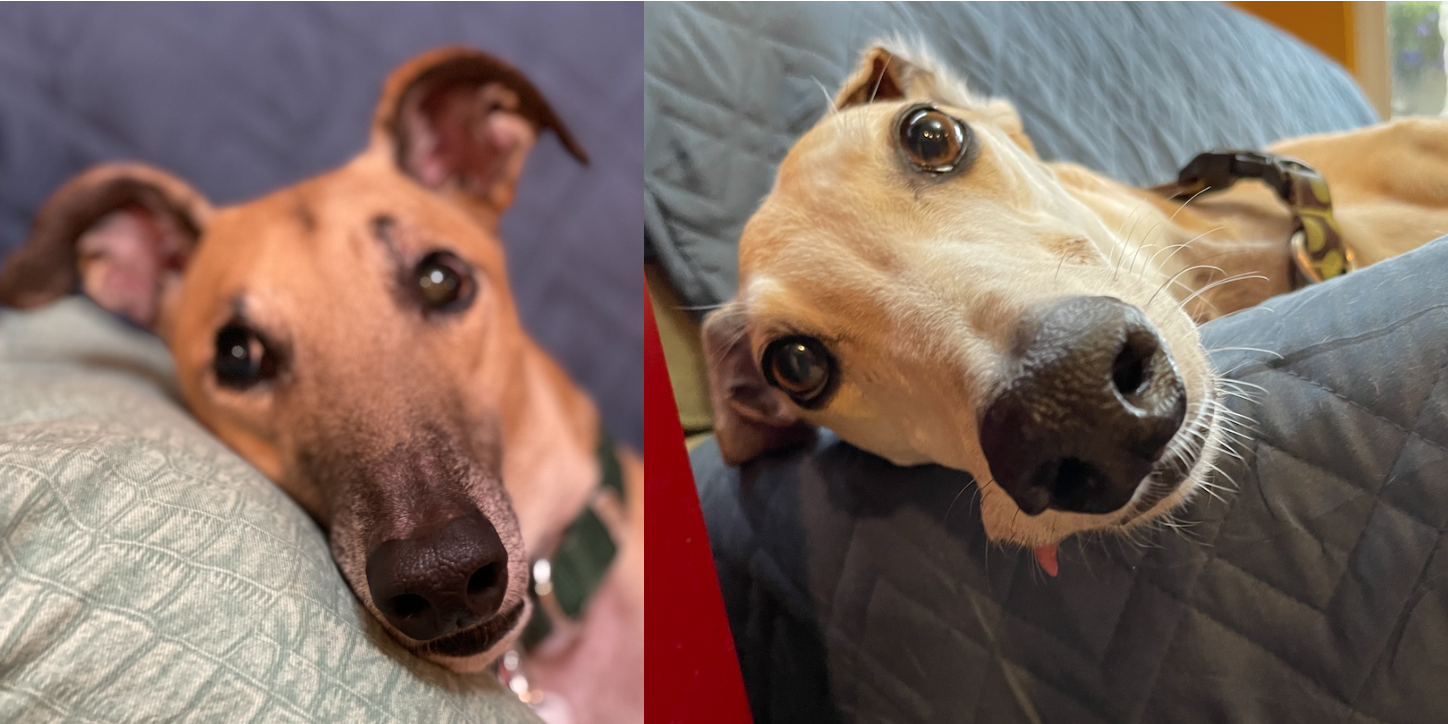
    Speaking of the dogs, it’s been a bit since I’ve shared a photo. That’s Wallace on the left. Since he turned four this summer, he’s really chilled out and relaxed into a friendly pup. Oberon, on the right, is still excited for three-mile walks despite his arthritic hip, and he’s entering old age with a boundless enthusiasm for cuddling.

    Putting meat on the bones

    One of the things I love about writing comics is the fact that there is no standard format for a comic script. Pretty much every comic book writer formats their script differently. I’m sure this is a nightmare for editors and, sometimes, for artists. But to me it feels fun and casual—a reminder that none of this is a science and it’s all intuition at heart. And it’s caused me to experiment with my writing in ways that would never have occurred to me with my prose. 

    For instance, I have never successfully been able to outline a piece of writing before. Something about working from an outline drains all the fun out of writing for me—it turns the exploratory art of writing into a boring game of connect-the-dots.

    But I’m working on a short comics story for an anthology, and I decided to try a new technique with this script:

    • First, I write a brief sentence explaining what happens on each page.
    • Then, I write a short sentence for every panel on the page, explaining the action in each panel in really simple terms.
    • Then, I do another pass to fill out the visual detail in each panel.
    • Finally, I write the dialogue.

    I think of this like the brilliant scene in Moore and Gibbons’s Watchmen, in which Dr. Manhattan explodes to atoms in a nuclear disaster and then reassembles himself from basically nothing over the span of days:

    Something about this process feels uniquely suited for writing comics. It melts down each page and panel to its essential action, while also leaving space for all the details, allowing me to add them in as the story deepens. Comics are a visual-first medium, and this method allows me to think of the art in a cartoonier, more action-oriented way.

    The previous method that I used—just writing the whole script from beginning to end, like a piece of prose—felt a little too writerly, a little too obsessed with the language over the art. This way feels more respectful of both the artist and the medium. It’s exciting to be experimenting with the fundamentals of writing in a medium like this—to admit that I don’t know anything and to try techniques that previously never worked. 

    Above all else, I’m just happy to still be learning. 

    I hope you’re learning, too.

  • What i’ve been reading and writing: October 2022

    What i’ve been reading and writing: October 2022

    I’m very pleased to report that Snelson: Comedy Is Dying, the graphic novel that artist Fred Harper and I recently published with AHOY Comics, was featured on the New York Public Library’s list of Best New Comics for Adults for 2022.

    This one means a lot to me. While many year-end and best-of lists are loaded with pay-to-play advertorial content, this list is assembled by librarians with no other motivation than to promote the books that they love. I’m honored that they chose to highlight our work, in a year that saw the publication of so many great comics.

    There’s such great company on this list! I’ve written about how much I enjoyed Ram V and Filipe Andrade’s Sandman-esque The Many Deaths of Laila Starr in this newsletter, The 6 Sidekicks of Trigger Keaton is one of the funniest comics I’ve read in a long time, and I can’t wait for the second printing of Kate Beaton’s long-awaited memoir Ducks to drop so I can finally get my hands on a copy.

    Everybody is making so much stuff all the time that publishing new work can occasionally feel like tossing yourself into the Grand Canyon. This kind of recognition is a reminder that it does exist in the world, and that people do respond to it. And not just any people—book people. My people!

    In a year that has been tough on librarians and libraries, I just want to express my thanks to, and admiration for, the good people of the NYPL. Everyone who helped create Snelson and send it out into the world was deeply moved by this recognition. Thank you for all your work. It means the world to us. What a thrill, what an honor, what fun!

    I’ve been writing

    As part of a big special celebration of the West Seattle Junction in the Seattle Times, I profiled Pegasus Book Exchange, an amazing used-and-new bookstore that has been an anchor of the Junction for four decades but which still has recently managed to become a bit of a local star on TikTok. On one of my visits to the store in writing this piece, I discovered a novel written by comic writer Steve Englehart that has been on my want list for decades. Pegasus is that kind of place—a bookstore where you casually stumble upon books that have haunted you for years.

    And for Insider, I wrote about how the housing market is making income inequality worse, and why it’s a hugely bad idea to treat housing like an investment.

    I’ve been reading

    I really dug A.M. Homes’s The Unfolding, which could technically be described as a Franzen-esque novel about a wealthy family falling apart in 2009 but is actually a book about how white American men absolutely lost their minds when a Black man became president. There is a scene in this book that is so absolutely insane, so wild, that I can’t believe Homes managed to insert it into this story without breaking the narrative. (The scene involves prehensile toes. You’ll know it when you read it.) It’s funny, it’s weird, it’s excellent satire about a recent time that somehow feels like ancient history.

    Speaking of President Obama, one of my favorite observations of his presidency comes from someone—I think an anonymous source, but I can’t recall for sure—who told a journalist that Joe Biden and Barack Obama’s relationship worked so well because each believed that they were the wise counsel in the friendship, giving the other one much-needed advice and insight. The Long Alliance, Gabriel Debenedetti’s account of the Obama-Biden partnership, doesn’t contain that particular observation, but it is a thoughtful history of one of the most successful president-vice-president working relationships in American history. I especially appreciated a story about Biden inviting the newly elected Senator Obama out to dinner—Biden suggested an Italian restaurant in DC that he liked because it was good and cheap. Obama got offended because he thought Biden was suggesting he couldn’t afford an expensive restaurant, and then Biden got offended by Obama’s offense because he thought Obama didn’t appreciate his reputation as the poorest senator. It all feels so wholesome, in retrospect.

    Aside from its cheesy soundtrack, I really enjoyed Confess, Fletch, the Jon Hamm-starring reboot of the popular Chevy Chase mystery-comedy film series. The dialogue was sharp, the mystery felt substantial, and the movie didn’t insult its viewers’ intelligence. I dug it so much that I went back and read Gregory McDonald’s very first Fletch mystery, Fletch. It’s not as outright comedic as Confess or either of the Chevy Chase adaptations, but it is a sharp little thriller set in the burnout world of the 1970s. And there’s a neat trick in the middle of the novel where Fletch sits down and reads everything he knows about the case into a tape recorder, which is a clever way to remind readers of everything and everyone they’ve encountered so far. As someone who has a hard time remembering character’s names, I really appreciated the expository handholding.

    Ongoingness is Sarah Manguso’s nonfiction literary collage about keeping a diary. I’ve come to love these short, contemplative books that focus deeply on a subject in a kaleidoscopic burst of brief observations—Maggie Nelson’s Bluets is a great example, and Claudia Rankine’s Citizen is probably my absolute favorite because it takes the form further than anyoneAs someone who has never successfully managed to keep a journal for more than two days at a time—honestly, this newsletter might be the closest I’ve ever managed to a diary, come to think of it—I appreciated Manguso’s deep thinking on the subject.

    I’ve read every one of Charles Portis’s novels, so I thought I would never again read a new book with his name on it. But then a couple months ago I found a big chunk of unread Portis at Mercer Street Books, in the form of a collection of his journalism, short fiction, and plays called Escape Velocity. The big surprise for me was how much I loved Portis’s journalism, in which he documents the death of Elvis’s mother and the dawn of the civil rights movement of the 1960s. It’s not flashy gonzo journalism, but there’s so much of Portis’s self in those stories that you feel like you’re inhabiting his body, watching those events unfold. I was disappointed by Portis’s full-length play, which was too talky and fairly uninteresting, but then I learned when I read Vonnegut’s play Happy Birthday Wanda June that there is not necessarily a great playwright waiting to burst out of every great novelist.

    I haven’t read very many good prose novels about superheroes—broadly speaking, I think the interiority of a novel tends to clash with the visual appeal of superhero stories, which is why superheroes excel in comics and movies. But Natalie Zina Walschot’s novel Hench is the exception that proves the rule—it’s the story of a gifted and talented young henchperson who is wounded in a crime gone wrong, and then finds herself at the center of an even larger conflict between heroes and villains. The author is great at imagining the banal day-to-day existence of people who do superheroics and villainy for a living, and there are real bursts of genius—one passage in which the protagonist learns how to see the world with ultraviolet vision will stick with me for a long, long time.

    Richard Stone’s Mammoth: The Resurrection of an Ice Age Giant opens with a survey of all the people who are currently racing to use excavated mammoth DNA to bring the extinct species back to life. It’s only about halfway through the book that Stone really digs into the question of whether we should bring mammoths back from extinction. (And while everyone’s talking about bringing extinct giant animals back to life, I’m personally kind of rooting for scientists to bring back the dodo. I’ve always felt bad for those poor little guys.) I liked this book, but I honestly would’ve been happy just reading an article about the subject.

    I found Lucy Knisley’s early travel memoir French Milk in a Little Free Library in West Seattle. I love Knisley’s autobiographical comics, but had never even heard of this particular book, a pleasant and slight account of Knisley’s six-week trip to Paris with her mother—they eat pastries, walk around, get annoyed with each other, and have trouble navigating the fact that Knisley, fresh out of school at 23, is becoming her own person. It’s not so much a comic as a heavily illustrated journal, so it felt a little like eavesdropping on someone’s account of a relatively uneventful, but emotionally consequential, vacation.

    Tweet less, read more

    Well, Elon Musk bought Twitter. Within hours of the deal closing, various heinous slurs were trending on the site as the worst people in the world celebrated Musk’s supposed free-speech absolutism. I’m not saying that Musk should be personally held responsible for all that hate, but I am saying that if literal Nazis thought I was a pretty cool guy, I’d immediately investigate every single choice I ever made in my life.

    Musk celebrated his first few days in charge of Twitter by spreading false conspiracy theories about the attack on Nancy Pelosi’s husband, essentially calling the New York Times fake news, and accusing the Guardian of being a “far left wing propaganda machine.” Those attacks on news organizations have consequences: I’ve already noticed that emboldened bigots are brigading prominent journalists on Twitter, and I don’t want to participate in that kind of an environment. I’m leaving my account open for work purposes—I’ll retweet stuff, as kind of an automated signal, for as long as Twitter retains its influence—but I obviously can’t and don’t want to spend time on the site.

    I’m still trying to figure out my new routine. I tried to return to Tumblr, and I love some of the artists and unabashed fans of nerdy stuff that have flourished on the site, but there’s absolutely no news or immediacy on there. I reserved placeholder @paulconstant accounts on all the networks that people are talking about as Twitter replacements: Mastodon, Counter Social, Cohost. But none of them have reached the kind of velocity that I liked about Twitter.

    One thing I have done, though, is beef up my RSS feeds. I’m a big fan of NewsBlur, which became my RSS reader of choice when Google Reader closed down. And I recently found an app called Unread that turns my hundreds of RSS feeds on Newsblur into a very readable, chronological stream of what’s happening in the world. This seems to have scratched my reading-Twitter itch. I used to scroll through Twitter while standing in line, or waiting for a train, and now I read articles from sites like the Washington PostVox, and all the comics and culture news blogs I follow, as soon as they’re published. It feels like a positive change.

    So that’s the reading part of Twitter sorted. I’m less concerned about where I’ll post my thoughts. I was posting less on Twitter over the last year, anyway, and I’ve grown to appreciate not forming and broadcasting an immediate opinion on everything. 

    But as recently as last month my monthly newsletter was hosted through Revue, the newsletter service owned by Twitter. I appreciated at the time that Revue was linked so tightly to Twitter’s service, but the emails were a nightmare to format and the writing experience was awful. So because the end of the month was looming, and a decision had to be made, I just moved the whole operation, archives and all, over to Substack

    Of course, Substack has its own problems. They platformed some of the biggest TERFs in media, using the typical Silicon Valley “free market of ideas” bullshit as cover—spend any time reading about economics and you’ll learn that unregulated free markets are a terrible idea—and I expect they’ll be at the center of even more controversies as the service continues to expand.

    I don’t know how to ethically navigate any of this. If this was a paid newsletter, I’d donate a hefty portion of my monthly profits to transgender health and equity nonprofits. But this is a free newsletter and will remain a free newsletter. I’ll keep assessing my options and trying to find a service that’s more ethically sound. Or hopefully I’ll at least come to a conclusion that doesn’t feel like I’m exploiting others in exchange for a buttery-smooth user experience. 

    Nobody can deny the good that social media has done in the world—it’s given a voice to people who have historically been locked out of mainstream media. But all of these networks, from Twitter to Substack to the ancient, dessicated husk that was once known as Facebook, are just too goddamned big. You can’t appeal to an audience of billions without stepping on people every time you move.

    Well. That’s an appropriately spooky place to end on Halloween, I think! Hope this finds you well.

  • What i’ve been reading and writing: September 2022

    What i’ve been reading and writing: September 2022

    For those of you who follow my comics writing, I’m happy to report that there’s a new arrival in comics stores and bookshops this fall: I wrote a story in an anthology called Edgar Allan Poe’s Snifter of Death from AHOY Comics. It’s a comedy/horror anthology series by some of the best comics writers and artists in the business today (and me,) adapting classic Edgar Allan Poe stories in irreverent ways.

    My story in this book is a riff on the lesser-known (and very druggy) Poe story “Silence: A Fable.” In my version, a demon drags Poe to the present day and introduces him to various modern horrors: Amazon reader reviews, Twitter, Mark Zuckerberg—that sort of thing. I’m proud of this one because it’s a stylistic reach for me, a. little more abstract and packed full of callbacks to the original Poe text. I really wanted to keep the spirit and the theme of the original story intact, even as I riffed on the intersection of Poe and internet culture.

    Best of all, the story is illustrated by Joltin’ Johnny Lucas, and he delivered just the right blend of MAD Magazine comedy and EC Comics terror. The brilliance he brought to my script transformed me from an admirer into a hardcore Johnny Fan 4 Life™.

    And this book has plenty of other stories written by Mark Russell, Stuart Moore, and Tom Peyer, and illustrated by artists including Frank Cammuso and Peter Sneibjerg. It’s easy to be enthusiastic about self-promotion when there are so many other talented writers and artists—many of whom I’ve adored since I was a teenager—between the same covers. I hope you’ll pick up a copy in time for Halloween. There’s no other comic quite like it.

    i’ve been writing

    Speaking of stories I’m proud of, I published a piece in the Seattle Times about walking around Lake Washington in a single day. At least once a year, usually around the solstice, I try to schedule a walk that goes from sunrise to sunset—and in the Pacific Northwest, our summer days stretch out to 18 or 20 hours or so of daylight. In the piece, I talk about what it’s like to walk 56 miles in a day, why anyone would possibly want to walk 56 miles in a single day, and how I became the kind of person who would walk in 56 miles in a day. There’s also a map detailing all my pee breaks and meals, and some pictures I took of the route. It’s been years since I published something so personal and voice-y, and I received quite a few nice emails from readers in response to the story, which was fun.

    Also at the Times, I interviewed Gail Vaughn, the owner of the Walls of Books bookstores in Issaquah and Covington. Some Times readers alerted me to Vaughn’s Issaquah store—they said it filled a very important gap in the community that was left after the local Barnes & Noble closed at the beginning of the pandemic. In this piece, I talk a lot about how people’s attitudes toward chain bookstores have changed since the 1990s, and what it means now that Barnes & Nobles are closing and leaving bookstore deserts in their wake.

    At Insider, I wrote about why it’s so important for the Biden Administration to restore the overtime threshold. Salaried Americans used to get time-and-a-half pay for every hour they worked over 40 hours per week, but the demands on our time have only increased as the threshold has been allowed to languish for the last four decades. Restoring the overtime threshold is a great way for American workers to get back a little bit of their free time or take home a little bit more pay—or a mix of both.

    And at Crosscut I previewed a new book festival at Town Hall. Please be advised before you click through that the festival has already happened. But the piece digs into why Seattle hasn’t had a big, citywide book festival since the old Northwest Bookfest rolled over and died almost 18 years ago—and why now might be the time for a new book festival to take its place. In short, the publishing industry ain’t what it used to be, and the glory days of three or four touring authors visiting town and doing readings five nights a week might be a thing of the past. Many of Seattle’s independent bookstores are thriving right now, but our readings scene simply ain’t what it used to be in the pre-pandemic days. Now is the time to come together and figure out what we want the literary culture in Seattle to become.

    I’ve been reading

    At the beginning of this month, I was in the middle of a weeklong vacation at the beach. So I’ve read a lot more than I usually do, which means this is going to be a long one.

    I revisited a pair of pulpy mystery authors I read a lot of in my 20s—Rex Stout’s Nero Wolfe mystery Over My Dead Body and Ed McBain’s thriller Downtown. They were both really entertaining books with crackling dialogue, sharp plot twists, and some unfortunate casual racism. The agoraphobic genius Nero Wolfe is, I believe, one of the most underrated great fictional detectives, and Dead Body introduces a character who may be his long-lost daughter. McBain is best known for his excellent 87th Precinct series of novels—a big, connected universe of police stories he published over the course of decades—but Downtown is a standalone comic novel about a normal guy who gets swept up into a ridiculous criminal underworld after being conned in a bar. Anyone interested in writing witty dialogue that doesn’t feel overdone could do worse than picking up either a McBain or a Stout story—I laughed out loud a couple times at both of these books, and Dead Body, in particular, is one of the best-written outings for Wolfe’s assistant and emissary, Archie Goodwin.

    Jane Smiley’s novel The All-True Travels and Adventures of Lidie Newton is intended, I think, to be a kind of feminist parallel to Huckleberry Finn, and it certainly kept my attention. But the way race was addressed in the book, while undoubtedly forward-thinking for the white, late-1990s audience Smiley was writing to when the book was published, feels awkward and ill-considered to me in 2022. Given that the book is set in Kansas in 1850, race is a huge part of the book and so the novel just didn’t work for me. I hope to read another Smiley novel soon, because I feel like I did her a disservice by choosing this one.

    I sat on the beach and re-read Tove Jansson’s The Summer Book on a single sunny afternoon. The novel, about a prickly young girl and her prickly old grandma spending the summer on an island while also navigating an unspeakably huge loss, has become a summertime ritual for me. It’s a story about the sadness and ephemerality of summertime—how every gorgeous day has a little bit of chill on the air, a reminder that nothing is permanent. Every year this book becomes a little more important to me, and every year I find something new to love about it.

    Several of you recommended Ursula Le Guin’s The Left Hand of Darkness, which I’d somehow never read. I’m sure there’s nothing I can say about Le Guin’s genius that hasn’t been said before. But this book, about an earthling who must navigate an alien world where gender is fluid, is a stone-cold classic. Something I noticed, though, is that our language in the year 2022 is so much better equipped to talk about people whose genders don’t fit the standard male-female binary. The narrator in this book describes their companion, who is at the time of the story presenting as male, as “he” throughout when a modern author would more likely use “they.” The non-binary usage would absolutely change the reader’s perception of that character, and I’m sure Le Guin would have used it had she written the book today. Isn’t it great that our language evolves to better suit our more nuanced understanding of the world?

    And Frances and Ivan recommended Bohumil Hrabal’s Too Loud a Solitude, which is a brilliant short novel about the power of books written from the perspective of a man who destroys books for a living. This one is something special—a masterful book about books by an author with a phenomenal sense of humor.

    Vladimir by Julia May Jonas is a novel about college professors and washed-up writers and affairs and complicated marriages. It’s a pretty sleazy, although beautifully written, novel about pretty terrible people. If you’re looking for a recent novel about sexual politics that won’t leave you feeling like you binge-watched a whole season of a smarmy prestige-TV soap opera, I’d instead recommend Patricia Wants to Cuddle, Samantha Allen’s novel about a Bachelor-like reality TV show that is filming its final episodes in the San Juan Islands. A monster gets involved in the reality TV drama, and people start to die. My two biggest problems with this book have nothing to do with the writing—first, the title is a huge spoiler; and second, the cover depicts a King Kong-like ape that is nowhere in the book. The marketing department fell down on this one in a huge way, which is a real shame.

    Bill Schutt’s Cannibalism: A Perfectly Natural History is a non-fiction account of the history of cannibalism—humans eating humans, yes, but also frogs eating frogs and other intra-species dining options. It’s not nearly as sensational as you might expect a book like this to be—instead, it’s a clear-eyed scientific and historical account of what leads someone to eat their own.

    I greatly enjoyed Becky Chambers’s second Robot and Monk book, A Prayer for the Crown-Shy. In it, a monk who performs tea ceremonies travels around an alien world with a curious robot and they talk about what it means to exist in the world. Not much happens in the book, really—it’s just a running dialogue between two characters who are deeply interested in existence while simultaneously feeling outside of existence, in very different ways. I’ll follow these characters for as long as Chambers wants to write them.

    I also read a standalone novella published a few years ago by Chambers titled To Be Taught, If Fortunate. It’s about a crew of four space travelers who journey to strange worlds. They’re a science-minded exploratory crew, and they try not to leave any damage in their wake. While they’re on their years-long mission, messages from Earth become more mysterious and sporadic. I loved this book—like the Robot and Monk series, Chambers is using sci-fi tropes to explore ethics, kindness, and togetherness. While some might be turned off by the conclusion of the book, I loved it—it felt just right, and true to everything that came before. These two books turned me into the kind of person who will seek out and read every Becky Chambers book on publication. It’s always exciting to find a new author whose career you’re excited to follow, regardless of whatever their next book is about.

    That’s all for this month

    This is a weird thing to write in an email, but there’s a good chance that I might owe you an email.

    I’ve been really bad about responding to emails lately. I think the expanse of summer and its boundless possibilities for outdoor interactions left me feeling paralyzed and overwhelmed. And then as you may know, the guilt of not replying to emails only compounds with each passing day until each individual email weighs the emotional equivalent of six pickup trucks. They become dense and immovable objects, impossible to ignore but also impossible to address.

    Emails are opportunities, and I’ve been allergic to opportunities, lately. I’ve turned down multiple public events in the last few months—onstage interviews, readings, the type of thing I used to happily do six to eight times a month in the pre-pandemic days. Part of the reason behind my repeated refusals was that the majority of Seattle-area bookstores and readings venues do not have mask mandates, and I’d feel pretty dumb if I got my first Covid infection while asking a novelist where she got her ideas from.

    I’m not consumed with fear of Covid, but I definitely wanted to reduce my risk by masking in big indoor groups of people. I’m still not eating in restaurants, and I’m masking on public transit and in stores. Going maskless in public spaces felt particularly reckless, given that a new (and hopefully more effective) round of boosters was on the way.

    Well. As I type this, I have Band-Aids on my left and my right arm because I got my bivalent booster and my flu shot earlier this afternoon. This means I have one less excuse holding me back from getting out there and interacting with the world. We’ll see how that goes.

    In the meantime, if I owe you an email, I hope you understand that it’s not at all about you, or what you mean to me, or what I think of you. It is entirely about me. Believe me when I say I’m working on it, and trust that one day soon I will send you an email that you can ignore and feel increasingly guilty about. Emotional labor is so much easier when it’s shared, don’t you think?

    Take care of yourself,

    Paul

  • What I’ve been writing and reading: August 2022

    What I’ve been writing and reading: August 2022

    Every time I opened a newspaper in my late teens and early 20s, when the fatwa against Salman Rushdie was at its height, I half-expected to read news that Rushdie had been attacked. But that was decades ago, and so much time has passed that this month’s heinous attack on Rushdie was somehow a shock.

    And the photos of the aftermath of the stabbing—a single drop of blood on a familiar beige chair, arranged on a familiar stuffy stage in front of a familiar well-to-do older white audience—turned my stomach in part because it felt so disquietingly normal. I’ve been on plenty of stages just like that, interviewing authors. I know what the atmosphere in the room was just a few minutes before the attack: I know the sounds the audience made, the volley of questions and answers, the mild electric buzz of finally breathing the same air as someone whose books you’ve adored. I’ve spent a lot of time in variations of that room.

    But I’ve never been in a room where an author is stabbed by a member of the audience. I can’t imagine feeling that terror, experiencing that jarring moment where reality readjusts itself around a strange new normal. I’d call it unthinkable, but someone thought it. And now it’s real, and now we all have to live with it.

    There have been plenty of inspiring words written about how literature will prevail, and how there will always be writers brave enough to speak the truth no matter the cost. I’m glad that those pieces exist and I took comfort in them. But I’m personally having a hard time perceiving this moment as a battle in the epic war between good and evil.

    I haven’t spent any time learning about the attacker, so I don’t know anything beyond the fact that he was caught and arrested on the scene. Odds are pretty good he will claim he did what he did because of religion, but it really could have been any reason. There are always young men who want nothing more than to destroy something larger than them—something they don’t, in their youth, have the patience to comprehend.

    Rushdie was doing what writers do. I’m glad he was doing it, and I hope he’ll soon be back to it. I admire his bravery, and the bravery of everyone in that room who stood up to help, even while I desperately wish that it had never happened. I hate that one angry young man can assert his will on the world through an action like this, even as I’m comforted by the fact that writers will continue to write, despite the monstrous actions of those who just want to burn our libraries down to the ground and plunge the world into darkness. They’ll never win, but sometimes they knock the wind out of us.

    I wish Rushdie a swift recovery. I have not a single doubt in my mind that he’ll continue to be a light in the world, standing against the night of ignorance.

    I’ve been writing

    This kind of feels like cheating, but I pre-scheduled this month’s newsletter. By the time you read this I’m just back from a vacation on the Washington coast—away from work and the news and, perhaps most importantly, the internet. So everything I’ve written this month has not yet been published in time for me to link here. I’ll include those links next time.

    For the Seattle Times, I profiled Mercer Street Books, one of the most gorgeous bookstores in the city. This was an emotional piece for me to write for a lot of reasons, and I really hope the story will inspire more Seattleites to seek the shop out, because it is an absolute hidden treasure.

    For Business Insider, I wrote about the many different definitions of what it means to be in a recession, and why our current economic climate doesn’t really match any useful definition. I also wrote two pieces about about the Inflation Reduction Act: First, why it’s a big win for the average American, and then why its tax on stock buybacks is a tremendously underrated development.

    I’ve been reading

    Last month, I said I was trying to not read brand-new books for a while. Many of you chipped in with brilliant backlist recommendations, and I’m going to be reading off that list pretty heavily for the next few months. I begin, awkwardly, with two recommendation-adjacent books because I couldn’t track down the actual recommended titles.

    Amber recommended sci-fi author Sherri Tepper, who I’m embarrassed to say I’ve never read. The local used bookstore didn’t have any of the Tepper titles Amber recommended, so I picked up the only option available: A novel titled Gibbon’s Decline and Fall. Published in 1997, it’s a dystopian future set in a millennial America in which fundamentalists have taken over, a presidential candidate rides a crest of fascism by stoking the public’s anger at women, and the nation is on the verge of a violent coup. I don’t imagine this is one of Tepper’s best books, but I really enjoyed the political satire—even though it hit too close to our current reality for comfort. This definitely won’t be the last of her books that I’ll read.

    And Frances recommended Bohumil Hrabal’s Too Loud a Solitude, but the only Hrabal immediately available at the library was I Served the King of England, which I’ve always meant to read. What a fun, artful shaggy dog joke of a book this is! With the hotel trappings and the European sensibilities it reminds me a little bit of Stefan Zweig‘s fiction, only a lot wilder and less restrained. I suspect that when I finally get my hands on Too Loud a Solitude I’ll enjoy it a great deal.

    And then a few newer titles I had on waitlists came in from the library. Jerry Stahl’s memoir Nein, Nein, Nein! is about Stahl having a breakdown while on an extensive tour of historical Holocaust sites. Be advised that it’s written in that kind of macho 20th century male literary cadence—think Hunter S. Thompson—but Stahl is funny enough, and emotionally aware enough, that it doesn’t feel like a pose.

    Funny You Should Ask is a comic romance novel about a journalist who is assigned a profile of a hunky but dumb American movie star. I thought it was charming and fun, but the idea that an American actor would ever be given the role of James Bond was so ridiculous as to make the book feel like science fiction. And even though the book acknowledged that female journalists falling for their subjects is a tired trope, it still asked us to buy into the trope. So this one kind of qualifies as a guilty pleasure because I had to overlook two big flaws—but a guilty pleasure still counts as a pleasure as far as I’m concerned.

    A Novel Obsession is a novel about a writer who becomes obsessed with her boyfriend’s ex-girlfriend, secretly befriends the ex, and then writes a novel about the whole experience. It’s a dark thriller with an unreliable narrator, and it’s a real page-turner—though it doesn’t quite follow all the way through on its delicious buildup.

    I also re-read the first twenty or so Sandman comics to refresh my memory before I begin watching the Netflix series. I last read these books in the 1990s, but they were such essential texts to me that I remembered a lot more than I expected to. And I was pleasantly surprised to find that unlike a lot of comics from the late 80s and early 90s, these books still read very smoothly. Neil Gaiman seems to have an innate understanding of exactly how many words each panel can hold without making the page feel too wordy and overwrought. And I was also impressed how, even with a rotating cast of artists, settings, genres, and times, Gaiman’s writing somehow made the series feel of a single piece. There’s a pulse in the writing that is unmistakable and continuous, even if the art switches from a cartoony 90s-style in one issue to a gritty abstract horror style in the next. I don’t exactly know how Gaiman does it, but now that I’ve written comics I’m even more impressed with how successful this comic is.

    That’s all for this month

    Briefly, I just wanted to touch on a couple of topics I’ve brought up here in months past.

    First: I do still plan on leaving Twitter if Elon Musk buys it—he’s confirmed he’d bring Trump back to the service, which is a hard quit from me—but since it looks like Musk’s deal might fall apart in court I’ve been cautiously tweeting again.

    Second: I definitely still feel that literary burnout I was talking about last month, and the Penguin Random House trial has only made me feel worse about the state of publishing. It confirmed all my worst suspicions about mainstream mega-publishers being vapid and incestuous, paying their authors and staff way too little while also giving multi-million dollar advances to famous people, and having no idea how to run a sustainable business. Add in the Barnes & Noble gossip and things look pretty bleak to me. I think I’m going to slip a little further into backlist land and catch up on some classics for the next little while, so your recommendations continue to be much appreciated.

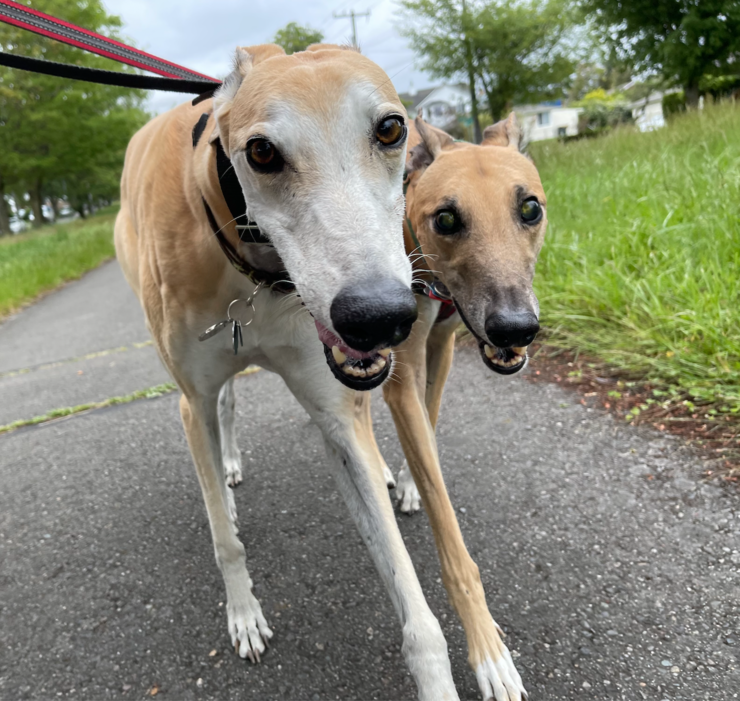
    And many of you are asking after Obie and Wally. The boys are doing just fine. They’re happy, loving the sunny summer weather, and enjoying each others’ company a great deal. Oberon turned 8 this year, and he’s every inch a distinguished older gentleman. He’s leaner and not as muscular as he used to be, but he’s still prone to silly bursts of energy and leaping when he’s excited.

    What a distinguished older gentleman looks like.

    And Wallace has calmed down a little bit, after hitting his 4th birthday last month. He’s unusually vocal for a greyhound and he used to bark at any stranger who got too close. But he’s less prickly and more trusting now. I think in addition to age and familiarity, he’s realized that he’s in his forever home and that he doesn’t need to continually be on guard for danger. He’s on a very sweet emotional journey. I love that he greets me with a little dance, hopping from one paw to the other, when I arrive at home after a long walk.

    Two good boys on the prowl.

    I hope you had a terrific summer.

  • What i’ve been reading and writing: July 2022

    What i’ve been reading and writing: July 2022

    This week’s heat wave has forced the dogs and I to retreat to the one room in my house with air conditioning for 21 hours a day. Because my life right now is pretty much crammed inside these four walls, everything is feeling kinda insular and maybe a little claustrophobic. I’m also finding it pretty hard to focus, so this introduction is just going to hit a couple random points before we careen, full-speed, into this month’s update.

    I traveled to Alaska earlier this month for a work trip, which was a lot of fun. Alaska is one of the few states I’d never visited, and while I stayed pretty close to the Anchorage area, I saw enough—the mountains, the mud flats, the mind-bogglingly great Anchorage Museum and the magnificent Alaska Native Heritage Center—to know that I want to return sometime. And I stayed masked in high-risk situations and managed to avoid Covid, which felt like a real triumph.

    I also realize I’ve been pretty quiet on the comics front lately, but trust me when I say there is progress. The next project is moving slowly, but I’m incredibly happy with what we’re cooking up and I’m excited for you to see it. Hopefully we’ll make some solid steps forward this summer and have something to show you later this year.

    In the meantime, please read Snelson: Comedy Is Dying, and also check out new work by my comics collaborators: Alan Robinson, who absolutely nailed the art on Planet of the Nerds, is doing a great job on The New Fantastic Four for Marvel Comics. Alan is not only drawing a super-cool Spider-Man, he’s also working with Peter David, who was one of my favorite comics writers back in my teens and twenties. And Fred Harper, who melted my face off with his incredible work on Snelson, has a new comic coming out soon with the estimable Stuart Moore called Highball, which is about alcoholics in spaaaaace. They’re both brilliant artists and excellent collaborators, and anything they do is worth your attention.

    I’ve been reading

    In the Seattle Times this month, I profiled Mercer Island’s own Island Books, a (surprisingly large) neighborhood bookstore that’s been a community lynchpin for nearly 50 years. This store has some of the best booksellers in the Pacific Northwest, and my only regret is that I didn’t have the word count to properly give all of them credit by name.

    I’m also really happy with this month’s crop of Business Insider pieces; I’ve gotten to cover some of the most pressing economics issues as soon as they’ve hit the headlines. Topics include:

    • CEO pay hit record heights this year. You know what else happened? Thanks to inflation, the federal minimum wage of $7.25 per hour hit the lowest value an American minimum wage has held since 1966. Those two data points are absolutely connected.
    • I wrote about why the American appetite for taxing the rich has never been higher in my lifetime.
    • I explained why the Federal Reserve’s insistence on raising interest rates in fact might not solve the inflation crisis but will almost certainly immiserate millions of Americans.
    • And I unpacked the weird situation that unfolded on Twitter earlier this month when Jeff Bezos and Big Oil teamed up to dunk on an innocuous tweet President Biden wrote about gas prices. The billionaires and oil companies probably aren’t on your side, people.

    I’ve been reading

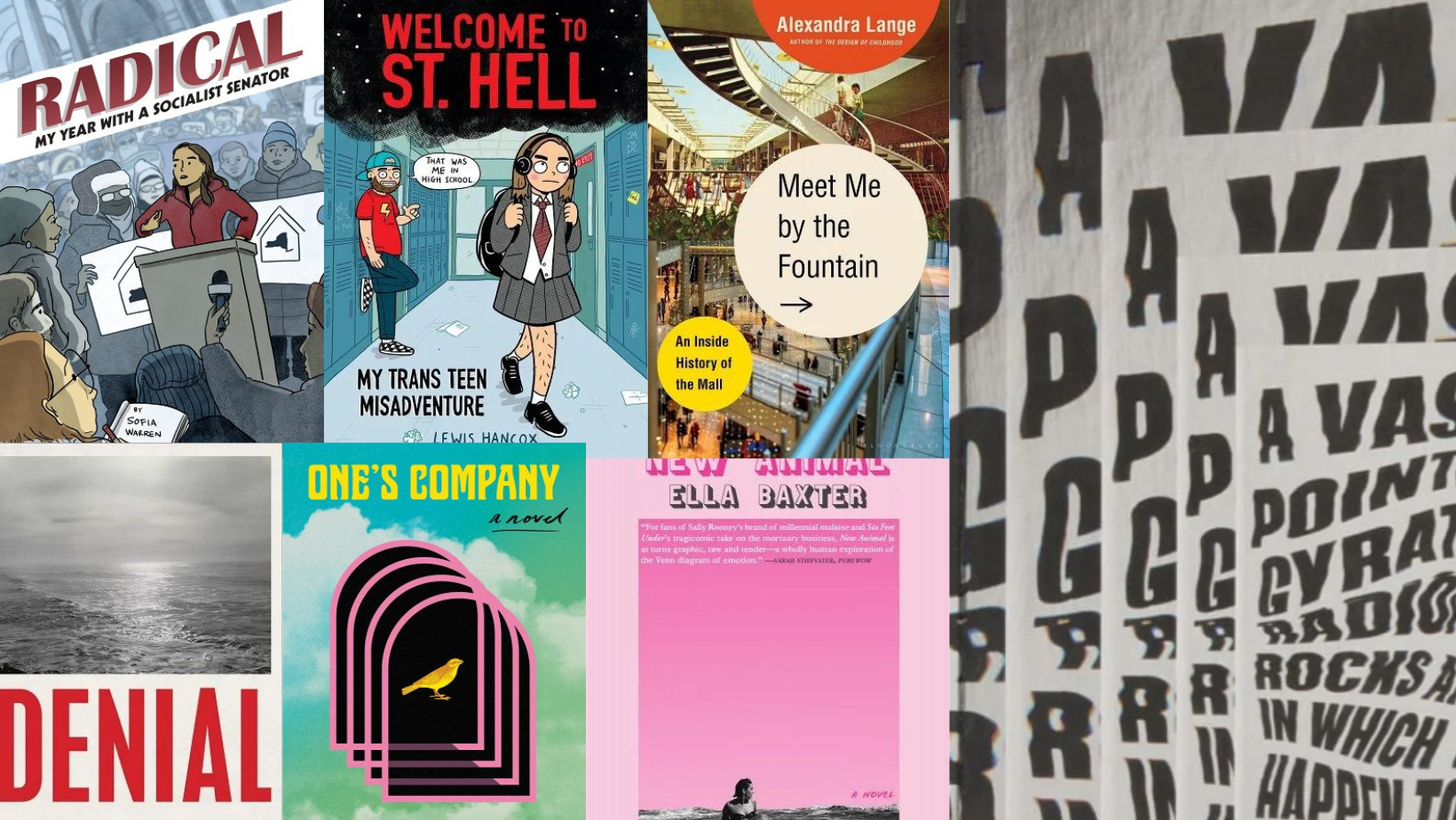
    I picked up Ella Baxter’s debut novel New Animal from the staff recommends section of Paper Boat Booksellers in West Seattle, and I’m so glad I did. It’s the story of a young woman who, in the wake of her mother’s death, wrestles with grief by getting involved in the BDSM scene. It’s a really interesting and funny book about control, loss, emotions, and having to sit with yourself. And it was an interesting companion for another debut novel I read this month, One’s Company by Ashley Hutson. This one is also about a young woman who wrestles with grief and trauma, but the protagonist of One’s Company wins a large lottery jackpot and spends part of her fortune building a huge temple to the sitcom Three’s Company, and then she decides to spend the rest of her life reliving classic episodes of the sitcom. Thematically, One’s Company and New Animal are very similar books but they venture in some very different directions. I do feel like the protagonists of these books would get along if they ever met, though.

    I read three super-interesting nonfiction comics this month. New Yorker cartoonist Sofia Warren’s Radical: My Year with a Socialist Senator seems to have been tailored directly to my interests: it’s a journalistic comic about the nuts and bolts of what it’s like to run a state legislative campaign, and also (uh, spoiler alert) how to actually govern after you win. Featuring revealing interviews with staff and the state senator herself about the complex and frustrating process of politics, this is one of the clearer and easier-to-understand books I’ve ever read about state politics. Lewis Hancox’s YA memoir Welcome to St. Hell: My Trans Teen Misadventure is an accessible comic about growing up trans in an environment that doesn’t make any space for people who fall outside the cisgender experience. Hancox’s cartooning is deceptively simple and it reminds me of some of the best in the autobio field, including Tom Hart and James Kochalka. And Shelly Bond, Imogen Mangle, and Laura Hole’s Filth & Grammar: The Comic Book Editor’s (Secret) Handbook is the Understanding Comics of comic book editing—an explanation of what comics editors actually do. I didn’t know half of what they cover in this book, and I’ve written hundreds of pages of comics.

    I mentioned in the last issue that I adored the film Everything Everywhere All at Once. A friend loaned me an anthology edited by the directors of that film, A Vast, Pointless Gyration of Radioactive Rocks and Gas in Which You Happen to Occur, and it’s a pretty special piece of art unto itself. It’s less of an anthology and more of a literary collage—an exploration of alternate universes in literature with contributions from Etgar Keret, Ted Chiang, and a classic story from Jorge Luis Borges. There’s art and small books stitched inside the larger book and it’s just a really fun experiment. This feels like the kind of book that McSweeney’s used to publish in its heyday, and I wanted to read a million more books just like it as soon as I finished.

    Jon Raymond’s latest novel Denial brings the author’s usual melancholic lonely Pacific Northwestern vibe to dystopian fiction. As is typical for Raymond, the dystopia is more of the slow-moving and depressing variety. I enjoy Raymond’s quiet narratives and his beautiful spare prose a great deal, but this one didn’t move me as much as his more down-to-earth novels The Half-Life and Rain Dragon. But that could just be how I’m meeting this book—I’m so tired of living in a dystopia that the idea of spending more time in a slightly more depressing dystopia is just exhausting.

    And Meet Me By the Fountain: An Inside History of the Mall, Alexandra Lange’s history of the rise and fall of the 20th century’s most popular architectural monstrosities, was just the summer book that I needed. I’ve always been fascinated by malls, and the history and psychology of shopping malls in America was a nice low-stakes subject that I could get lost in for a while. Lange’s a great and intelligent tour guide for this exploration and if, like me, you spent much of your late teens working in a mall (pour one out for Sears and Roebuck,) there’s likely a little pang of nostalgia hiding in these pages just for you.

    That’s all for this month

    For a number of reasons, I’m feeling pretty burnt out on the publishing industry at the moment. I’ve been reading, selling, and writing about brand-new books for the last 20+ years, and I kind of feel as though I can’t stop staring at the strings at a puppet show: Everything feels orchestrated by publicists and manicured by agents and perfectly safe and more than a little bit incestuous. The new arrivals table at my neighborhood bookstore hits me more like a burp of stale air than a refreshing breeze.

    I think I might have to take a step back from the look-at-me of it all and get lost in some old books for a few months. Maybe a Steinbeck and a Highsmith I haven’t read yet, maybe some funky old 1970s sci-fi paperback by some guy I’ve never heard of before.

    If you’ve got a hidden backlist classic that made your toes curl, I’d love to hear about it—anything from high art to genre trash, so long as the author isn’t currently doing a podcast reading tour or endlessly retweeting praise on Twitter. Send me an email (thisispaulconstant at gmail) with your decades-old faves and help me temporarily climb off this hamster wheel of literary inanity, please.

    Take care of yourself,

    Paul

  • What I’ve been reading and writing: June 2022

    What I’ve been reading and writing: June 2022

    I was disappointed, but not surprised, to read that Seattle author Neal Stephenson, who invented the idea of a metaverse in his 1992 novel Snow Crash, has partnered with a blockchain company to create a real-life metaverse. The disappointment comes from the fact that I’m a big fan of Stephenson—I nominated him for a Genius Award in Literature nearly ten years ago, after all. But my lack of surprise comes from the fact that he’s always been a bit of a libertarian, and I wrote in this very newsletter just a few months ago that he’s been way too appreciative of billionaires in his last few books.

    You could say that the warning signs have always been there. I’m not one of the many fans who got burned by Stephenson’s involvement in a Kickstarter to create a sword-fighting video game system that basically returned nothing to its backers. But Kickstarter has always been a disappointment factory, and I just assumed that Stephenson’s enthusiasm for the project had blinded him to what was possible.

    This, though? Stephenson’s most recent novel, Termination Shock, is about the global devastation that climate change will cause, and so his involvement in a technology that is apocalyptically terrible for the environment is doubly disappointing. And of course Snow Crash, which I read and loved in the 1990s like most book nerds my age, felt at the time like a cautionary tale about exactly the kind of technology that he’s actually creating.

    I don’t think I can in good conscience continue to read Stephenson’s books. I just can’t support an author who profits from the monstrous ideas that he once tried to warn us about. I’m also shaken by the fact that Stephenson willingly went into business with Peter Vessenes, a serial crypto investor who has left a swath of dissatisfied customers and partners in his wake.

    I might reinvestigate Snow Crash in order to determine if I completely misinterpreted the book when I read it decades ago, but I can’t really see myself giving Stephenson any more of my money or attention aside from that. I’m done.

    I’ve been writing

    Any month in which you get a chance to interview Dr. Ibram X. Kendi is a good one, right? Talking to Dr. Kendi was an honor. I’m always a little blown away when I meet someone who speaks in complete, perfect sentences and paragraphs. Part of that skill, of course, is because Dr. Kendi is a brilliant man. But I also had the sense when I interviewed him that he was very careful about what he said because he knows that if he were to accidentally drop a single word out of place in an interview like this one, his enemies—by which I mean white supremacists—would immediately use the quote as a weapon against him. He’s aware of the tremendous responsibility that he carries, and I deeply respect his strength.

    I also wrote about Vashon Bookshop for my Neighborhood Reads bookstore profile column. What a lovely bookstore—it’s partly a vacation-friendly island bookstore for tourists to pick up beach reads, but it’s also a vital community hub for Vashon’s year-round residents. I’ve watched the shop evolve over the course of my many visits to Vashon through the years, and it’s just a pleasure to learn about the store’s history.

    For Insider, I wrote about a new study showing that nations around the world which worked to shrink income inequality also reduced political divisiveness. The head of the UN-sanctioned group that performed the study makes a policy recommendation that she believes would help resolve both political and economic disparity in America. And the piece I wrote about why childcare is an absolute necessity for working moms reads a little different on publication, because it was written before, but came out after, the Supreme Court’s shameful decision to overturn Roe.

    I also wrote about an interesting theory from an author: The idea that the invention of public policy grad schools in the late 1960s and early 1970s actively made public policy worse, because the standardization required in “rating” policies meant students and teachers measured prospective policies through economic terms. The most cost-effective policies are now deemed the “best.” But by those same measurements, the best policies in America—Medicare, Social Security, etc.—would never have been adopted.

    I’ve been reading

    I realized when I read Bainbridge Island author Jon Mooallem’s excellent new book of essays, Serious Face, that I miss regularly reading good magazine writing—by which I mean non-fiction essays that run for thousands of words and don’t feel rushed to get to a point. Mooallem is one of the best non-fiction writers in the state of Washington, and this book—full of eccentrics, scam artists, historical weirdos, and literal Neanderthals—is a showcase of his many talents. There’s even a celebrity profile of sorts, in the form of a long and self-referential interview with the screenwriter Charlie Kaufman that gets hijacked by the early days of the pandemic. This book would be a great vacation companion—the kind of book you can pick up, lose an afternoon in, and then throw in your bag as a guest on your next adventure.

    I found a pristine copy of Tananarive Due’s The Good House in a Little Free Library on one of my walks, and by the time I fell asleep that night I was a hundred pages in. It’s a story about an intergenerational curse in a small town in Washington state, and though it takes a while to get started, Due knows how to pay off a slow burn. The next time you’re getting ready to pick up a bottom-tier Stephen King novel just because you’re bored and in the mood for a horror fix, do yourself a favor and pick this one up instead.

    Tripp Mickle’s book about Apple’s tumultuous years following the passing of founder Steve Jobs, After Steve, is full of juicy corporate gossip. Unfortunately, Mickle frames the narrative as a battle for the company’s “soul” between number-crunching new CEO Tim Cook and art-loving design guru Jony Ive. Based on the detailed quality and unbalanced quantity of anecdotes about Ive, though, it’s obvious which “side” of the “struggle” most of Mickle’s sources are on. And the very premise that Apple has a “soul” to lose represents a dangerous kind of corporate anthropomorphization that I believe a journalist shouldn’t indulge. If, like me, you’re interested in an insider account of how giant corporations get things done, there’s plenty of gossip here to enjoy. But you also have to be careful to continually keep the source in mind, and interrogate the narrative for secret agendas.

    Hernan Diaz’s novel Trust is a complex novel about a tycoon and his massive business empire in the early days of the 20th century. It’s sharply written, and it smartly avoids the trap of trying to be an overstuffed DFW-style “everything novel,” which it easily could have been. Unfortunately the narrative is broken into several discrete chunks, and those structural choices sapped the narrative of some necessary velocity.

    Biloxi, a novel by Mary Miller, is a simple story about an unpleasant old man who has made an incredible mess of his life. Then he gets a dog and things start looking up, until he realizes that the dog belongs to someone else. Biloxi is really an exercise in voice—a damaged, prickly man who is aware of, and desperately wants to fix, about half of his toxic traits. I really enjoyed it, but I could see the unlikable narrator turning a lot of people off.

    Amy Bloom’s memoir In Love, about her husband’s early-onset Alzheimer’s diagnosis and their joint efforts to seek out legal assisted suicide for him, completes my recent reading trilogy of nonfiction books about marriages and relationship disasters. (I wasn’t crazy about Foreverland, but I enjoyed Heartbreak quite a bit.) It’s probably not surprising that Bloom’s book is my favorite of the three, but be warned—it’s a totally heartbreaking exploration of what it means to be the partner who has to not only say goodbye to the one they love, but also help shepherd them through to death. It’s shot through with wry humor and optimism, but I wouldn’t recommend it to anyone in a tender emotional state.

    Seems like there’s a little bit of a clone trend happening in popular culture. From the gorgeously contemplative Mahershala Ali film Swan Song to the action flick Dual, creative people are investigating the idea that clones are something disposable. Edward Ashton’s novel Mickey7 is a sci-fi thriller along those lines—the story of a clone on a deep-space colony whose only job is to die on dangerous missions, be cloned, and keep doing the dangerous work until he dies again. Of course, something goes wrong and Mickey7 and Mickey8 come face-to-face, even though strict and vaguely religious colony rules forbid “multiples.” The narration suffers a little too much from the wiseass-in-space vibe that has plagued sci-fi since The Martian‘s massive success, but it’s an interesting read, and if you’re at all interested in the high concept you’ll want to read this book now: it’s apparently set to be adapted as Bong Joon Ho’s followup film to Parasite, starring Robert Pattinson.

    That’s all for this month

    Just above, I wrote about a new storytelling trend I’ve noticed in sci-fi books and movies: clones becoming sentient, breaking free from their disposable fate, and transforming into their own autonomous beings. I’ve been wondering why this particular story is floating around in the collective unconscious right now.

    Of course, America loves a story about a worker drone who self-actualizes themselves into free will. It appeals to our national idea, the concept that if we just work hard enough, we will somehow make enough money that we won’t ever need to worry about money again. But this clone craze feels a little more pointed than just the usual bootstraps narrative, and I have a theory about why.

    From Spider-Man (live-action) to Spider-Man (animated) to Doctor Strange to Loki to the Flash to Everything, Everywhere, All at Once, a lot of our blockbuster brain space right now is keyed into the idea of the multiverse. And setting aside Everything, Everywhere, All at Once for a moment—which truly feels to me like a generational achievement in filmmaking and a deeper exploration than all the others—the idea behind these multiverse stories is that no matter what you do or where you go, you’ll always wind up in some version of the life you live now, albeit with endless cosmetic variations.

    I’ve always disliked the Destined Chosen One narrative because it ultimately doesn’t have any drama to it, and I think the multiverse narrative is just a slight twist on the Chosen One narrative without a climactic (franchise-ending) battle.

    It’s a little surprising to me that Spider-Man has become the premier multiversal superhero, because to me it takes some of the specialness away from the character. I like Peter Parker because he’s just some kid who found himself thrust into a role that demands every ounce of his attention. And no matter how likable Andrew Garfield and Tobey Maguire are, I think Tom Holland’s Peter Parker feels a little less special when he’s on screen with the others. When you get a bunch of Spider-Men together, being Spider-Man shifts from a complicated moral choice to yet another version of the destiny narrative—a role the universe forces him to play. (And note that I don’t include Miles Morales in this Too Many Spider-Men argument. Miles’s whole thing is that he’s someone who has chosen to respond to Peter Parker’s choice in his own way—he’s a unique take on the Spider-Man story, and not a blurred photocopy.)

    All of which is a long way of saying that I wonder if all this clone pontificating is a pushback to the disposable multiversal variants we’re seeing in superhero films and TV shows right now. We can be more than just a background character in a multiverse-spanning epic, these stories argue. We can be whatever we want. We have free will, and we can make better choices. There are a lot of problems with that narrative, too—libertarians love it for a reason—but I would choose to be the protagonist of a Rogue Clone story over a Multiverse story any day of the week.

    Anyway, this is a long one. Sorry. In conclusion, please enjoy a photo of Obie and Wally, who have been absolutely loving their occasional warm and sunny walks.

  • What i’ve been writing and reading: may 2022

    What i’ve been writing and reading: may 2022

    I’m in the pits right now, friends. The news is all heartbreaking, the weather in Seattle is pretty dire, and nobody knows for sure if Covid is or is not going to throw the mother of all comeback tours in the fall.

    I’m also tearing my hair out over the fact that a judge in Virginia ruled that two books for young readers are obscene. I can’t believe that last story isn’t getting more attention, by the way: If the ruling stands, it would be the first time in 50 years that a book would be banned in the United States on the grounds of obscenity. It could be illegal to own a book in certain parts of America. Chew on that for a while, and then try to tell me that cancel culture on college campuses is the real problem right now.

    So in order to chase the late-spring blues away, let’s talk about a few things that I’ve been grateful for lately:

    • We’re still waiting for the really good summer foods to come in—Rainier cherries, where are you?—but I was very excited to find this strawberry curry recipe at Atlas Obscura. I’ve been cooking a lot of Indian food for the past year, thanks to Meera Sodha’s excellent cookbooks, and this summery treat of a recipe felt quite in line with what I’ve learned from Sodha.
    • I managed a 72,000-step (36-mile) walk around most of Lake Washington on the last day of April that left me feeling pretty good, although my new Nike hiking sneakers left my feet covered in huge blisters, which is why I wasn’t able to complete the walk all the way around the lake (That’s what I get for straying from my beloved Brooks hiking sneakers.)
    • I’m not traditionally a huge Harry Styles fan, but his new album, Harry’s House, is phenomenal. The opening song, “Music for a Sushi Restaurant,” is a bop and while the album flags a little toward the end, it’s definitely worth listening all the way through.
    • I also love Seattle musician Hollis’s new album Subliminal, and that will be sharing space with Styles (and, presumably, Lizzo’s new album that comes out in July) on heavy rotation all summer long.
    • Last month, stand-up comedian Gary Gulman reached out to me on Twitter to say he enjoyed the comic I made with Fred Harper, Snelson: Comedy Is Dying. He also invited me to his show at the Moore in Seattle on May 28th. I already knew I enjoyed Gulman’s work—his HBO special, The Great Depresh, is well worth your time, and he’s got a small but hilarious role in Amy Schumer’s very good Hulu sitcom Life After Beth—but I wasn’t prepared for how much I’d love his live show. At nearly two hours, he ventured everywhere from cancel culture to toasters to stage magic, and he simultaneously provided a running commentary on how the set was going all the while. It was a deeply funny, gorgeously written show. If you’re a reader—and if you’re getting this email, you are almost certainly a reader—I can’t encourage you enough to check out Gulman on his Born on Third Base tour if he’s anywhere near you this summer or fall.

    I’ve been writing

    I loved talking to Tacoma author Peter Bacho about his memoir Uncle Rico’s Encore for The Seattle Times. Bacho grew up in Seattle and his book is all about his experiences with the local Filipino community—their labor victories, their efforts to change the city for the better, their complicated ties with the country they left behind. He was a funny, fantastic interviewee.

    And also for The Seattle Times, I wrote about Blue Kettle Books, a cross between an indie bookstore and a food truck. The owner and operator of Blue Kettle, Monica LeMoine, is driving Seattle’s newest—and smallest—bookstore to festivals, breweries, and farmer’s markets all over the north end. I was really interested to learn about her process for stocking the shop: There’s room for about 800 titles, so she has to be very choosy. And I love her mission to take the books directly to people who otherwise might not visit bookstores.

    For Business Insider, I wrote about a new proposed tax on Big Oil’s profit markups, three very progressive policies in President Biden’s proposed 2023 budget, and the private equity firms that murdered Toys R Us in the name of a quick profit.

    I’ve been reading

    Emily St. John Mandel’s latest novel, Sea of Tranquility, features a character who, like Emily St. John Mandel and her runaway bestseller Station Eleven, recently wrote a blockbuster novel about a pandemic. Usually those self-referential characters are a huge turnoff for me, but St. John Mandel’s self-insert was possibly my favorite part of this book. It’s not as good as Station Eleven, but it similarly brings her empathy and sensitivity to science fiction tropes like pandemics and moon bases.

    I really enjoyed Florence Williams’s nonfiction book Heartbreak: A Personal and Scientific Journey, which begins with a brief memoir of Williams’s marriage falling apart unexpectedly through no fault of her own and then transforms into her exploration of the science and history of human heartbreak. There are ninety ways this book could have gone bad, but Williams dodges them all.

    I was enthralled by two short works of fantasy this month: Sarah Tolmie’s All the Horses of Iceland is a fable about the origins of Iceland’s short-legged horses , and Spear is Nicola Griffith’s gorgeous feminist reexamination of the Arthurian legend. These are both short books that don’t lean into traditional fantasy tropes, and I was haunted by the both of them in very different ways. Ask me to pick a favorite and I’d give Griffith the edge—but I have to note that I am not impartial because I am maybe the only person on earth to have ever been thrown from the back of an Icelandic horse, so I hold a little bit of a grudge toward the little bastards.

    I was also swept up by two similar books about bizarre animals: The Soul of an Octopus is a heartbreaking and fascinating exploration of the consciousness of octopuses, and The Sound of a Wild Snail Chewing is about a woman who, during a long illness, is charmed by a wild snail that a friend places on her bedside table. Neither of those animals are recognizably human in any way, but the authors do a fantastic job of explaining what makes them worthy of our attention—and our emotions.

    Written by Ram V and illustrated by Filipe Andrade, The Many Death of Laila Starr is a comic about what happens to the personification of death when a scientific genius makes death obsolete. Basically, death gets laid off, and she decides to get her revenge on the inventor of immortality. It’s a charming story about a subject that’s prone to cliches, but the creative team dodge every obstacle in their path. Maybe the nicest thing I could say about this book is that I think it stands up alongside Neil Gaiman’s Sandman series with its personification of grand concepts and its mythologization of the everyday.

    The most interesting parts of Claire Stanford’s new novel Happy for You were the segments in which the main character, an academic born of a Japanese mother and a Jewish father, struggles with the boxes that website intake forms try to categorize her into—does she check “Asian-American” or “Other,” for instance? Our hero is airlifted out of grad school limbo and into a large tech company’s project to map and measure human happiness, and Stanford does good work exploring that fuzzy area between computational precision and human messiness. The book doesn’t find a satisfying conclusion but I loved the way it explored its themes so much that I didn’t really care.

    And John Scalzi’s latest sci-fi novel, The Kaiju Preservation Society, is a summer blockbuster of a book. It’s about a loser who gets hired by a company to travel across dimensions and keep an eye on the giant city-destroying monsters on the other side, and Scalzi is having great fun drilling down into what a creature like Godzilla would really be like—giant parasites and all. If you’re looking for a big, fun science fiction thrill ride to take on vacation this summer, I think this might be the one for you.

    That’s all for this month

    A couple weeks ago, I walked to the Fauntleroy Ferry Terminal, took the ferry to Vashon Island, and then walked to downtown Vashon. I can’t recommend Vashon as a walking destination because there are no sidewalks on most of the island, so the only obstacle between your body and traffic hurtling at 45 miles per hour in the opposite direction is a little white strip of paint.

    But as I was nearing Vashon, I saw a sign by the side of the road near the entrance of the Episcopal Church of the Holy Spirit:

    A few years ago, I’d done a little research into labyrinths in the Seattle area (apparently, there are 24 of them, according to the World-wide Labyrinth Locator) but I’d never actually visited one before. So I stopped and walked the path. While the Vashon Labyrinth follows the formula of a labyrinth—it’s just a circuitous path around a circle with a central area for meditation—it’s a fairly low-key affair. The path itself is just a rut dug into a lawn next to the church:

    Now that I’ve officially walked one labyrinth, I understand the appeal. Part of the reason why I enjoy frequent miles-long walks is that it serves as a form of meditation for me—once I pass mile 20, my brain stops cycling through the usual array of annoying repetitive thoughts and I start to feel a little less like a restless brain in a jar and more like a body existing in the world.

    The labyrinth, then, serves as a kind of focused meditation exercise that distills the meditation of walking: You trust the path, you round the corners, and you can see the whole path around you, so you just patiently put one foot in front of the other. At the center, you pause and look at where you’ve been, and then you reverse your steps. I bet if you were to do some breathing exercises while you walked the path, it would be even more calming.

    Maybe this fall, I’ll start including Seattle-area labyrinths into my walks. I can’t see labyrinths taking the place of my regular walking practice, but they’re an interesting exercise for someone who walks an average of ten miles a day: Going nowhere in particular, slowly, for no reason, and taking the longest possible route to get there. I could probably use some more of that in my life, and I bet you could too.

  • What i’ve been writing and reading: April 2022

    In the week since Elon Musk announced he was buying Twitter, he has already encouraged racist and misogynist bullying of Twitter employees, he’s publicly embraced alt-right sleazoids including the guy who inspired the “Pizza Gate” misinformation campaign, and he’s continually railed against the “woke” left (which apparently includes Netflix for some reason.)

    Now I’m not the brightest bulb on the Christmas tree, but I know that when a right-wing scumbag with a racist army buys a social network there’s no point in trying to change that system from the inside. Just within the last week, fascist Musk bootlickers have been emboldened, picking fights with trans people and people of color on Twitter and swarming their replies with abuse. It all reminds me of the days after Trump won the election in 2016, when the Nazis realized they didn’t have to hide anymore.

    So if Musk’s $44 billion offer goes through and he takes control of Twitter in six months as planned, I’m leaving Twitter, and I’m already throttling down my daily Twitter use to prepare for that moment. (Though it may not happen; if Tesla shares start to really tank, there’s a good chance Musk might have to back off. I hope the deal falls through, but I’m not holding my breath)

    I’ve been experimenting with my old Tumblr account and I’m enjoying myself over there. It’s a creative community that’s visual-forward but allows for long-form blogging. There are two big problems with Tumblr, though: First, there’s no news on the site to speak of, so I’ll need a new way to stay on top of breaking news, and second, there aren’t enough people on there to make my feed feel as lively as my Twitter feed does. I can’t do much about the first problem, but you can do something about the second: If you’re on Tumblr or you want to experiment with the network, be sure to say hi over there.

    If Musk does buy Twitter, that means I’m also going to have to do something with my newsletter. I currently use Revue, which is Twitter’s newsletter service. It is, quite honestly, very bad: The formatting is terrible and the back end is janky. I only chose Revue because it was integrated so tightly with Twitter. There’s no value to it otherwise. But the good news is that I can just move those email addresses over to another service and readers shouldn’t notice a thing when or if that happens.

    This opening note feels horribly self-indulgent and navel-gazey, but I think it’s important to explain where I’m coming from, in part because I was a huge proponent of Twitter right from the beginning. And yes, I realize that every social network is run by terrible rich people, but I draw a very clear line at people who happily attract mobs of Nazis to do their bidding online. I spent four years on Twitter being obsessed with one deranged rich guy with too much power and a base of foaming-at-the-mouth bigots. I won’t be fooled again.

    I’ve been Writing

    At the Seattle Times, I interviewed Neil Gaiman in advance of his reading at Benaroya Hall this Sunday night. It was a great conversation, and he was, as always, impossibly charming. (As a bonus, I’m including some outtakes from that conversation at the end of this email.)

    Also at the Times, I wrote about Open Books, Seattle’s lone poetry-only bookstore, and its recent move to a new storefront in Pioneer Square. Aside from the pure joy of a new bookstore opening in Seattle’s original Bookstore District, the thing that I love about the new Open Books space is the fact that it has two rooms—the Parlor and the Print Shop—that are intended to be community hubs for Seattle’s poetry community. It’s now a space where literary magazines can be formed, edited, and printed; writing groups can meet to discuss work that will appear in upcoming chapbooks; and authors can debut new books to adoring crowds—all at the same time.

    On my Tumblr, I wrote a little bit about why I, a huge Nicolas Cage fan, was disappointed by the new film The Unbearable Weight of Massive Talent. I do a little meditating about what I think the film gets wrong about Cage’s allure.

    And it was a big month over at Insider, where I wrote about a new wage tracker that shows exactly how little 66 of the world’s biggest, most iconic companies pay their workforce, why banning stock buybacks would raise wages for workers, why America’s shameful and racist mass incarceration problem is doing serious economic harm to the country, and why the minimum wage would be well over $20 per hour if worker pay had kept up with productivity.

    i’ve been reading

    So I finally read Jonathan Franzen’s latest novel, Crossroads, and I found it to be a compelling, if way too angsty, soap opera about a family that’s falling apart at the center of a church community in the 1970s. I can’t deny that it’s well-written, but every single character in this book was an awful person, and every single one of them made at least one choice in the narrative that just completely turned me off. In other words, it’s Franzen doing Franzen.

    Seattle cartoonist and comedian Brett Hamill’s latest comic book memoir, Sk8 Dad Summer, is a sweet, low-stakes collection of anecdotes about Hamill rekindling his interest in skateboarding, and a meditation about how the rebelliousness of his youth as a skater interacts with his relatively gentle adult life as the dad of a toddler. The comics in this book reminded me a little of the diary comics of James Kochalka and John Porcellino—a huge compliment, coming from someone who was obsessed with autobio comics in the 1990s—and the stories build on each other to form a lovable portrait of a man trying to do the best he can at honoring responsibilities he’s taken on, while still being true to himself.

    Gideon Defoe’s An Atlas of Extinct Countries is an encyclopedia of nations that fell apart, collapsed, or otherwise completely disappeared from the face of the planet. It’s an interesting premise for a non-fiction book, and Defoe (who wrote a few humorous novels about pirates a while back) is both a good researcher and a chatty tour guide. But if you do buy the book, I recommend not reading it straight through from beginning to end, as I did. The various extinctions all get a little same-y when you read them one after the other. This is a better book to flip through than swallow whole.

    And while we’re talking about humorous books that you probably shouldn’t rip through cover-to-cover, Ryan North’s How to Take Over the World: Practical Schemes and Scientific Solutions for the Aspiring Supervillain is a very funny book that applies real-world science to the plots and schemes of super-villains. Under the guise of describing how to build a secret lair and plot world domination, North explains the basics of earth sciences, computer programming, and climate change in easy-to-understand language. It’s hard to find the perfect mixture between entertaining and educational, but North pulls it off.

    Photo No-Nos: Meditations on What Not to Photograph is an anthology from Aperture that collects essays from world-famous photographers who explain the subjects that they refuse to include in their photographs. Of course, it’s light-hearted: if you took every single prohibited subject in the book seriously, you wouldn’t ever take another photograph in your life. But the subject is an interesting constraint, and you can learn a lot about art by studying what mistakes the great practitioners have made over the course of their careers. Great photography is as unknowable to me as magic—I know it when I see it but I have no idea what goes into it or why it works so well—and this book helped me think like a photographer for a while. In that respect it was a fascinating exercise.

    I’m a huge fan of Michel Faber—Under the Skin and especially The Book of Strange New Things are all-time great novels—and so I was thrilled to see that he published a novel for young readers. D (a Tale of Two Worlds) is an homage to Charles Dickens and a fantasy novel about what would happen if one day the letter “D” just suddenly disappeared from the world. It’s not my favorite Faber book by any stretch (and this is a very specific recommendation: If you want to read a good novel about letters mysteriously disappearing from everyday use, I’d recommend Mark Dunn’s Ella Minnow Pea before this one) but if you’re a fan of Faber’s analytic voice, whimsical creativity, and slightly aloof observational eye, you’ll find plenty to enjoy.

    I do love to read books about marriage, but I never really feel as though I recognize the marriage described in the book. That’s how it was for my experience with Heather Havrilesky’s Foreverland: On the Divine Tedium of Marriage. I didn’t at all agree with Havrilesky’s insistence that every married person hates their spouse on a regular basis, for instance. That concept is just alien to me. And at several points, the story feels like the author is pumping up the drama of some moments just for the sake of making the memoir more memorable—and a climactic epiphany that involves the Netflix show The Crown and the astrological signs of various British royalty left me absolutely cold. There are four or five good essays stashed inside Foreverland, but I can’t recommend it as a book with any particularly unique insights into marriage.

    I listened to Bob Odenkirk’s memoir Comedy Comedy Comedy Drama because Odenkirk reads it himself, and if you’re going to spend time with a celebrity memoir you might as well hear it in the celebrity’s own words. It’s a fun book, and I especially appreciated that Odenkirk didn’t try to hide the fact that he could be downright surly if he feels like someone is trying to mess with his art or screw him in business. He’s got a few axes to grind, and I’m here for it. But I was frankly shocked that Odenkirk didn’t include the near-fatal heart attack he suffered on the set of Better Call Saul last year in the book. Look, I get that publishing works on a very long schedule and I understand that the book was absolutely finished before the incident. But my God—it’s the 21st century: Surely you can rush to insert a chapter acknowledging how close the memoir was to being a posthumous release? Knowing what we know now, the book kind of fades out, and the heart attack is a giant looming shadow over the last couple chapters that’s never addressed.

    Wow—in retrospect, I read a lot of books by white dudes this month. I’ve got to broaden my scope for next month.

    That’s all for this month

    I figured I’d close with a couple of questions and answers that were cut for space in my Seattle Times interview with Neil Gaiman. (My questions are in bold, his responses are in normal type.)

    PC: Many years ago, I realized that the first Neil Gaiman book I read was not the Sandman or Black Orchid, but in fact was Don’t Panic, the companion book to Douglas Adam’s Hitchhiker’s Guide to the Galaxy. If time was no object, would there be any kind of art that you’d write a companion book for today? Any novels or comics that you’re moved by in the same way that Adam’s fiction spoke to you in the eighties?

    NG: That’s a really good question. I don’t think so. But having said that, I did love getting to do my book, The View From The Cheap Seats, which contains lots and lots and lots of essays, introductions, and encomia that actually allow me to talk about books that I love, about writers that I love, about works of fiction that I love, poems I love. And that to me was hugely important.

    You do seem to be a world-class reader. I wonder if maybe in another reality you wouldn’t be a literary critic? You’d probably also be a lot poorer.

    Well, I was a book reviewer when I started, and so that was where I began. But I’m professor in the arts at Bard College, and I love being a professor, it’s great. One reason why it’s great is because I get to work with young kids and show them what’s amazing to read, and why it’s fun to write, and all of that kind of stuff.

    I mentioned on Twitter that I was interviewing you and a Twitter follower named Carrie wanted to know if you have a favorite graveyard.

    I have a few favorite graveyards. I love Highgate Cemetery West. It’s amazing. I am very fond of Glasgow’s Necropolis. I love every graveyard I’ve ever been to in New Orleans. I don’t think I’ve ever done an official graveyard tour in New Orleans, but I’ve absolutely had friends in New Orleans take me around graveyards and talk. Actually, I did! I did one official graveyard tour. I remember because they filled me in on lots of interesting facts about how bodies were disposed of in New Orleans that I did not know.

    I love graveyards and I love wandering through them. I always find them peculiarly happy places. And I think even when I was a little kid, I’d be scared of graveyards, but I also found them very, very peaceful. There’s something very human about a graveyard—just the idea that people have lived their lives and finished them. That’s wonderful!