Author: Paul Constant

  • The Longest Little Vacation

    In which I share my thoughts on Bellingham, the movie Halloween, and two of November’s hottest tickets.

    Hi!

    Since the last newsletter, I’ve been out of commission with a pretty bad cold that might have been the flu. If you haven’t gotten your flu or Covid shot yet, please consider making an appointment to do so soon. (And while I’m nagging, I hope you’ll remember to vote if you have a local election happening Tuesday. Also, please don’t vote for Nazis.) 

    So since the last few weeks have been more or less a wash, let’s talk about the best choice I made this month: On October 3rd, I took the Amtrak north to Bellingham, which, for those non-local readers, is a small Washington city close to the Canadian border. If you’ve never taken the train north from Seattle, I highly recommend it—the route follows the Puget Sound coast, so I was treated to a lovely sunset view of water and mountains as I relaxed and read a book. Because I booked the trip at the very last minute, the downtown hotels were all booked, so I rented a nice basement apartment through AirBnB that was just a couple blocks away from the downtown center.

    On October 4th, I followed the route of the Subdued Saunter, a 20-mile walk around pedestrian trails of Bellingham. I haven’t spent a whole lot of time in Bellingham so it was a pleasure to wander around and take it all in—the campus of Western Washington University, which is nestled up against a lovely arboretum; the streets of Fairhaven, with a dizzying array of ice cream shops; a truly gorgeous waterfront walkway; and the quiet green calm of Whatcom Falls. 

    A female deer standing on the sidewalk as I turn a corner, lit from the back by sunset colors.
    You sometimes just run into deer on the sidewalk in Bellingham.
    Five sailboats on a completely placid Puget Sound, under partly cloudy skies.
    The waterfront walkway was a very useful pedestrian path that actually connects Fairhaven with downtown Bellingham. It’s the rare pedestrian path that is genuinely as beautiful as it is useful.

    Once I finished the Saunter route, I kept walking. I visited The Comics Place, which has to be one of the very best comic book stores in the whole Pacific Northwest, and I watched families enjoying the last few rain-free evenings of fall at the BMX park at the Port of Bellingham. The foliage was turning all sorts of vivid shades of gold and orange, the air was crisp, and the skies were clear. All told I walked 32 miles, and I had plenty of time the next day to stop for a big breakfast before catching a bus back to Seattle. I got home and had a lazy Sunday afternoon with my dogs. 

    Getting to know a city on foot is one of my all-time favorite activities, and it felt so refreshing to carve out some time in a regular old weekend to take a trip just for the pure pleasure of it. I’ve taken longer vacations this year, but no other trip left me feeling as rested and reinvigorated as this one. If you have the time and the extra cash, I really recommend taking a few days to explore a nearby town or city that you’ve never taken the time to explore on foot. 

    Find Me Offline

    I’ll be introducing David Sedaris at Benaroya Hall on Sunday, November 16th. Tickets are still available. Sedaris is an excellent reader of his own work and an entertaining and funny live answerer of audience questions. And as I mentioned in my last newsletter, he will be joined by special guest Patricia Lockwood, which makes this an especially noteworthy evening. They are the funniest and most original observers of human nature of two different literary generations, and the alchemy of them sharing the stage at Benaroya should be particularly powerful.

    Also, tomorrow is the Short Run Comix Festival, which is happening in Georgetown. Because I’m a fan of comics, zines, and hand-drawn and printed art I’ll be there, and I hope you’ll be there too. 

    I’ve Been Writing

    As part of the trip mentioned at the top of this email, I profiled Bellingham’s own independent bookstore, Village Books. It’s a huge new-and-used bookstore with robust writing programs, author events, a long-running variety show, and a regularly published print catalog that runs a whopping 80 pages! It’s an exemplar of what an independent bookstore that’s really plugged into its community can be.

    I’ve Been Reading

    I re-read The Crying of Lot 49 this month. I originally read this one in my late teens, when Gravity’s Rainbow felt too daunting but I wanted to get my head around some Pynchon. Now that I’m 30 years older, I get a lot more of the references but the conspiracy-theory plot seems sillier and more light than it did when I was a Serious Young Man. 

    Daniel H. Wilson’s Hole in the Sky is a thriller about an alien invasion story that centers itself around a Native American community in Oklahoma. I enjoyed it for the personal touches woven into the story—the characters were more interesting than the plot, which was an interesting way for a page-turner to go.

    Jesse Lonergan’s comic Drome is a fantasy epic that creates its own alien mythology of creation myths and warrior civilizations. It’s a largely wordless comic told in Lonergan’s trademark style—he breaks pages up into, sometimes, dozens of tiny panels and parcels information out into those panels in fascinating ways, sometimes squeezing more action into one page than some artists include in a 20-page comic. My favorite Lonergan book is still Hedra, which is a much smaller and more intimate sci-fi story that uses the multi-panel technique to, in my opinion, greater effect. But Drome is an ambitious and exciting new use of the comics form.

    Elizabeth is a novel written by Ken Greenhall that was published in 1976 and recently reissued by Valancourt Books. I guess this was my Halloween read by default, since it’s the only horror novel I read this month. This one is dark—it’s about a little girl who is ensorcelled by a weird spirit who appears to her in the mirror. She then almost immediately murders her own parents with a spell. The book is actually even darker than that last sentence might suggest so if you’re in a tender place, I don’t recommend it. But if you want to read something really screwed up and vaguely timeless, it’s a lost cult classic that absolutely deserves to be rediscovered.

    That’s All for This Month

    Hey, it’s Halloween! I’m not a huge fan of the holiday, honestly. When I had a lot of little kids in my life I enjoyed going along on the trick-or-treat outings, but I’ve never been one for costumes and camp.

    Aside from It’s the Great Pumpkin, Charlie Brown!, I think my favorite seasonal media is the John Carpenter movie Halloween, which basically created the modern slasher film as we know it. If you haven’t watched it, I highly recommend spending time with this one—it’s a lean, tense nihilistic little burst of a movie that’s way better than it ever had any right to be. 

    This week’s episode of the What Went Wrong podcast offers a crash course in the making of Halloween and it’s kind of a tribute to making art on the cheap. I found it really inspiring how Carpenter and his crew manufactured an autumnal suburban neighborhood out of sunny Pasadena, and though I already knew he wrote and performed the soundtrack on his own, I had not realized that Carpenter made the whole minimalist score from scratch in three days. It’s one of the all-time best movie themes, and it bounces around my head all month whenever October rolls around.

    Anyway, even though I’m not much of a Halloween guy, I don’t want to rain on your trick-or-treat. Which is to say, if you’re into costumes and parties and all the spooky trappings, I hope you have the Halloween of your dreams…or nightmares. [Insert cackle here.]

    Talk to you in a couple weeks,
    Paul

  • One Organizational Challenge After Another

    One Organizational Challenge After Another

    Hi!

    Thanks so much to all the folks who wrote back with opinions about the cadence of this newsletter. Two of you wrote to say you prefer one big edition at the end of the month, the vast majority of you said you would be happy with two editions per month, and a couple of absolute sickos said they’d read as many newsletters as I could send every month. 

    So I’m going to listen to the majority and try emailing two shorter (still free!) editions of this newsletter per month—one on the 15th and one on the last day of the month. I hope I don’t drive the two of you crazy with the extra email, and I reserve the right to switch back if the workload gets too heavy or it feels like the new cadence isn’t working.

    In this issue, I want to talk about a movie that has been lodged in my brain since I first watched it a couple of weeks back: One Battle After Another. If you haven’t seen it and don’t want to be spoiled, feel free to skip over the next section—I’ve got some great book recommendations at the end of this email. But first, let me say that you absolutely should see this movie—preferably in the theater if you can. It’s a movie that took two decades to be made, but it somehow feels as raw and as real as today’s news headlines.

    As far as I know, there’s no word in the English language for a very common occurrence that many of us have experienced: An organization founded to solve a specific problem enjoys a certain amount of success and expands to the point where the organization more or less abandons its stated goal and instead becomes entirely devoted to the complex struggle of making sure that organization continues to thrive. 

    For instance, when I worked as a journalist I watched firsthand as the Occupy Seattle protests gradually transformed from a campaign to increase the visibility of America’s growing income inequality into a nonstop self-referential debate about the enforcement of urban camping laws. Many huge non-profits have seen their management structure bloat and detach from the people the non-profit is supposed to help, in favor of instead developing a series of more and more ornate fundraising exercises. 

    Elsewhere, corporations become so obsessed with unlimited growth that they hire expensive marketing firms to erase the thing that they’re most famous for from the brand entirely. Because there’s only so much money that can be made from the sale of chicken, Kentucky Fried Chicken becomes KFC, for example, and because health-conscious consumers are shying away from sugary fried bread products, Dunkin’ Donuts becomes, simply, Dunkin’—a name that means absolutely nothing.

    We humans are easily distracted animals, and so rules are necessary in order to make cooperation possible. Unfortunately, humans are also obsessed with rules and organizations, and that meta-obsession can consume the whole endeavor if we’re not careful. I’ve asked anthropologists and political science majors, and nobody is aware of a term for this process. “Mission creep” isn’t quite right—it doesn’t capture the snake-eating-its-own-tail of it all. And “bureaucracy” doesn’t recognize the ouroboros of idiocy behind the organizational brain-death.

    In any case, my favorite sequence in One Battle After Another is a perfect example of this nameless kind of crushing meta-organizational weight. When Bob Ferguson (Leonardo DiCaprio) is trying to call the revolutionary organization that he was a part of a couple of decades ago, he’s greeted by a pedantic know-nothing on the phone who’s more interested in nagging Bob for not knowing the secret pass phrase than he is in overturning the state. 

    The revolutionary group has even become so institutionalized that its phone line plays Gil Scott-Heron’s “The Revolution Will Not Be Televised” as its hold music—a decision that is directionally correct but obviously symptomatic of bigger problems behind the scenes. If the revolution ever does come, I’m pretty sure it won’t have hold music. 

    But the best part of the scene is that while Ferguson is trapped in organizational hell, and while anti-immigrant troops are circling, Sensei Sergio St. Carlos (Benicio del Toro) is calmly walking around, making sure that his underground network of immigrants are emotionally and physically cared for on a personal level. St. Carlos introduces Ferguson to everyone he meets, acknowledging their personhood in ways that the pencil-necked gatekeeper quibbling on the phone with Bob has likely never considered.

    In other words, while Ferguson is quite literally struggling to talk the talk, St. Carlos is walking the walk. 

    Without ego or pretense he’s getting the job done, and he’s making it look easy. This happens all the time in the real world—the thankless care work that millions of women perform every day, the mutual aid organizations feeding and protecting people from the real-life anti-immigrant forces that are much scarier than One Battle After Another ever could have anticipated. The opening of the film is full of bombs and guns and car chases, but quiet, caring competence is the true revolutionary act. 

    Writer/director Paul Thomas Anderson says that del Toro basically came up with the character of St. Carlos and his underground immigrant railroad on his own, and I’d argue that means del Toro deserves, at the very least, a credit as co-writer of the screenplay. St. Carlos is easily the most memorable character in a movie crammed full of memorable characters. 

    I could go on for thousands of words about this movie. Sean Penn ’s Colonel Steven J. Lockjaw is what happens when you shove the entirety of the Trump Administration into a leathery human-sized sack. Chase Infiniti’s Willa Ferguson doesn’t make herself fully known until the movie is two-thirds of the way through but she never loses the conviction that the movie is entirely her story. And on and on and on. But for me, my thoughts always go back to that one scene depicting a kind of heroism that you rarely see in the movies: Kind, unassuming, brilliant, and competent. 

    I’ve Been Writing

    I wrote about the most intriguing (and scariest) paperback releases of October for the Seattle Times. 

    I’ve Been Reading

    I will always buy any book written by Patricia Lockwood as soon as it’s released. I loved her memoir Priestdaddy and her poetry collection Motherland Fatherland Homelandsexuals. This month’s Will There Ever Be Another You, a fictionalized account of her experiences in the depth of the Coronavirus pandemic, is a continuation of Lockwood’s previous book, the semiautobiographical novel No One Is Talking About This and it’s full of the same surprising images and latticework of carefully constructed sentences. I’ll probably re-read both of these novels together back-to-back because they feel of a piece—but I’ll probably wait to re-read both books until after Lockwood reads with David Sedaris at Benaroya Hall on Sunday, November 16th, so that her reading voice is fresh in my mind. I can’t think of any other writer who is so perfectly distilling the internet’s informal and absurd language into something so personal and profound. It almost makes all the doomscrolling worth it.

    I was sideswiped by an amazing novel earlier this month. Anna North’s Bog Queen is the story of a forensic anthropologist who, in the process of investigating a murder, uncovers a 2000-year-old corpse. The novel intertwines the modern-day story of the discovery and its aftermath with flashbacks to the young druid’s life in Iron Age Europe, in the weeks leading up to her death. It’s one of the most engaging and interesting novels I’ve read all year. 

    I liked the form of Catherine Lacy’s The Möbius Book more than the content. It’s a flipbook with two front covers that can be read from either side, and the narratives—one told in first person, the other in third person—braid together in different ways, depending on which one you read first. Unfortunately, I didn’t feel as though the narrative earned the interesting format of the book. If you’re going to play with the form of a book like this, your story needs to make that form absolutely essential. I didn’t feel like this one met the challenge.

    Vulture, by Phoebe Greenwood, is a novel about war correspondents. It’s a deeply cynical story of the kind of people who charge into war zones for the sake of their bylines. I enjoyed the insiders’ view into the world of war reporting, but it was a little too dark for my already-dark state of mind.

    The Bus on Thursday is a novel about a woman who is diagnosed with breast cancer and promptly loses her mind. The novel follows her as her world unravels, putting her teaching job on the line and potentially throwing her into the middle of a murder investigation. It’s a manic, bizarre little book with a fascinating off-kilter narrator—you never know where Shirley Barrett’s protagonist is going to take you on the next page. 

    That’s All, Folks

    Thanks for reading! I’ll be back in your inboxes at the end of this month. 
    Take care,
    Paul

  • What I’ve Been Reading and Writing: September 2025

    What I’ve Been Reading and Writing: September 2025

    Hi!

    Slightly different format this month, starting with three random points:

    1. I’m thinking about changing the frequency of this email, from monthly to biweekly or weekly. It would still be free, of course, but each individual email would be a lot shorter rather than one big one at the end of the month. I sometimes miss the cadence of blogging and being able to write about something immediately—writing shorter pieces about politics, movies, news, art, Seattle stuff. I’m curious what those of you who receive this email think about that. Too much? Don’t mind? Let me know if you have any opinions.
    2. For you poets out there, I wanted to let you know that the excellent crew at Expedition Press will open submissions to their broadside contest from October 1st to 31st. The winner will receive 20 letterpress broadsides of their poem and $100 cash. I’m sharing this because Expedition Press does gorgeous work printing literary works by hand, and even if you’re not a poet you should be aware of them. 
    3. And you should get excited for this year’s edition of the Short Run Comix Festival, which features comics and art from around the country and the world. This year’s festival happens on Saturday, November 1st, and it will be Short Run’s first outing in a new venue: The Seattle Design Center in Georgetown. You can learn about riso printing, watch some hand-drawn animation, and even hear from the Pulitzer Prize-winning political cartoonist Ann Telnaes, who recently resigned her job at The Washington Post after they axed one of her cartoons that was mildly critical of Post owner Jeff Bezos. This is, for my money, continually the most important (and fun) arts festival in Seattle, and I’m excited to see how it grows and changes in its new home in Georgetown.

    I’ve Been Reading

    Seattle author G. Willow Wilson’s latest comic with artist M.K. Perker, The Stoneshore Register, is a quiet little masterpiece. It’s about a young journalist who gets a job writing at a tiny newspaper in a coastal Washington state town where weird things happen. It’s a perfect mix of Our Town and Twin Peaks, and a hopeful refugee narrative. It’s right up there with my favorites of Wilson’s work.

    Ken Bruen’s The Guards is about a disgraced alcoholic former police officer in Ireland who tries to become a private investigator, even though Irish law doesn’t recognize private investigators as a thing. The mystery in this book takes a back seat to the protagonist’s beautiful observations about addiction and depression—a lyrical and funny and thoroughly Irish novel. I loved it and I’m looking forward to reading more in the series.

    Jordan S. Carroll’s short book-length-essay Speculative Whiteness: Science Fiction and the Alt-Right got my attention when it won the Hugo Award earlier this year. It’s a scholarly work that looks at the close relationship between white supremacy and science fiction, and it just may forever change the way you think of the genre. 

    Celine Saintclare’s Sugar, Baby is a novel about a poor young woman who begins flirting with and dating wealthy older men in exchange for favors. It’s a sharp and sad novel about class, power, and sexuality.

    My favorite thing about Richard Russo is that he writes amazing smartasses. Unfortunately, there aren’t any smartasses to be found in his novel Chances Are. Instead, it’s the story of three young men and their friendship with (and lifelong obsession over) a young woman who disappears soon after they graduate. It’s a very readable novel, but I missed the wiseass spark that Russo brought to his novels Empire Falls and Nobody’s Fool.

    Gifts of the Crow is a super-interesting book from local authors about crow behavior, but in the decade-plus since it’s been published a lot of its most interesting factoids have been chopped and channeled and shared on the internet, so it felt like I had read about 65% of this book already.

    William Sloane wrote two short novels of Lovecraftian cosmic horror. They’ve been collected under one cover by the New York Review of Books and titled The Rim of Morning, with a new introduction by Stephen King. Unfortunately, these are hardly lost classics. Sloane slowly builds the terror in his stories and then fails to pay them off in any meaningful way, resulting in one long build to nothing much at all.

    On vacation this month, I embarked on my annual re-read of Tove Jansson’s The Summer Book, a collection of short scenes about a grandmother and her granddaughter spending a bittersweet summer on an island off the coast of Finland. It’s an incredibly special book for me, and I always find something new in it every year. This year, the sequence that most stood out for me centered around a filthy old semi-haunted bathrobe. The week that I read The Summer Book, a movie adaptation of the book starring Glenn Close opened in a few theaters. I’m still not sure if I’m going to watch it or not—I think my relationship to the book is strong enough that my relationship to the characters won’t be changed by seeing them onscreen, but I’m not entirely sure I want to risk it.

    I’ve Been Writing

    My bookstore profile column this month focuses on Haunted Burrow Books, a horror-centric bookstore on Capitol Hill. It’s in a temporary space that’s planned to be torn down, so the future of the shop is uncertain. But I hope it picks up enough fans in the meantime to ensure its continued survival.
    I wrote about the most interesting new-in-paperback debuts for the month.

    And I also interviewed RF Kuang, who’s one of my favorite young authors, about her very funny new dark academia novel Katabasis. She was so smart and forthcoming in her conversation with me. She admitted that her novel Yellowface was probably too mean—it was written during the pandemic, when she mostly was seeing the world through Twitter scrolling—and that she would probably never write another book like it again.

    In one part of the conversation that didn’t fit in the published piece, Kuang also explained why she hasn’t taken to Bluesky in the same way that she used to post on Twitter. “People just aren’t as funny on Bluesky,” she explained. “When Twitter was funny, the humor was amazing. People could be hilarious on Twitter. There’s just not a public commons where people can be that funny anymore.”

    She also talked about art that’s in conversation with her latest book, including the movie Whiplash and the novel Jonathan Strange & Mr. Norrell.

    Kuang also gently corrected me when I referred to the protagonist of her novel The Poppy War as a hero. “I just don’t really believe in singular heroes, solving widespread social problems,” Kuang said. “I think it takes collective action and a tremendous amount of solidarity” to make lasting change, “and that is antithetical to this very neoliberal idea of the singular hero.”

    This is something I’ve wrestled in with my few attempts at writing fiction—the idea of one person changing the world has always felt hollow and childish to me, and maybe that’s why Kuang’s fiction appeals to me on such a fundamental level. She’s struggling with real ways to change the world in her novels, and as I age that becomes, more and more, my favorite kind of fiction.

    That’s all for this month. Maybe I’ll see you a little sooner than next month. I hope you’re doing well.

    Paul

  • What I’ve Been Reading and Writing: August 2025

    We’ve hit the portion of the summer that’s best described as “overripe.” People are annoyed and aggressive, drivers are even more unhinged than usual, and it feels like every trash bin is overflowing into the streets. I don’t know how other cities do it, but in Seattle, at least, we need a good chilly rain to come through and remind people of their manners.

    It probably doesn’t help that the president is sending troops into cities, ICE is taking firefighters off the line at wildfires, and nepo babies are trying to make it impossible for anyone to get their Covid shot. It wasn’t exactly a long, hot summer—at the time that I write this, no real violence has erupted in Washington DC, thankfully—but it was certainly a long, itchy summer. 

    The thing that I’m hoping for this fall, both for myself and for the elected leaders I support, is clarity. Clarity of mind, clarity of purpose, clarity of action. This year has been an out-and-out mess, and bad people are working hard to make sure it gets even messier. I hope the cooler air brings a little more thoughtfulness and intentions to our actions. We can’t just respond half-assedly and irritatedly to everything all the time—that’s how the bad guys keep us on the back foot. 

    So let’s agree to make this autumn Suck It Up Season, a time to regain our focus and stop wallowing in the mess of it all.

    I’ve Been Writing

    Because my boss, Zach Silk, went on vacation at the beginning of the month, I guest-wrote an issue of The Pitch, the weekly economics newsletter from Civic Ventures. My essay is all about corruption in government and why it’s bad for everyone. 

    I wrote about Lovestruck in Seattle, a new pop-up romance bookstore on Lake City Way that is officially the first brick-and-mortar romance bookstore in Seattle. Lovestruck has been met with rapturous crowds of romance fans, and now they’ve launched a Kickstarter to fund a permanent location in Wedgwood, which is opening this fall. 

    I also wrote about the best paperback releases for August. 

    I’ve Been Reading

    We’re starting my month’s reading recap with three huge bummers, so be warned:

    If you’re feeling outraged about the teenager who was coaxed into committing suicide by ChatGPT or the man who was coaxed into a murder-suicide by ChatGPT, you should read Karen Hao’s Empire of AI to understand how thoroughly vile OpenAI is, from top to bottom. Nothing good can grow from roots this rancid.

    Paula Bomer’s The Stalker is a novel about a terrible young man who treats women badly and steals from his friends. He’s not as slick as Patrick Bateman and he’s considerably dumber than any of the malicious turds in Fight Club. To get into this one, you have to be in the mood for a dark book from the perspective of someone with absolutely no redeeming values.

    Swing Low is labeled a memoir, but it’s more of a novel by Miriam Toews that is written from the perspective of Toews’s own father in the months leading up to his suicide. It’s a talented daughter’s attempt to comprehend why her emotionally troubled father made the choices that he did, and the book really hurts to read. You feel like you’re bearing witness to something very intimate and painful.

    Sophie Elmhurt’s A Marriage at Sea is the true story of a young married couple that gets lost at sea together. I’m not generally one for true survival tales, but the relationship of the couple in the book is a fascinating one, and the way the external hardships mirror the challenges they face internally as a young married couple is interesting.

    A Field Companion for Wandering is a small collection of quotes, passages, poems, and other snippets loosely arranged around the idea of wandering and getting lost. It’s compiled and written by Connor Bouchard-Roberts, a Northwest poet, and it’s one of those books that you can dip into and out of at random times—more a meditation tool than a book you read cover to cover.

    I’d been wondering for a while where the cartoonist Peter Kuper had gone off to. I love his graffiti-inspired style, and I’d been missing his work, which was regularly published in places like Mad Magazine. I never would have guessed in a million years that Kuper had spent years writing and drawing Insectopolis, a kid-friendly guide to the wide and wonderful world of insects set in a post-apocalyptic New York City. It’s a fun and informative book that I wish I had around when I was a kid.

    Did you know that before photography existed, a common argument that captivated the popular imagination was how horses run? Some people argued that at least one pair of horse hooves were always on the ground when they ran, while others argued that all four hooves left the ground mid-stride, and other people argued that horses actually leapt forward, like frogs. Because photography hadn’t been invented, there was no way to be sure! That’s one of the things I learned reading Muybridge, Guy Delisle’s excellent comic-book biography of Eadweard Muybridge, the man who invented the technology that finally captured photographic evidence of how horses run—and incidentally invented motion pictures as the same time. Muybridge’s life is a long and exciting one full of rich patrons, professional gossip, and murder, and I was shocked several times by the twists and turns in his story. And last weekend I was delighted during one of my walks to discover the Muybridge, which is a bridge in Renton devoted to Muybridge’s photographic achievement:

    The Muybridge at dawn. It's a bridge with Eadweard Muybridge's photographs of a horse in motion printed on each segment of the bridge so you can see a horse running as you walk along the bridge.

    You Can’t Spell “Apathy” Without “AI” (More or Less)

    It’s nearly impossible to browse around online without encountering some sort of egregious AI monstrosity. But for some reason, this AI graphic meant to advertise a bagel restaurant on a food delivery app just broke me:

    An AI image of a pastrami bagel with two awful carrot-like glazy things next to it. It's covered in two kinds of weird yellow sauce and it looks just wrong enough that it's not appetizing and it looks kinda nightmarish.
    The longer you look at it, the worse it gets.

    For some reason, this instance really hammered home the thing that annoys me most about this dawning AI age. 

    If anyone who worked at this restaurant stopped for even one second to think about how the AI was presenting their business to the world, they never would have published these graphics. But instead, they typed “bagel sandwich” into an AI engine, saw the first result, and said “what the hell, close enough” and then uploaded it to a delivery service.

    All these ugly graphics with weird glitches, all these texts with fabricated quotes, all these bizarre videos of long-fingered people cheering Will Smith on—they don’t happen unless someone (or, more likely, several people) fails to give a shit about their job. If they checked their work or asked someone else to take a look, there’s no way they would publish the AI work. But they didn’t care, and neither did anyone else.

    I know people who have lost jobs to AI. It’s not because AI did their jobs better than they did, or even half as well as they did. It’s because their bosses don’t care how poorly the job is done as long as it gets done quickly and cheaply. We’re learning how little good work matters to a large swath of the population—especially in fields that involve writing and art.

    I guess the question I can’t answer is this: How much of this work never mattered? How many advertising executives and editors of websites never cared at all about the work they were putting out into the world? Is this largely a new development, a result of everyone being too damn busy and too damn distracted all the time? Or did the writing and photography and graphic design and illustrations we were putting out into the world never matter at all to a huge portion of the population?

    These things have always mattered to me. I go nuts when a popular song has a bad rhyme or an awkward lyric. I hate an ugly ad or a confusing piece of advertising copy. I generally read every single blurb in, say, a Bumbershoot or SIFF preview package in a local publication, and I can pick out the blurbs that were phoned in by someone who felt like the job was beneath them. 

    These little details matter to me because they feel like the glue that holds everything together. But now so much of the audio-visual wallpaper in my everyday life is being spackled over with AI slop, and it makes me feel a little bit like everything is falling apart. 

    So if you’re rejecting the easy apathy of AI, and you’re still doing your job and focusing on the details, I just want you to know that I see you and I appreciate you. Thanks for doing what you do. It’s important.

    That’s all for this month. 

    Take care,
    Paul

  • What I’ve Been Reading and Writing: July 2025

    What I’ve Been Reading and Writing: July 2025

    Hi!

    When I was younger (groan,) summer was the season of pop culture. All the catchiest pop songs tumbled out of the windows of passing cars, all the expensive blockbusters popped off in movie theaters like a months-long fireworks show, and all the grabbiest books by the biggest-name authors weighed down the new arrival tables at local bookstores.

    Part of the reason I associate summer with the season of grand pop entertainments is because I was absolutely soaked in the culture of magazines when I was growing up, and all of my beloved magazines published thick summer preview issues full of breathless blurbicles describing all the confections coming our way. And I bought into that enthusiasm with every inch of my being. Every summer, it felt like the world was straining desperately to entertain me, and I was eager to be entertained. 

    The pop-culture schedules are still roughly the same. The structures of entertainment industries still favor summer for the release of the crowd-pleasingest cultural artifacts. Podcasters squabble over the songs of the summer and movie theaters still try to entice audiences with big names and bigger CGI spectacles. But something—some urgency, some wildness, some fun—is missing

    Maybe now that I’m older, it’s just as simple as the fact that none of this is aimed at me. But based on my limited peer group, I don’t think people between the ages of 13 and 30 have the same enthusiasm for pop-culture summers that I did back then. Everything feels a little smaller and more fractured now than it did when the monoculture was drawing its last breaths at the end of the 20th century. 

    So in the spirit of the listicles in my beloved magazines of yore, I thought I would compile a little list of my favorite summer entertainments—the pop culture that has distracted me from the ongoing collapse of the United States of America.

    First up, it will probably surprise no one to know that I absolutely loved Superman. I’m aware it’s not the best comic book movie, but it might be my favorite just because it nailed everything that makes me love Superman: David Corenswet was earnest and not at all corny, Rachel Brosnahan nailed the prickly brilliance of Lois Lane, Nicholas Hoult understood that Lex Luthor is motivated by envy. Around the time the heroes in the movie were (minor spoiler alert) fighting their way through a rainbow river of negative protons or what the fuck ever that emptied out into a black hole in a pocket universe, I realized that James Gunn was trying to capture the joy of being a kid picking up a comic book from a drug store spinner rack. You don’t always have a clear idea of everything that’s going on in the comic you just bought, but you are desperate to learn everything about this weird and colorful universe in your lap. The Fantastic Four movie was one of the best Marvel movies since the pandemic began, but it doesn’t even feel like it’s playing in the same league as  Superman. Superman felt like it had something important to say about goodness and kindness and living in a cynical world, and I appreciate that kind of investigation in a blockbuster.  And in maybe the biggest surprise, KPop Demon Hunters on Netflix was far and away the most fun animated movie of the summer. In fact, it could potentially be the best animated movie of the year—not earth-shattering, but artful and fun, with catchy original music all the way through. 

    The two songs I’ve enjoyed most this summer blend pop with a little bit of melancholy that suits the time. Miley Cyrus’s “End of the World,” which urges us to “pretend it’s not the end of the world,” is exactly what I’m thinking as I go for a long walk in the sunlight and try to momentarily stop thinking about the human rights violations that are probably happening within a couple of miles of me. Reneé Rapp’s sexy, snotty “Leave Me Alone,” with its chorus of “Can I tell you a secret?/I’m so sick of it all,” reminds us that there’s a very fine line between copping a bitchy attitude and falling into a deep depression. And the purest fun of all is Kesha’s “Boy Crazy,” whose video is decidedly NSFW. It’s so good to have Kesha back.

    TV has not been particularly great this summer. The fourth season of The Bear recaptures most of the mojo that the disastrous third season squandered. It felt good to see these characters work together again after a weird season where everybody felt detached and mopey—in fact, I think I’d advise new Bear viewers to skip the third season entirely and instead jump from the superlative second season straight to the fourth. And probably the best single episode of TV I saw this summer was the final episode of the second season of Poker Face, which cleverly builds on previous episodes of the season and adds to the show’s mythology in a satisfying way.

    Now we’re entering August, which is traditionally a little bit of a pop culture purgatory. Every so often a fun genre flick will break free from the sludge of misfit movie releases, and occasionally one final audacious pop song will escape containment, but for the most part the fireworks show is over, and Serious Autumn is about to begin. Based on how things in the news are going, I imagine I’ll be yearning for the distractions of summer by the time September 30th rolls around. 

    I’ve Been Writing

    I wrote about July’s best paperback releases for the Seattle Times, and I also wrote about the excellent Long Bros. Books, a fine antiquarian bookstore and bar in Pioneer Square. This is a remarkable shop that every Seattle book-lover should frequent, owned and operated by a true character who knows more about Seattle than just about anyone.

    I’ve Been Reading

    I took a short trip to Maine earlier this month, and while walking around Portland I pulled a signed paperback of John McPhee’s book The Headmaster out of a Little Free Library. I never would have thought to pick this book up while browsing a bookstore, but I’m so glad kismet dropped it in my hands. It’s a profile of a longtime headmaster of a small New England boys’ school, and the whole time I read the book I was picturing it as directed by Wes Anderson—a whimsical, quirky, colorful sketch of one man who accidentally devoted his whole life to creating an institution that helped transform boys into good men.

    A novel I brought on my trip to Maine, Grifter’s Game, was about the exact spiritual opposite of McPhee’s good-hearted character study. It’s the story of a con man who falls in love while pulling a scam, and the ending of this book is so dark, so mean-spirited, that I kind of had to just set the book down and let it wash over me in silence for a while. If you’re in the mood for a quick and dirty Jim Thompson-like crime thriller, this one’s for you.

    The Last Bookstore on Earth is a fun genre story about a young woman who runs a bookstore in a post-apocalyptic New Jersey. It’s not world-changing, and I actually might have appreciated more bookselling in the plot. But this is a fun vacation distraction for bookish types.

    The Anthropologists is an airy piece of literary fiction about a married couple trying to find an apartment in a foreign city. They develop a few friendships, and their relationships get more complicated as they learn more about their new friends. It’s one of those books where we never learn anything concrete about the characters—where they’re from, where they’re going—but this is one case where that literary vagueness actually pays off by evoking a very particular emotional journey at a certain kind of uncertain period of life. It’s a tone poem about feeling estranged from reality, and I enjoyed it a great deal.

    Ginseng Roots is a book-length graphic memoir by Craig Thompson, author of Blankets, about growing up in a small Wisconsin town that happens to have the world’s best land for growing ginseng. Much of the book is made up of Thompson investigating the global trade of ginseng from Wisconsin to Asia, and I wound up enjoying the non-fiction parts of the book more than the memoir itself—though it is interesting to see Thompson reinvestigating and atoning for the one-sided way he portrayed his family in Blankets.

    John Scalzi’s latest, When the Moon Hits Your Eye, is a novel made up loosely linked chapters about what happens when one day the moon suddenly and for no reason turns into cheese. Scalzi seriously explores the physics of the situation—it turns out that a giant ball of cheese the size of the moon would almost immediately start collapsing in on itself—and then wrings every cheese pun imaginable out of the situation while featuring a huge cast of people whose lives are transformed by the situation, from astronauts to politicians to billionaires to ordinary folks. This one is pretty much just a thought experiment run wild, but I had a lot more fun with it than I did with Scalzi’s last couple of books.

    The Disappearing Middle-Class Author

    I’ve been thinking a lot about a post that local author Cherie Priest wrote on her blog. In theory it was supposed to be a post celebrating the release of her latest novel, a haunted house thriller called It Was Her House First. 

    But Priest, as she explains, is going through it right now and so her post is kind of an extended explanation of how hard it is to be a non-superstar author in the year 2025. It’s the first public airing of many complaints and observations that authors have shared with me off the record over the last few years, and I think anyone who cares about books should read it.

    This one sentence is the thesis statement: “Publishers spent less and less on promotion (and there were fewer and fewer venues to spend it), and authors were expected to do more, and more, and more.”

    Too many people still have the mistaken belief that publishing a book is shorthand for Making It Big—once that book comes out, you become a Published Author and your career has forever changed. But publishers do very little in terms of publicity these days, and very few media outlets devote any time to books. The reality is that most authors are lucky to sell a few hundred copies of their books, and they’re pretty much expected to sell those books by themselves.

    I’m not going to pretend that the publishing industry ever treated writers fairly. It’s always been exploitative and exclusionary. But there used to be a few middle-class novelists out there who managed to make a modest living from writing, whereas now it feels like you have one Stephen King and you have ten thousand authors with day jobs trying to find the time to do promotional podcast interviews that they had to schedule themselves. 

    The middle has been cut out of the publishing industry. You’re either a blockbuster hit or you’re a nobody. It’s probably not a coincidence that this is happening at the same time that the economy is getting hollowed out, with fewer and fewer Americans landing comfortably in the middle class. 

    Call me crazy, but I would much rather live in a world in which hundreds of authors are able to make a decent living than live in a world where one billionaire author is able to launch a franchise and then spend a chunk of her fortune to try and wipe out the civil rights of a minority. And I’d rather live in a world where millions of Americans are able to afford homes, healthcare, and retirement than live in a world where one Nazi with an electric car company is in the headlines all the fucking time. 

    Anyway, it seems to me that the publishing industry isn’t a legitimate business plan anymore. It’s a pyramid scheme that bets everything on one big name breaking out per season while thousands of other suckers take the fall. 

    That’s a lot of complaining, so here’s what I want to do about it: I think for my part as a reader, I’m going to try to focus more on reading books from small presses and try as hard as I can to step away from the big five publishing conglomerates that have hollowed out the creative class. And if you have any ideas on how to establish a literary middle class, I’d love to hear them, too.

    Enjoy your purgatorial August and I’ll see you next month, when the days become noticeably shorter.

    Paul

  • What I’Ve Been Reading and Writing: June 2025

    What I’Ve Been Reading and Writing: June 2025

    Hi!

    Sometimes the summer solstice leaves me feeling a little depressed. I’ve always seen the solstice as a time to celebrate and luxuriate in the long warm days, but also a time to mentally prepare for the dark days ahead. I think it says something about the way I see the world that my innate response to the longest day of the year is not to think “how pleasant that the days are so long,” but rather, “it’s only going to get darker from here on out.”

    Weirdly, because this year’s solstice was cloudy and gray in Seattle, I didn’t experience my usual sense of joyous dread. The solstice could have been any other day, and the summer is still tentative, like it’s stuck in dress rehearsal mode. Maybe the 4th of July will make it all seem real.

    Or maybe the world is so insane that it’s hard to focus on something as ephemeral as the seasons. For a child of the Cold War 1980s, all this talk about nuclear weapons and bunker-busting missiles has been nightmare-making. It appears that Elon Musk is one or two meme-able moments from getting away with going full Nazi without facing any major repercussions. And Donald Trump is even more Donald Trump than he used to be.

    All of this is to say that I could use some buffoonery in my life. All the art I’m reading and watching and listening to right now seems too serious and afraid to take risks. The internet has been algorithm-ed to death and even the very nerdy subcultures I used to frequent on social media now feel formulaic and prone to interference by bots and trolls.

    The fad diets right now are obsessed with protein and meat and maximizing muscle. Every piece of tech news is about how AI will destroy the world. A shocking number of celebrities and influencers are using steroids, and gambling has become normalized in public spaces. Both political parties are obsessed with slashing budgets and cutting anything humane and decent out of government. Everything in the culture feels at best mean and at worst unnecessarily cruel.

    So here’s a question that I’ve been rolling around in my head for a while: What if the way out of this doom loop isn’t through resistance and being more joyless than the opposition, but instead through dicking around and having fun?

    Anyway, what I do know is this: It’s been a Harsh Year and a Grim Winter and a Serious Spring and a Dour Summer. If I don’t have a Goofy-Ass Fall in my future, I might just pop a blood vessel.

    I’ve Been Writing

    I visited East West, a religion and spirituality bookshop that used to be in the Roosevelt neighborhood but now is up in Edmonds.

    I looked at the best paperback releases of June.

    And while my boss Zach Silk was out of town, I contributed an essay about the evils of private equity for the weekly Pitch newsletter. Basically, any failing chain store you can think of (Toys R Us; Red Lobster; Bed, Bath & Beyond) has either already been or is about to be sucked up by a private equity firm looking to dump a bunch of debt into the company, sell it for scrap, lay off all the employees, and then leave the chain for dead.

    I’ve Been Reading

    A few of you reached out after last month’s issue about my long walks to recommend books about walking meditation. I read one of those recommendations this month: Hiking Zen by Phap Xa and Phap Lou. It’s a short, straightforward guide to being more mindful while you walk and incorporating walking into a meditation practice. I already do box breathing at certain points of my walks, but this book offered several other suggestions that I can’t wait to try.

    I’m a sucker for an Oulipian book, and I recently found one titled Why I Have Not Written Any of My Books by Marcel Benabou in a local Little Free Library. It’s basically an attempt to write a book about the meta experience of writing and reading a book. If, like me, you enjoy reading books that are extended exercises to explore the limitations of literature, this is a good one to put on the shelf alongside Raymond Queneau.

    Rutger Bregman is a Dutch historian who was famous for telling the wealthy elites who gather at the Davos conference that they had to pay their taxes if they actually want to improve the world. (He was not invited back to Davos.) His new book Moral Ambition is an attempt to do the same for working professionals—it’s basically just a book-long pitch intended to convince middle managers and corporate drones to quit their jobs and go do work that actually improves the world. I don’t know if I buy the book’s premise, exactly, but I enjoy being directly challenged by a book and I appreciated the way it forced me to investigate my values.

    I met Seattle author Danya Kukafka at a literary function a little while back and that chance encounter reminded me to read her novel that had been on my to-be-read shelf for a year. Notes on an Execution is a literary exploration of a serial killer and the women whose lives he forever altered. I really enjoyed how the book picked apart some of the most enduring cliches about serial killers and our true crime culture. (Fun fact: Kukafka is also a literary agent, and I have loved many of the books that she’s represented.)

    John Muir: To the Heart of Solitude is a graphic novel by someone apparently named Lomig, and it’s a biography of the great American naturalist. I appreciated how this comic incorporated the appreciation of nature into its rhythms—there are panels and pages that just consist of beautifully drawn trees and plants, encouraging us to take in the same nature that drove Muir to go on his epic walks around and across America. It’s spare, but it’s an affecting comics biography—one of the better examples of the form I’ve encountered lately.

    And I also read Alison Bechdel’s fictionalized memoir Spent, which also serves as a continuation of the characters in her long-running alt-weekly soap opera comic strip, Dykes to Watch Out For. Bechdel is one of the best in the business when it comes to pacing out comics about interpersonal dynamics—she’s incredible at juggling a large cast and investing the reader in every single character. But this one did feel self-indulgent in the same way that some of the middle works of literary figures like Philip Roth and John Updike used to feel. There comes a point in the career of the most-lauded artists that they can only see to the edge of their own writing desks. I read this book, and I was entertained, but I came away from it liking Bechdel a little bit less as an artist.

    Tell Them While You Have Them

    If you asked me in my teens, I probably would have told you that Peter David was one of my favorite writers. He wrote comics including X-Factor, Spider-Man 2099, and a 12-year-long run on The Incredible Hulk that was probably my favorite monthly read when I started buying comic books with my own money as a child. David also wrote a bookshelf’s worth of Star Trek novels and a few original novels including the monster farce Howling Mad, about a wolf who turns into a human after being bitten by a werewolf.

    I liked the way that David always made room for humor in his fiction—he’d slip a pun or an allusion to a raunchy joke into virtually every scene he ever wrote, because he understood that making a reader laugh is the best way to make a reader care about a story. But he wasn’t afraid to write about violence and war and other serious issues, either. In many ways he struck a perfect balance for a writer of commercial fiction—he knew how to keep a story moving but he was never happy just advancing a plot for the sake of advancing a plot. He wanted his books to mean something, and they did.

    Peter David died on my birthday. He was 68 years old, which is too young. And his family had to run several crowdfunding campaigns in the final years of his life–first to help him with some tax trouble, and then to pay for healthcare after a stroke and kidney failure in 2022.

    I want to say plainly that it’s downright shameful that David created so much value for Marvel and DC Comics, for Star Trek and other intellectual properties, yet in the end his family had to ask fans for money to pay for healthcare. Concepts that David created were used in billion-dollar-grossing movies, but none of those companies stepped in to even help make his last days more comfortable.

    David himself wrote many times about the shabby ways that comics publishers treated their creators as they entered old age. I recall him encouraging fans to send money and support to other writers who had fallen on hard times. So it’s likely that he knew what he was probably in for. But it’s disgusting that this is the kind of world we live in—where a man who wrote hundreds of thousands of pages of prose, non-fiction, comics, and screenplays can wind up with nothing to his name. Our priorities as a culture are all wrong, and they’re not likely to improve anytime soon.

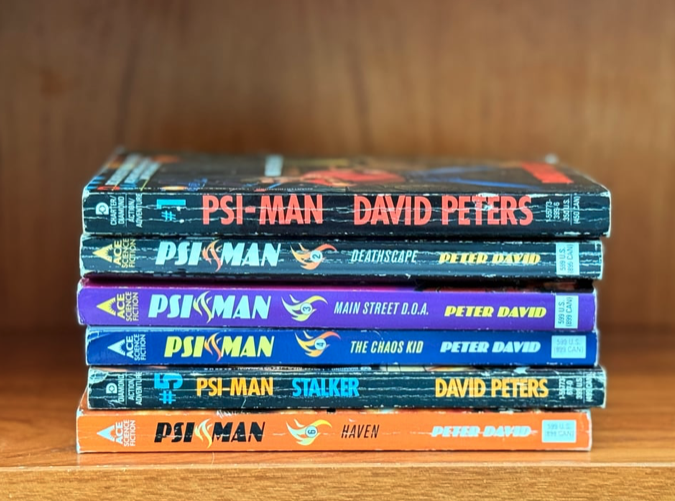
    When I heard about David’s death, I tracked down six of his books online—a serialized collection of paperbacks under the series title “Psi-Man,” which were originally published under the pen name “David Peters” but were eventually republished under his real name. They’re a sci-fi twist on the men’s adventure serials of the 1970s and 80s, about a pacifist named Chuck Simon who has psychic powers. Simon (Psi-Man, get it?) must go on the run to evade the shadowy government and criminal forces that want to harness his powers for evil, and he is aided by a sardonic telepathic German Shepherd who served as both the comic relief and the muscle.

    I’m reading my way through the Psi-Man books right now and David’s writing is just as fun and well-structured as I recall. I don’t know if I could recommend these books to anyone who doesn’t have experience with David’s writing or serialized men’s fiction like Doc Savage or The Destroyer series of novels. But it’s been a wonderful experience to go back and experience the writer who made such an impression on my youth with adult eyes. Reading these books has filled me with gratitude for the life of a man who I never met.

    So anyway, here’s a gentle suggestion: If a writer who meant a lot to you as a kid is still alive, maybe you should write them a fan letter while you still can.

  • What I’ve Been Reading and Writing: May 2025

    What I’ve Been Reading and Writing: May 2025

    Hello!

    On the first Saturday of this month, I did my annual(ish) walk around Lake Washington. 

    Let’s start with the stats that people most frequently ask about: I left the house around 4:30 in the morning and got home around 10 pm. According to my Pedometer++ app, it was 109,284 steps, and 60.4 miles. I walked from the Chief Sealth Trail to Beacon Hill, then over to 23rd Ave, up to the Burke Gilman Trail at Husky Stadium and along the Lake Washington Trail around the top of the lake. I took the Kirkland Connector Trail south and then got a little lost amid the construction south of Bellevue and fumbled my way through the neighborhood of Woodridge until I picked up the Lake Washington Trail south in Factoria again, then looped up and over to the Chief Sealth Trail home.

    And to the frequently asked physical questions: My feet were not blistered, I’ve never lost any toenails while out on any of my walks, and while I was a little stiff the next morning I was totally fine by about 10 am the next day. I didn’t sit down or really stop for breaks aside from waiting in line for coffee, the bathroom, or groceries. And rather than stopping for meals, I ate a steady rotation of protein bars. I also drank a lot of Gatorade and once I got home I ate a lot of bananas and guzzled some pickle juice. 

    In terms of equipment, I swear by my Brooks Cascadia 18GTX trail runners and my Danish Endurance socks. 

    As to the more philosophical matters: I am the kind of person who enjoys rituals, but I’m also the kind of person who is deeply suspicious about whether rituals are a good thing in and of themselves. I enjoyed taking part in National Novel Writing Month, for instance, until I began to suspect that the exercise wasn’t improving my writing at all, and that I was instead just getting good at writing 50,000 words in the month of November. 

    Similarly, this tradition of walking around Lake Washington has caused me to wonder if maybe, rather than improving my health and testing my physical limits, it’s just making me very good at the very highly specialized talent of walking around Lake Washington in a single day. I’ve learned, for instance, where all the bathrooms are and I’ve timed my breaks for coffee and hydration to fit perfectly within those prescribed stops. The walk now runs like clockwork, which almost flies in the face of the challenge of an all-day walk. 

    These walks also used to leave me completely flattened. One time, I was lying on the floor swearing that I’d never walk around the lake again. The last time I did the walk I added an extra few miles to the loop and I was so exhausted that I couldn’t see straight. But at the end of this month’s walk, I wasn’t particularly tired in any meaningful way—in fact, I walked an extra half-mile past my house because I was at 59.5 miles and I wanted to break the 60-mile barrier. So if the point of the walks is to go as hard and as long as I possibly can, I guess this year’s walk was a failure.

    But the real point of these walks, I think, is to hit a mental and physical point that I wrote about in the Seattle Times a few years back: 

    “I do them to chase a magic moment that often arrives sometime around the 30-mile mark, after I’ve listened to all the podcasts in my phone. There’s a point where the volume on everything — the traffic noise, the pink and purple sprays of wildflowers, my nattering thoughts — turns way down, and then goes completely silent.
    “In those moments, I’m not even myself. I’m just a pair of feet measuring my brief journey through the universe, one step at a time.
    “

    I think of this state as a kind of ego death: All the countless worries and random thoughts and observations that make up what I believe to be me—those ambient traffic sounds in my brain of thoughts darting to and fro—just sort of fade away. There’s nothing to think about aside from the next step.

    Using that metric, this was my most successful walk yet. I was in that state of walking meditation for roughly three hours, from Renton to home. It’s never been that sustained for that long. Even more unusual, I felt weirdly high from the experience for the next three days. 

    I walked the me right out of me.

    I’ve Been Writing

    I spotlighted 11 of May’s best new paperback releases. 

    I also checked in on three local bookstores that have made big shifts in the last year: Nook & Cranny Books moved from Capitol Hill to the University District near Ravenna Park, Paper Boat moved to the Junction at the heart of West Seattle, and Couth Buzzard Books changed ownership and opened a brand new fancy food service counter. 

    And I celebrated the opening of the Seattle area’s first brick-and-mortar romance bookstore—Hardcovers, up in Mill Creek. 

    I’ve Been Reading

    If you’d like to read a smart person write about the importance of bookstores, Jeff Deutsch’s In Praise of Good Bookstores is probably exactly what you’re looking for. These types of books often strike me as a little too grating and navel-gaze-y, but this was the right book at the right time for me, given the current anti-intellectual and anti-free-speech activities of the Trump Administration. 

    I enjoyed Jessica Anthony’s political novel Enter the Aardvark, but her third novel, The Most, is even better. It’s a very short novel about an abnormally warm day in the fall of 1957, when a housewife decides to go into the pool and just stay there. Her husband and children are dismayed—what will the neighbors think?—but she refuses to leave the pool for hours and hours. This is a book about marriage and adulthood that doesn’t feel cliched. 

    Edward Ashton wrote the sci-fi novel that became the basis for the excellent Bong Joon Ho movie Mickey 17. His latest sci-fi novel, The Fourth Consort, is probably not worthy of that high of a level of adaptation. Instead, it’s a fun sci-fi novel about a guy who accidentally joins the harem of an alien queen (but not in a fun, sexy way.) 

    It’s easy to understand why the promotional materials want to compare Liann Zhang’s novel Julie Chan Is Dead with R.F. Kuang’s novel Yellowface. Zhang’s plot bears a lot of similarities to Kuang’s excellent novel. It’s about a poor young woman named Julie Chan who learns that her estranged twin sister, a wealthy social media influencer, has died. Rather than mourning her sister, Chan decides to take her sister’s place. But this book goes to very different places than Yellowface. It’s a broader, more fantastical novel and it would perhaps be more aptly titled Escape from Influencer Island. I didn’t enjoy it as much as Yellowface—that’s one of the best books I’ve read in the last five years, so it’s a tall order—but I had a lot of fun with it.

    I enjoyed The Thursday Murder Club, which is soon to be adapted into a miniseries by Netflix, but by the time the charming protagonists discovered that a second murder had happened I found myself wishing they had solved the crime already. A little too long for what it is, but enjoyable.

    James Morrow is one of the most important authors I encountered in my youth. His satirical—some might even say blasphemous—novel Only Begotten Daughter, which I discovered when I was in my teens, opened the world up to me in ways that I’m still discovering. In his latest works, Morrow has been exploring two of his biggest fascinations—his admiration for Charles Darwin and his love of black-and-white classic monster films. Behold the Ape combines evolutionary theory with a feminist take on King Kong in a showbiz satire that doesn’t hit the heights of Morrow’s best work but which clearly belongs on the same shelf as those books.


    Utopias on Puget Sound, 1885-1915 is a fairly dry and academic study of intentional communities in the Puget Sound area around the turn of the 20th century. I wouldn’t necessarily recommend it to anyone for casual reading, but I hope some author is reading this book and planning to turn one of its stories into a full-length novel, because this region is full of people who tried to build utopias and that is fascinating and fertile ground for fiction. 


    And finally, I read a pair of books about the embarrassing habits of rich people. Survival of the Richest is a short and entertaining book about super-rich people trying to build apocalypse-proof bunkers that will allow them to survive the end of the world. (Spoiler alert: They will not survive the end of the world.) More Everything Forever is a book that pokes plenty of holes in the growing obsessions of the super-rich, including the nonsensical belief that a “singularity” is coming that will bring about a technological paradise, eliminating death and aging; and the moronic philosophy of “Effective Altruism” that basically only exists to fluff the egos of rich people and make them feel as though they’re the all-important saviors of all humanity. 

    Does Something Gotta Give?

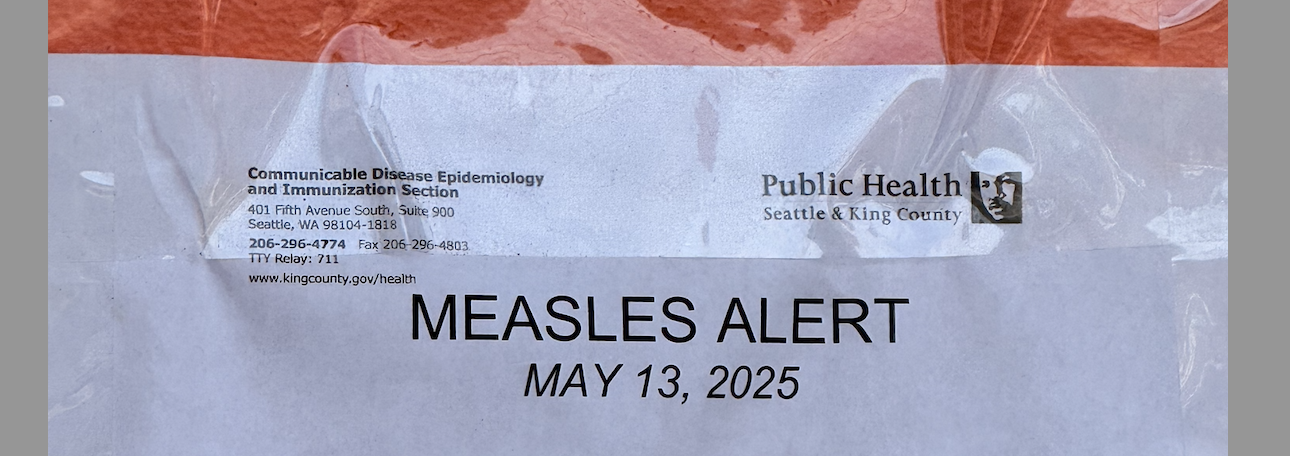
    I turned 49 this month. The day before my birthday, I walked past a notice stapled to the front of a bar. It was a public health notice warning the community that a person with measles had been at the bar on a certain date, and advising anyone who was at the bar on that date to keep an eye out for measles symptoms within a given timeframe.

    So I’ve lived nearly half a century, and this was the first public notice of a measles outbreak that I’ve ever seen in my life. The image stuck very firmly in my head and I haven’t been able to shake it. Not to be superstitious, but it had the feeling of some kind of a portent. 

    That’s what the news feels like to me right now. Every headline could be the first ten minutes of a disaster movie—aggression between Pakistan and India, Israel’s latest ground operation in Gaza, old-fashioned diseases roaring back and thriving thanks to anti-vaxxers, instability in international relations. 

    It’s important to not give these eerie feelings too much credence. But it’s hard for a pattern-recognizing primate to ignore the lessons we learned before. We saw this already in the first Trump Administration—specifically, in 2020 with Covid. It started as an item low on the front page of a news site, and then it slowly spread to consume everyone in a global conflagration. 

    Because the same guy is back in the White House dumping the same buckets of chaos all over the mechanisms that run the world without any reason or sense of responsibility, this moment feels much like that pre-Covid moment to me. Pick any news site and read the headlines and it all feels like a game of societal Russian roulette: Which potential disaster is going to be the one that takes off and personally affects every human on the planet?

    I don’t want to be a downer. I don’t really believe in the end of the world, as such—every person who lives long enough will eventually see the world that they grew up in wither and die and be replaced by another one. But rarely in my lifetime has the world felt so primed for the unfettered release of chaos as it does right now. 

    Now, chaos isn’t always a bad thing. Society can also make great progress in moments of chaos. So I guess what I’m saying is keep your eyes open and keep your imaginations primed. There could be danger right ahead, but there could also be opportunities to build good new things. 

    Take care,
    Paul

  • What I’ve Been Reading and Writing: April 2025

    Hi!

    I cannot tell you how much I needed spring to show up. Here’s a picture of Wally that really captured how I felt last week as the good weather arrived:

    The world is still on fire, of course. The news that broke me this month was the government sending a four-year-old American citizen with cancer to Honduras. And arresting judges is real tin-pot dictator behavior. 

    But for now, I’m trying to get out and walk as much as I can, and get as much lush green scenery into my eyeballs as possible because it felt like an awfully long winter and it feels like there’s another awfully long winter lurking right around the next corner. 

    I’ve Been Writing

    On the Pitchfork Economics podcast, Goldy and I talked with Mike Konczal about Ezra Klein and Derek Thompson’s book Abundance, which has become all the rage in progressive political circles. 

    I was excited to write about three different employees at Third Place Books Lake Forest Park for my bookstore profile series. 

    And I wrote about 10 of April’s best paperback releases. 

    I’ve Been Reading

    When I worked at Elliott Bay Book Company, I was always wondering which of my coworkers would go on to write the Great Elliott Bay Novel. So many booksellers are aspiring authors, and Elliott Bay attracted so many excellent writers that I assumed it was only a matter of time before someone wrote a novel about their experiences there. Here’s a contender for the title: Kim Fay worked at Elliott Bay for years and left right before I started working there in the year 2000. Her latest book, Kate & Frida, is an epistolary novel between a woman living in Europe and a bookseller at the Puget Sound Book Company, which is a (very) thinly veiled stand-in for Elliott Bay. I don’t know if I would call this the Great Elliott Bay Novel, but the details described in the book fondly brought me back to my bookselling days in Pioneer Square. I can’t recommend this one wholeheartedly—the main characters are a little too naive and earnest for me to get completely on board with them—but it’s a charming enough story that surely will appeal to booksellers and the people who love them.

    Olivia Waite’s sci-fi mystery novella Murder By Memory takes place on an interstellar ship and it stars a detective named Dorothy Gentleman whose consciousness has been downloaded in someone else’s body. I had a really good time with this one, and I’m excited to read more Dorothy Gentleman mysteries in the (hopefully) near future.

    I read two books about the intersection of urban life and the natural world. Thor Hanson’s Close to Home is a short guide to observing all the miracles of nature around us. But I preferred Christopher Brown’s A Natural History of Empty Lots, which was much more useful for my walks that take me into places where concrete highways bump up right next to wetlands that are teeming with wildlife.

    The Hole is a novella about a young woman whose husband takes a job in a strange new town. Left to her own devices, she wanders the unfamiliar territory and meets fantastical animals and falls into a hole that seems to be designed just for her. If you want the bizarre touches of Haruki Murakami without all the other Murakami hangups, this one might work for you.

    Forgotten All-Star is a biography of a comic book writer named Gardner Fox, who created a lot of the trappings that we still see in superhero comics today. I don’t know if a general audience would appreciate this, but as someone who reads and makes comics I really enjoyed following the arc of Fox’s career, from the golden age of comics on through the silver age and even into the bronze age as well.

    I read two independent comics that offer commentary on superhero comics while still being their own thing. The Pedestrian is a comic book about a hero whose power is being a pedestrian—their arch-nemesis is a don’t walk sign. The story involves secret cults and mysterious existential threats and it all feels kind of like Grant Morrison’s run on Doom Patrol, which is very much a compliment. I also really enjoyed Santos Sisters, which aesthetically looks like an Archie Comic, but which thematically feels more like the superhero comics that Jaime Hernandez wrote into Love and Rockets—it’s about two sisters who have adventures with an ever-enlarging cast of characters, until the whole thing becomes a sort of biome allowing the creators to tell any kind of story that they want to tell. I could read the Santos Sisters stories forever—it’s just the kind of cheery, imaginative, fun, and mysterious comic that appeals to me on a very deep level.

    A Pair of Recommendations

    I wanted to recommend a couple of non-book things that I’ve really been enjoying lately. 

    The first is the movie Sinners, which you’ve probably heard of—it’s Ryan Coogler’s first film based on original material. The less you know about the movie going in, the better off you’ll be. But I do want to say that if you haven’t gone to see it because you don’t like horror movies, I urge you to give it a try. Sinners doesn’t really feel like a horror film except in a 20-minute passage in the center of the movie. It’s not interested in horrifying audiences, or scaring the daylights out of you. Instead it’s a movie about music and community and the long pasts we all have trailing behind us. It’s the biggest and best movie spectacle I’ve seen in theaters since probably the Barbie movie. I left fully entertained, and I spent the next two weeks thinking deeply about it. I honestly don’t know what else you could ask of a movie, and I recommend you see it while it’s still in theaters.

    Musically, I’ve fallen for a new electro-pop album by a performer who goes by the name Daughter of Swords. The album is called Alex, and Daughter of Swords described it as “a happy-sounding record about the death of humanity on planet Earth.” 

    That’s right in my sweet spot—a catchy verse-chorus-verse structure, combined with lyrics like “I feel strange/But it’s just a natural reaction/to a world coming apart at the seams.” If you like The Blow or any of the musicians who came up in Olympia on the K Records label, you might find Daughter of Swords to be up your alley. 

    I think that’s all for this month. This one feels more discombobulated than usual. Maybe I’ll be more coherent next month! It’s nice to have goals.

    Take care,
    Paul

    P.S. I shared a picture of Wally, so here’s a picture of Obie being a happy older distinguished gentleman after a sunbath.

  • What I’ve Been Reading and Writing: March 2025

    “Sarah Wynn-Williams’s insider account of her time at Facebook arrived nearly under cover of darkness, with no promotion from the author or publisher until a week before its publication on March 11,” writes Jonathan Zavaleta at Rolling Stone. “Shortly after its publication, Facebook successfully won an emergency ruling from an arbitrator to block Wynn-Williams, the former director of global public policy at Facebook, from promoting the memoir.” 

    Facebook didn’t stop at suing the memoirist into silence. Their PR firm also harassed Washington Post book critic Ron Charles in an unprecedented pressure campaign which Charles said he had never encountered in his nearly three decades at the Post. 

    God knows what else Facebook is doing to try to get you to not read Careless People, Wynn-Williams’s memoir. Mark Zuckerberg clearly doesn’t want you to read it, and we all have heard stories about what Mark Zuckerberg will do to get what he wants: According to some accounts, he’ll buy a competitor outright, he’ll steal an idea for a website, and he’ll even allow bad actors to throw elections. 

    I don’t know about you, but when a billionaire doesn’t want me to read a book, I am overpowered by an urge to read the damn book. So I bought Careless People, and I read it. Regardless of how you may feel about the subject matter of the book, I urge you to do the same. When Facebook expends resources to silence an author, it’s up to the book-loving public to make sure that book gets in front of as many people as possible. (And I understand if you don’t have the money to buy Careless People—times are tough and the president is driving the economy into a ditch—but you can and still should request it from your local library.)

    For what it’s worth, I really enjoyed Careless People. It’s Wynn-Williams’ account of how she basically tricked Facebook into hiring her as a foreign policy advisor, back when Facebook was just small enough that it didn’t realize it needed a foreign policy advisor. I swallowed the book in two big gulps. Wynn-Williams sprinkles enough breadcrumbs of gossip and lurid details in every chapter to keep a reader happily following along to the very end.

    Basically, here’s the takeaway: Think of the dumbest boss you’ve ever had—the absolutely most thoughtless, casually cruel person you’ve ever met on the job. Now multiply that idiocy by a thousand, and you’re still not close to approaching the cluelessness of Mark Zuckerberg and Sheryl Sandberg, and the damage that those two do on a micro and macro scale over the course of this book. 

    For instance, Zuckerberg never questions why he always wins every board game he plays with his employees on long flights on his private jet—he just assumes he’s better at everything than everyone else. It never seems to occur to him that he’s surrounded by sycophants and terrified underlings. Sandberg performs feminism in public while gleefully stomping on women who fail to cater to her smallest whim. It would be hilarious if it weren’t so goddamned terrifying.

    Let’s be clear: This isn’t some smarmy tell-all. But it is cleverly disguised as a smarmy tell-all. Wynn-Williams knows that people want to read the lurid details of what it’s like to be in the Facebook inner circle, and she knows how to utilize those details to maximum narrative effect. 

    But what she really wants to do, as someone who cares deeply about the health of international relations, is send up a warning flare that Facebook is committing unbelievable harms in nations around the world—particularly developing nations. Once you’ve consumed all the salacious details, at the end of the book Wynn-Williams makes a clear-headed case that Facebook desperately needs to be regulated around the world, because these are not people you want to trust with your data. 

    They’re more than careless people; they have enough power that their lack of caution and high self-regard have transformed them into monsters. People have died because of their actions, and more will die unless someone takes a stand. Wynn-Williams deserves our respect for taking this principled stand, and this is a book that deserves to be read by everyone.

    I’ve Been Writing

    Last month, I wrote about Hex Enduction Records and Books, a tiny bookstore in the corner of a small record store on Lake City Way that punches way above its weight. If you miss the small cultural hubs that used to be in every neighborhood of Seattle that carried zines, records, and counterculture literature, you’ll be pleased to discover that their spirit is alive and well at Hex Enduction. 

    I also highlighted some of the best new paperbacks to be released in March. 

    And on the Pitchfork Economics podcast, Goldy and I interviewed Lainey Newman, the co-author of a book titled Rust Belt Union Blues, which argues that the decline of unions is more than just an economic and policy failure. She says that unions have declined in part because they’ve stopped filling the social needs of members. Union halls used to be places where people would gather to play pool with neighbors and host weddings and big birthday parties. Unions used to march in parades and participate in communities. As that civic participation declined, Newman argues, so did union membership. 


    I’ve Been Reading


    Crumble is a graphic novel for young readers about a young girl in a family of bakers who imbue their baked goods with emotions that other people can feel. When there’s a death in the family, the grief in her baked goods start to emotionally harm other people. I liked this one a lot. The artist, Andrea Bell, is a new favorite of mine. She also illustrated a graphic novel for young readers about journalism called The Leak that I really enjoyed.

    Obviously we’re in a period of reinvestigating Huckleberry Finn right now. In the flood of tributes and homages and critical reassessments, I don’t want you to miss the graphic novel Big Jim and the White Boy, which is written by David F. Walker and drawn by Marcus Kwame Anderson. It spins together multiple narratives to look at Huckleberry Finn from many different angles, including a framing story in which an elderly Jim and Huck argue over the details of the Mark Twain novel. I know Percival Everett kind of has the last word in this particular subgenre right now with his blockbuster novel James, but I don’t want this beautiful comic to get lost in the flood of press attention that book has (rightfully!) gotten.

    When I was at Hex Enduction Records and Books, I picked up a staff recommendation called Jellyfish Have No Ears by Adele Rosenfeld, a novel about a Deaf woman who is struggling with the question of whether to get cochlear implants. There have been a few interesting films, TV shows, and comics that have used their particular qualities to convey the world without sound—silent episodes, comics pages with no word balloons, that kind of thing—but I think this book does a good job of that by just putting us inside the Deaf woman’s head and letting her explain her experiences directly. 

    Chelsea Cain’s Heartsick is a thriller about using a serial killer to catch another serial killer that is not going to join the pantheon of great serial killer fiction, but I enjoyed it just the same.

    This month, NYRB released another Tove Jansson novel that had not previously been available in America. Sun City is by no means my favorite of hers—that’s still The Summer Book, which I re-read every summer—but I’m glad that I read it. It’s a novel about a retirement community in Florida and a pair of young burned out hippies who live in the orbit of those older folks. I especially loved Chapter 6, in which a woman writes a letter to her son that actually tells the truth, for once in her life. It’s a beautiful little standalone story that evokes the bittersweet perfection of Jansson’s best work.

    The novelist Geoff Nicholson died last month. I went through a period in the early 2000s when I read pretty much everything he wrote. I guess you’d call him a midlist author—he never broke big, but he had a small and reliable audience. One of his obituaries mentioned he wrote a nonfiction book called The Lost Art of Walking that I had never read, and so I had to track it down. It’s a slight non-fiction book of the kind that was published frequently in the late 90s and early 2000s—one chapter is pretty much Nicholson just listing songs that mention walking, which feels like a very before-the-internet kind of thing to do—but I was happy to be surrounded by his voice one more time, and to learn that he and I shared a love of long hikes in non-traditional hiking places.

    Stuff Is Messed Up

    It’s bad. It’s really bad. Students being pulled off the streets by masked thugs for cosigning an op-ed, experts in the history of fascism fleeing the country, an economy sliding into bad territory. 

    But I’ve seen some signs of life. Trump won’t let Elise Stefanik goto the United Nations because he’s worried Democrats would win in a Republican stronghold district, for instance. Wisconsin leaders are finally pushing back against Elon Musk’s blatantly illegal vote-buying scheme. And of course, the protests against Musk’s businesses are still going strong.

    I don’t want to make any predictions, but it does seem as though Trump is already at a point where he’s starting to take on water—his polling on the economy is below 50% for the first time ever, for instance. If the economy continues to slide, his popularity is likely to tank along with it.

    In the meantime, the question in my mind is this: How many people are going to just roll over and let Trump have what he wants? Those executive orders he’s signing that strip workers of union power and end voting by mail have no legal standing. But how much will states and the courts let him get away with, and how often will they push back? 

    In the end, I think the most important factor is not whether Trump takes control over the United States—it’s whether our institutions let him take control. If more people refuse to comply, that becomes a positive feedback loop and all of a sudden Trump looks a lot more fallible. Once people start to see a would-be demagogue as a human with human weaknesses, it’s almost impossible for them to reclaim an air of invincibility. 

    That should be the goal of everyone who stands against the fascists: You don’t have to beat them, you just have to reveal their humanity. That’s the way to win.

    Take care,
    Paul

  • What I’ve Been Reading: February 2025

    Hi!

    I hope you’ll forgive a little bit of self-promotion up top. I’m excited to announce that this month I published a new comic book as part of my day job at Civic Ventures that is free to read. It’s called Trillion Dollar Heist, and it explains a very real trick the super-rich use to steal trillions of dollars from the paychecks of working Americans.

    Trillion Dollar Heist tells the story of Marta, a janitor who steps in to stop a CEO from siphoning billions of dollars away from workers and into the coffers of the wealthy shareholder class. Along the way, Marta explains how the richest people in the world have sucked over $70 trillion from the pockets of the American middle class using a method that was completely illegal until the 1980s. You can read it for free on Bindings, a super-cool new site that helps comics creators share their work with readers with a slick interface. 

    The comic is drawn by my old pal Alan Robinson (who worked with me on my first comic, Planet of the Nerds,) edited by the great Sarah Star Litt, colored by Pippa Bowland, who also did marvelous work coloring Peter Krause’s art in our short comic about cryptids in the Washington woods last year, and lettered and copyedited by Andworld Design. It’s a beautiful package that is, again, completely free to read. And if you want to download it in PDF form and share it that way, I’ve also got you covered. 

    I’ve never written a comic about real-world issues before, and so this book was a fun challenge. I’m excited to make some more comics about economic issues in conjunction with my other comics work, and I hope if you like Trillion Dollar Heist, you’ll share it far and wide.

    I’ve Been Writing 

    It was a lot of fun interviewing Rick Steves and learning all about his successful travel business, which is based up in Edmonds, Washington. Steves is a dynamo, and we talked about topics ranging from the colonialism of travel to his plans for the future of the company that bears his name. 

    I’ve been going to comic book stores my whole life, but even I have to admit that the experience of shopping in them isn’t great for people who just want to browse: They’re often crowded and hard to navigate. So for the Seattle Times I wrote about Phantom Zone Comics, a comics shop in Lynnwood that is owned by a man with lots of experience at clothing retailers like Eddie Bauer. He’s brought that experience to comics retail, and the result is a brightly lit, nicely spaced-out comic shop that is a true pleasure to browse. 

    I’ve Been Reading

    In the middle of this month, I was hit hard by what I suspect is the flu. Even though I got my flu shot in the fall, it was still kind of a doozy. For more than a week, I didn’t have the mental capacity to read or listen to a sustained narrative, so a few poetry books entered the rotation. 

    I really enjoyed Caleb Femi’s The Wickedest, a book that documents one wild night out at the clubs—a celebration of youth and hedonism and dancing. Eve Ewing’s book Electric Arches features a few poems that start out typewritten and then transform into the author’s handwriting—a neat trick that I’d never seen before, and which works perfectly in book form.  Watchmen author Alan Moore wrote a book-length poem about the history of same-sex love called The Mirror of Love that was illustrated by José Villarrubia. It was my least favorite of the three, but yet again I’m in awe of Moore’s wide-ranging talents. 

    And then I read three books by young novelists. Maggie Su’s Blob: A Love Story is about a woman who finds a mysterious blob in an alley and trains it to become her boyfriend. It’s a fun but slight book—the kind of novel that keeps you locked in but quickly fades away once you put it down. 

    I was similarly half-engaged with Virginia Felto’s Victorian Psycho, a novel about a woman who goes on a killing spree in Victorian times. I’m far from a Bret Easton Ellis fan, but I do think if your novel’s title evokes American Psycho you’d better follow through with some satire or sharp comedy or something interesting. That said, I was not at all surprised to hear that this one is already being developed for a film starring Margaret Qualley, and I could see this being a case of the movie improving on the book. 

    Sara Siligar’s Vantage Point focuses on a vaguely Kennedy-esque wealthy family that lives in Maine. They’re confronted with a series of jarring personal attacks involving embarrassing videos and negative press attention, and everything comes undone in dramatic fashion. I do want to warn anyone thinking about reading this one that a character in the book is wrestling with disordered eating, and the passages describing her emotions and actions would definitely be triggering for people in the wrong headspace.

    In My Ears

    Last month, I wrote about moving from Spotify to Apple Music and I lamented the fact that while I was enjoying Apple Music, it wasn’t as great at recommendations as Spotify used to be. Well, a reader of this email who works for Apple reached out and directed me to this Reddit thread that explains all the different ways that you can find similar but fresh music. And as I’ve been playing with Apple Music in the month since, I’ve found some other neat discovery tools, including a handy pull-up menu that helps you find other songs to add to your queue. After a month of playing around with it, I think I can say that Apple Music is at least as good at recommending new songs as Spotify was back in its heyday, and I’m starting to think it might even be better at recommendation than Spotify ever was. 

    And Finally…the Politics

    I don’t know if I have too much to add to the daily chaos of politics this month. I’m watching and waiting to see how much damage Trump’s appointees are doing, and what I’ve seen so far has been exactly as bad as I was worried it would be. And as far as foreign affairs go, the administration has successfully accomplished a heel turn, completely reversing our standing in the international community. It would be almost impressive how quickly we allied ourselves with our former enemies and alienated our allies, if the implications weren’t so scary.

    One thing I’m encouraging myself to do is to make a mental list of people and organizations who have been unnecessarily complicit with the Trump administration: Jeff Bezos, Mark Zuckerberg, Target, Tik Tok, etc. I’d encourage you to do the same. And then the most important step is to never forget that these people happily rolled over for Trump. No matter what: Don’t forgive them, and don’t forget, and always speak loudly and repeatedly about what they did. Trump is not going to be in power forever, but the cowards who aided and abetted him should be shamed and shunned and ostracized long after he’s gone. This is the time to cultivate grudges.

    I do think the Trump administration is about to hit some brick walls. People are losing jobs all over America, and even Fox News pundits are basically begging Trump to reverse job cuts that affected their friends. Politics hits differently when it stops being about scoring outrage points on social media and starts actually affecting people in your lives. 

    But the one wild card in the Trump chaos for me is Elon Musk. Musk is already doing an incalculable amount of damage to the federal government, of course. But the most worrisome part of all this is that he’s not an elected official and he has a seemingly bottomless reserve of resources that he can use to ensure that he has access to the levers of power for decades to come. If Musk plays his cards right, he could basically be a major player on every single Republican ticket for the next twenty or thirty years, ensuring that we’re never fully rid of him.

    Luckily, Elon Musk is an idiot and a narcissist who needs to be at the center of everyone’s attention all the time, and people are getting sick of him. It’s very possible that he could wind up becoming the most unpopular man in America over the next year or so. But the problem is that the world’s richest man ultimately doesn’t have to care that much about what the hoi polloi thinks of him.

    That’s why I think #teslatakedown, the rolling protests of Tesla dealerships, is such a great idea. Musk’s immense fortune is still largely anchored by Tesla’s outsized stock valuation, and if we can successfully turn Tesla into a toxic brand that people are embarrassed to be affiliated with, Musk will still be incredibly wealthy but he will no longer be richest-man-in-the-world wealthy. Losing that title would be a catastrophic blow to his power and to his self-image. 

    I genuinely think speaking out against Musk and his products is one of the most important pieces of political action that we can take as individuals right now. So if you are the kind of person who goes to protests, maybe you should participate in one of the many Tesla protests happening around greater Seattle tomorrow:

    And if you’re not comfortable attending protests, think about how you can help transform Tesla and Starlink and SpaceX and Musk into toxic brands. Maybe you can make t-shirts or stickers. Maybe you can share an original song or a video to social media. Maybe you have friends in your life you can talk to about shunning all things Musk. Every little bit of social action helps. He’s currently the single biggest threat to our democracy, and we all can do our part to help make it absolutely embarrassing for anyone to have their name identified with him. 

    In order to save democracy, let’s all give that goddamned Nazi the biggest metaphorical atomic wedgie the world has ever seen. 

    That’s all for this month. The next time you receive this newsletter, the days will be longer and the weather will be nicer. That’s something to look forward to.
    —Paul