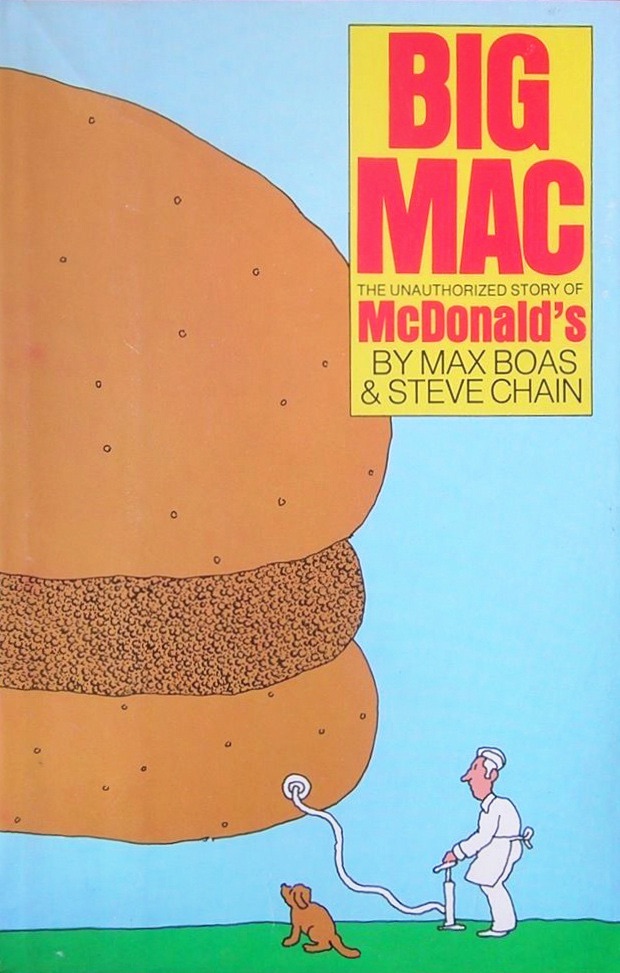
My friend Clinton gave me some old paperback curiosities a while back and I finally read the first in the stack: Big Mac: The Unauthorized Story of McDonald’s, written by Max Boas and Steve Chain. I went through a period where I read everything I possibly could about McDonald’s because I found the scale of the business to be so mind-boggling that I couldn’t fathom how it worked. Ray Kroc’s autobiography, Grinding It Out, was not very helpful in that regard, but it was pretty entertaining.
Somehow during that McDonald’s-obsessed period I never came upon a used copy of Big Mac, and I wished that I had—it’s a book that was published in 1976, back when McDonald’s was still a relatively new phenomenon and Ray Kroc was still alive and giving interviews. It’s written in that shaggy pseudo-gonzo style that was in fashion at the time—a little bit of Hunter Thompson, a little bit of Tom Wolfe, a lot of machismo. And it is very entertaining.
The thing that struck me most about reading Big Mac is that at the time the book was written, the general reading public could be expected to be more or less horrified by giant corporations—the way McDonald’s controls the experience to a level that the interior of a restaurant in Vermont is more or less the same as the interior of a restaurant in Arizona was a disgusting and off-putting thought to pre-globalization America. The authors also recount a speech by Lloyd Bentsen—the Democratic Senator from Texas, if you can imagine such a thing—giving a speech disparaging the fact that McDonald’s was becoming a bigger profit center in the American economy than steel manufacturers.
Overall, Big Mac is an entertaining and outdated guide to the history of McDonald’s as it was 50 years ago. I wouldn’t recommend that everyone rush out and read it, but if you’re looking for a record of the history of our tolerance of corporate power and reach, it’s a very interesting document.