For a few months, arts media has been reporting that the mass-market paperback has finally gone extinct. It’s been a long time coming. Even at the end of my bookselling career in 2008, publishers were phasing out the form factor and shoppers simply didn’t seem to care one way or the other.
On the one hand, who cares? Lamenting the end of a very specific type of paperback feels frivolous at a time like this. Mass-market paperbacks were cheap and flimsy and couldn’t survive more than a couple re-reads. The cover art was minuscule and often illegible. So, again, who cares?
I mean, I do. Honestly, my life would be vastly different if mass-market paperbacks didn’t exist when I was a kid. One of my favorite gifts every Christmas and birthday was a whopping $5 or $10 gift certificate to Bookland, a small chain of indie bookstores in southern Maine. I could get a mass-market paperback and maybe a comic book or two with those gift certificates, and the books that I chose on those occasions basically set the course for my reading life: I started with Douglas Adams’s Hitchhiker’s Guide to the Galaxy series, crashed into Terry Pratchett’s Discworld series from there, and then launched into Kurt Vonnegut.
If those books cost twice as much, I would probably not even have read half as much as I did in my tween and teen years. And as I got older and the Vonnegut books started to evolve into more prestigious trade-paperback editions, I opted for the mass-market versions just because I liked the way they felt in my hand.
The approachability of the mass-market paperback is something that means a lot to me. As I made the inevitable white-boy slalom into the works of Vladimir Nabokov, I found his works much easier to digest from between the slightly lurid covers of a used mass-market paperback; those elegant trade-paperback covers with their witty allusions to Nabokov’s wordplay always felt too erudite for little old earthy me. I eventually read every one of Nabokov’s novels in mass-market form. Same with Steinbeck, and Anne Rice, and Terry Southern, and James Morrow and on and on and on.
I first met Dorothy Parker in a pocket-sized Portable edition that the publisher soon replaced with a larger, non-portable Portable edition. In retrospect, that should have been a blaring early warning sign that mass-markets were on their way out—even Portable collections switched over to cumbersome larger paperback editions, which are only slightly easier to shove into a backpack than their hardcover brethren.
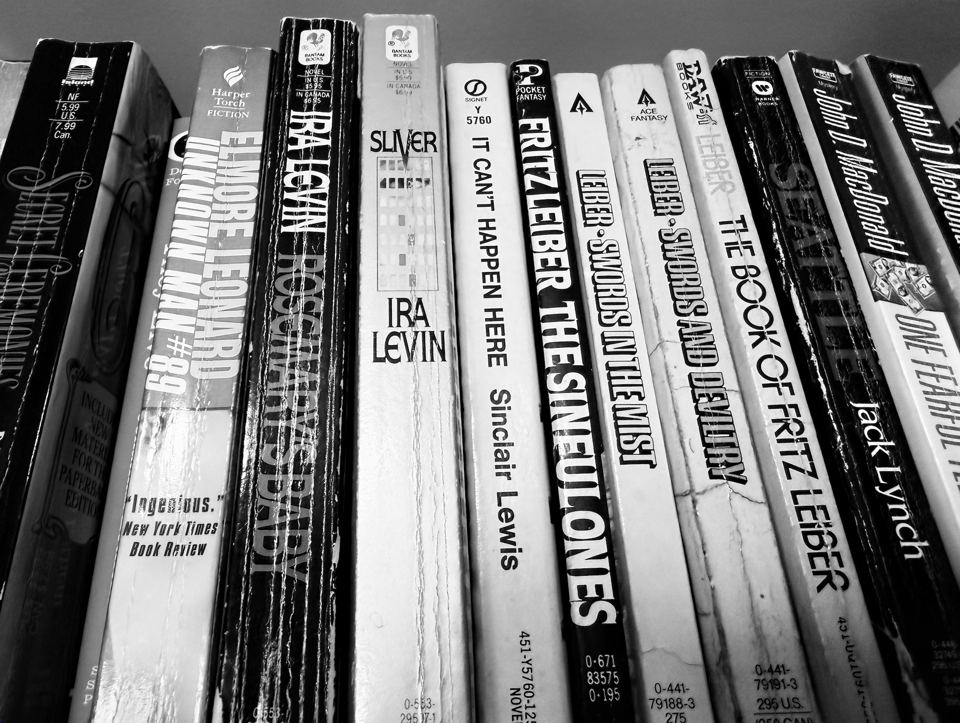
We should acknowledge now that something is getting lost as the last mass-market paperbacks slink off the press and into history. Publishers say that the form factor just isn’t popular with readers anymore, and that’s undeniably true. But when most paperbacks now cost about $20 a pop, publishers are also relinquishing their efforts to win over a certain kind of audience—the poor kids who maybe don’t live near a good library, the tourists who consider buying their first book in a decade but wince at the thought of laying out twenty bucks for a romance novel after they just had to drop thirty bucks for a shitty sandwich and a bottle of lukewarm water at the next airport stall over.
Literature is essential, yes, but that doesn’t mean that literature shouldn’t make an effort to try to be accessible in many different ways—including price.
The traditional publishing model dictates that a book comes out in hardcover, and then it arrives in paperback about a year later. And after that, unless it’s a bestseller, it’s basically in the wind, a memory. I’d argue that there would be value in a third step in the life cycle of certain titles: a mass-market release in non-bookstore spaces a couple years after launch, to grab the attention of irregular readers and Dollar Tree shoppers and the growing number of folks who don’t often encounter books in their daily lives.
On a purely commercial level, it seems as though the egalitarian entryway to literature has been shuttered with the mass-market paperback. And as publishers opt for fancy limited-edition releases with colorful decorated edges and gilt covers that you can only buy at Barnes and Noble or through other exclusive retail deals, it feels as though yet another art form is turning its back on poor people in favor of an upper middle class with disposable income to burn. Those extravagant and rarified types of art are always the first to get cut out of consumer budgets when the recession comes. By rushing after luxury, publishers risk making themselves inessential.
I’ve Been Writing
Speaking of those $20 paperbacks, I wrote an overview of some of March’s most interesting paperback releases for the Seattle Times.
And I guest-wrote an issue of The Pitch this month about the fact that this is the time to come up with big ideas for exciting policies that will help win over voters in the midterm elections this fall. Of course I used the occasion to bring up FDR’s Second Bill of Rights, which to me is the most interesting Sliding Doors moment in American history. What if, for most of the 20th century, we had enshrined a right to health care, work, affordable housing, and food into the Constitution at the end of World War II? What kind of world would we be living in right now?
I’ve Been Reading
I listened to George Saunders’s latest novel, Vigil. Like his last novel, Lincoln in the Bardo, the audiobook is a full cast recording that feels more like a radio play than your typical audiobook reading. Also like Lincoln in the Bardo, it’s a book about a complicated man hovering in the liminal space between life and death, only instead of Lincoln, this book features an unrepentant CEO of a world-destroying oil company. It’s an interesting companion piece to Lincoln in the Bardo, but I don’t know that Vigil stands on its own as an especially meaningful experience.
I read two recent nonfiction paperbacks this month: That Librarian by Amanda Jones and Money, Lies, and God by Katherine Stewart. They are both interesting books about current political conditions—book-banning in libraries around the country and the radicalization of the Republican Party, respectively—and if either of those topics interest you, they’re well worth your time.
Susan Orlean’s Joyride is billed as a memoir, but it actually reads more like a how-to-write book, except it’s specifically about how to write like Susan Orlean. It’s a fun, anecdote-packed story of Orlean’s rising career at the tail end of the golden age of print periodicals, and if you’ve ever loved a magazine or newspaper with all your heart I bet you’d enjoy this book.
A while back I read Batman Resurrection by John Jackson Miller, which is kind of a weird duck in the world of movie tie-in novels—it was a novelization of a movie that was never made in between Tim Burton’s 1989 Batman movie and its sequel Batman Returns. All the characters are obviously based off the movie; this Batman couldn’t be anyone but Michael Keaton, for instance. As a kid who loved those movies more than just about anything, I really enjoyed the book. Its sequel, Batman Revolutions, is not quite as enjoyable a read as Miller’s first foray into the world, but it’s still a lot of fun. If you’re into the pulpy kind of so-called “men’s adventure fiction” that used to make up a significant amount of the mass-market paperback sales I was talking about in the introduction to this newsletter, this will definitely scratch that itch. I hope Miller gets to explore these stories a little more because I will gulp up every one of these books that he writes.
Think Small, Think Regional
Late this week, the news broke that Paramount, which is owned by weird nepo baby David Ellison, is buying Warner Bros. and all its attendant properties. That means a rich kid convinced his dad to buy him Bugs Bunny, Tony Soprano, Batman, Turner Classic Movies, CNN, Harry Potter and the Game of Thrones all in one fell swoop, and it means that one man will own a significant share of the globe’s attention.
(And let’s not forget that his father was just handed TikTok on a silver platter by their spiritual godfather, President Trump.)
This is a nightmare scenario, and I’m not looking forward to the decisions I’m going to have to make as a consumer in the months to come. Dropping Twitter on the day that Elon Musk bought it was relatively easy for me, but I love me some HBO and some DC Comics. Still, if Warner falls prey to the kind of pro-fascist manipulation that we’ve seen in CBS News under Bari Weiss, the decision will ultimately be an easy one to make.
All this underlines for me that we need to get back into the art of building a regional entertainment sphere. Seattle famously was home to a Saturday Night Live-like TV show called Almost Live! back in the 1990s, for instance.
Even though technology and the internet have in theory made it easier for people to make and distribute art, it feels like everyone is still shooting for a global audience. We need to think small again, with movies and books and TV shows and podcasts with a hyperlocal focus. If you haven’t already, it’s time to stop giving your money to fascist failsons and instead direct that money and attention to people making art in your backyard.
Obviously, local news is important. But local art is important, too, and we should expand the idea of what local art is—it’s not just plays and gallery shows and poetry readings but movies and episodic video and all of the cultural artifacts that are so easy to make and distribute now. There are already local book distributors and plenty of independent bookstores and movie theaters in the Pacific Northwest. We need to bring back touring roadshows of movie screenings and multidisciplinary variety shows and find new ways to make and share and consume art on a more human, humane level.
We have scaled up everything to a planetary scale and that has worked out terribly for everyone except a handful of CEOs and investors and their pet Nazis. It’s time to figure out how to get small again.
Take good care of yourselves and I’ll see you on the Ides of March.
Paul

 Paul Constant