2026 has been a great year for conspiracy nuts. The latest Epstein Files dump proved every paranoid stoner to be correct. Yes, Epstein was involved in a plot to turn global politics sharply to the right. Yes, he helped create cryptocurrency, which made political corruption much more prevalent. He tried to get involved with the Gawker lawsuit, which eventually undid the blogging era. He colluded with a passel of powerful, disgusting men to try to unspool the progress made by the #MeToo movement. He was present at the dawn of Gamergate and its war on feminism and journalism.
This all sounds insane, but it’s right there in black and white. As Ryan Broderick said in a recent episode of his excellent Panic World podcast, “If you think that Jeffrey Epstein didn’t fuck with your life in some way, you’re wrong. He fucked with all of our lives for years.”
Before I whip out the corkboard and red yarn, I want to be clear about a couple of things: First, Epstein’s end goal was not to install Donald Trump as a fascist leader. He “just” wanted to make it easier for himself and his wealthy pedophile friends to make obscene amounts of money through illegal means, and he wanted to make it easier to launder and move those obscene amounts of cash around the world. He was a sick criminal who wanted to essentially transfer power from the governments of the world to the hands of elite, sick criminals like him.
So no, I don’t think the return of fascism was his end goal. It just so happens that when you tip the world into a consequence-free playground for the super-rich by bombing the pillars of civilization, fascism inevitably rises to fill the void you left behind. Whoops.
And second, I think that calling this a “conspiracy” is almost giving it too much credit. There is no shadowy cabal of carefully selected captains of industry acting out secret rituals according to ancient texts. There’s no hyperintelligent maestro delicately pulling the strings in order to enact a grand plan. No, our modern world was simply the result of a bunch of rich, barely literate perverts bashing out idiotic emails to each other at all hours of the day and night.
This is bleak stuff. But in a way, I feel a little better knowing that there is no grand design to all this, and that the agenda was nothing more than a messy get-rich-quick scheme from a bunch of self-pitying wealthy nerds. That our corrupt and regressive culture was created by bumbling human beings means that it can be unspooled by other human beings.
Now, granted, we have an uphill battle ahead of us. It always takes more effort to create something than it does to break something. But the citizens of the world have crawled out from under a massively corrupt Gilded Age and its attendant rise of fascism before, and that means we can do it again.
We may be poorer than these so-called elites, but the record proves that we’re definitely smarter than them. And when we look back on the historical record of the 1940s and 1950s, we have a very workable blueprint for building a more democratic, more broadly prosperous world. It can’t be impossible, because it’s been done before—and now we know that our opposition is nothing more than a basketful of absolute numpties who type with their big toes. We can take them.
I’ve Been Writing
For the Seattle Times, I wrote about the most interesting paperback releases of February.
I’ve Been Reading
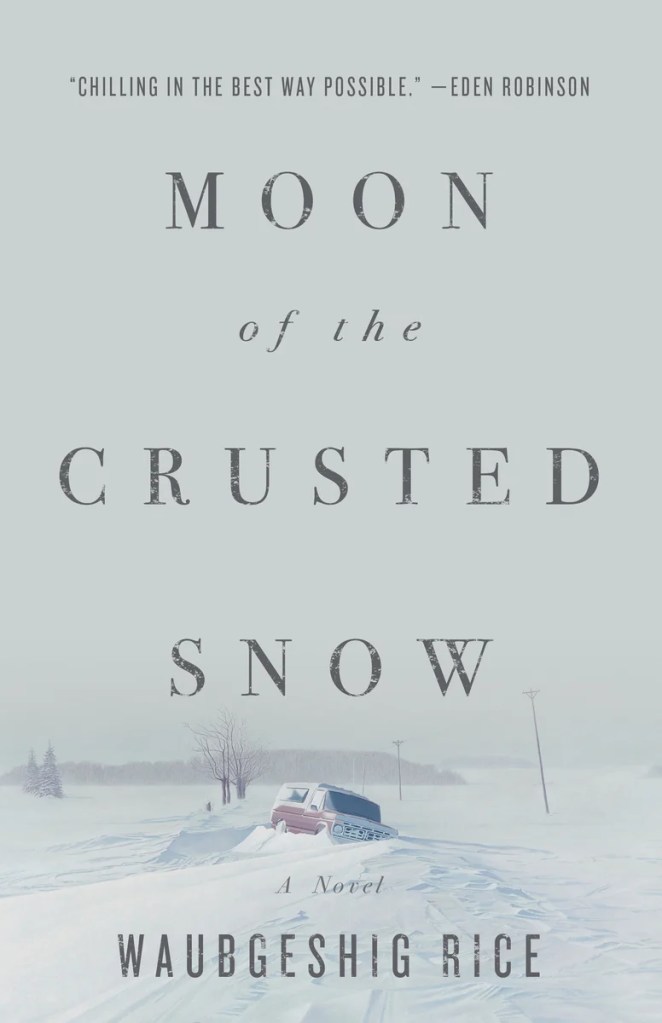
Waubgeshig Rice’s Moon of the Crusted Snow is a post-apocalyptic novel, but it’s one with a twist. It’s set on a native Canadian reservation in the Arctic Circle, and the way the end of the world touches that community. At first, they don’t even notice when the outside world shuts down. But slowly, shipments of things like groceries and gas stop arriving, and the harsh winter is right around the corner. Then white people start showing up from the south, and the problems really start. The spare writing style probably won’t appeal to all readers, but I was sucked right into this book. It takes a lot for me to even pick up a post-apocalyptic novel, but this one I enjoyed a great deal.
I was sick this month, so my reading list is shamefully small this time around. While I was in the throes of the cold, I read a compendium version of J.M. DeMatteis and the late Keith Giffen’s comic book Hero Squared, which is basically about a version of Superman traveling to an alternate universe where he’s a normal schlub. Giffen and DeMatteis wrote what was probably the most important comic I read in my youth—the humorous Justice League reboot that presented superheroes as ordinary people with ordinary problems. I wish I liked this book more, but the villains weren’t particularly well-established and the themes failed to come together in a meaningful way. Still, at a time when I was restless and abandoning lots of books in a cold-medicine haze, it was nice to soak in that old familiar shared authorial voice one more time.
The Culture Wars Are Coming for the Culture
This isn’t a trend piece so much as a vibe check: I’ve noticed a worrisome lean to conversations about art on Reddit and Bluesky and comment sections, and I need to write about it a little bit in an effort to understand it more.
Back during the first two years of the pandemic, I spent time on TikTok. Mostly, I followed comedians and economists. In retrospect, it kind of filled my social needs during lockdown—over lunch, I’d check in on how my parasocial friends were doing and lose a few minutes to scrolling.
One of the comedians I followed was Jane Wickline, who performed awkward comedy bits and the occasional musical number. I really enjoyed her sense of humor, which ranged from observational comedy to the occasional absurdist skit. And so in 2024 when it was announced that Jane Wickline was joining the cast of Saturday Night Live, I felt a little bit of proprietary pride that someone I’d been following since the beginning made it to the big leagues.
In the time since her SNL debut, Wickline has been a lightning rod for some of the most vicious criticisms on the internet. Comedy nerds and SNL fans have been remarkably cruel to her in all the ways that anonymous commenters are cruel to public figures.
But one of the weirdest strains of comments about Wickline are the comments that suggest that she objectively isn’t funny and that the people who claim to like her are lying for some reason. As in, no human being could possibly find Jane Wickline funny and therefore there’s some sort of gaslighting underway—either people who claim to be her fans are paid to post their support, or they praise her in order to advance some other agenda.
That sort of solipsistic argument—this art is bad and nobody could objectively enjoy it so its fans are not real—isn’t particularly new, but it definitely seems more widespread now. Music comment threads are full of people complaining about “industry plants,” which means musicians who had some pre-existing connection to the music industry that helped them get a foot in the door. Cindy Nguyen at The Santa Clara listed a few artists who have been defined as industry plants: “Billie Eilish, Clairo, Lil Nas X, Chance the Rapper and Cardi B.” I’ve also seen Wet Leg and Lorde in this conversation.
The term “industry plant” has warped over the years to essentially mean a musician with no real organic support, meaning the industry colluded to shove them down the throats of an unwilling public. Any support of those artists is viewed as artificial and somehow corrupt.
And the latest example that I’ve seen is the AppleTV show Pluribus. I love the show and its deliberate pacing, but I understand that it does not work for everyone. But the vitriol directed at both the show and its fans on comment threads is kind of breathtaking. And that vitriol also went an extra step, with people accusing the fans of being astroturfed bots who only pretended to like the show in order to drive up ratings. This is a common belief, with some people speculating that the show is “a social experiment to see if an objectively boring and mediocre script can still be successful with enough prestige signaling and astroturfing.”
This sentiment feels like a new and disturbing turn in the social conversation. Just as social media has amped up hyperpartisanship to the point that many people don’t believe in the basic humanity of people from the other party,* the discourse around art is transforming into an all-or-nothing fight over whether it’s even possible for someone else to like a piece of art that you don’t understand.
This is moving toward a very bad place. It feels like the algorithm is turning fandom into another never-ending war between two clearly delineated sides that are sworn enemies.
And it didn’t occur to me until I started writing this that all of my examples of art that internet dudes deem to be something no person could possibly organically enjoy are women-led. That explains a lot—it’s misogyny all along!
Sigh.
Take care of yourself and please consider wearing a mask in crowded spaces so you don’t get the cold that I had. See you in a couple weeks.
Paul
* But seriously: fuck Nazis. If your “partisan” and “political” beliefs include the argument that certain people are not fully human and deserve to be stripped of their rights and/or shipped off to camps, you are scum who should be shamed and shunned from society.

 Paul Constant