Hi!
The news is all bad. This year started off badly and it quickly got much worse. I expect there’s more awfulness to come.
I don’t have much to say about any of this except one thing: It’s important to remember that the Trump administration isn’t doing all of this—the kidnapping of other nations’ leaders, the shock troops invading American cities, the daily humiliations of enemies, the murder and torture and kidnappings—because it’s part of some genius plan.
This is not the measured and deliberate unspooling of a brilliant mastermind’s blueprint. These are frightened people doing everything they can as fast as they can in order to retain control over the reins of power. They are terrified because they know that if they let up for even one second, people will turn on them. So they keep throwing everything at the wall. It’s not governance. It’s pure panic.
And the thing about fear is that people make mistakes when they’re afraid. They go too far, they overreact, they expend so much energy on the short term that they don’t realize they’re destroying themselves in the long term.
Our job right now is to document their offenses, to protest when we can, and to remember everything as clearly as we can. But most importantly, our job is to survive this onslaught. They can’t keep up this pace forever and they’re burning through goodwill and allies with each passing day. If we survive this, the chances are very good that we’ll get to see them experience the consequences of their actions. That’s what gets me out of bed on the tough mornings.
I’ve Been Writing
For the Pitchfork Economics podcast, Goldy and I talked with journalist Osita Nwanevu about his new book The Right of the People, which is an aspirational book that outlines the need for a new constitutional convention that rebuilds American democracy to work for everyone.
I wrote about 18 of the most intriguing books that are slated to come out in 2026, and I also wrote about a dozen interesting new paperbacks released in January.
I’ve Been Reading
I found a copy of Emily Adrian’s 2025 novel Seduction Theory in a Little Free Library recently. It’s the story of two married college professors who cheat on each other in very different ways—one physically and one emotionally. This book builds to a very exciting final scene and I enjoyed it very much, though I thought the central couple of the book was presented as a little bit too perfect: beautiful, brilliant, emotionally intelligent. And the dynamics of the couple were also weirdly uniform—the man was slightly worse of a writer than the woman, he was a little bit less attractive, his career was more tenuous and he was not quite as loved by the community, and so on. A few more ragged edges would have ramped up some more delicious tension. But it’s a short book, and if you’re into academic novels it’s well worth it.
The second academic novel I read this month was The Material, by Camille Bordas, which is about a very dramatic day in the life of an MFA program for aspiring stand-up comedians. As someone who has written a whole-ass graphic novel about stand-up comedy, this felt right up my alley. The Material shares some sensibilities with Snelson: Comedy Is Dying—particularly what it means to be an aging comedian and whether there is such a thing as cancel culture. While most modern novels feel bloated and overlong, this is the rare one that left me wanting much more. I wish Bordas hadn’t constrained herself to a single day with these characters and this story. I wanted a deeper and more full exploration of all the themes.
If you’re looking for an audiobook to whip through in order to start your books-read tally for 2026 with some padding, you couldn’t do much better than Blake Crouch’s novel Famous. Like many of Crouch’s books, this one is about a doppelgänger—in fact, it’s narrated by a man who happens to look exactly like the most famous movie star in the world. It’s a wild, twisty story told by an absolutely irredeemable creep, and it’s only four hours and 40 minutes long—which is exactly how long it should be.
Helen DeWitt’s The Last Samurai (no relation to the Tom Cruise white savior movie of the same name) is one of the most significant novels of my life. I read it at a time when I was breaking free from a lot of the expectations and traps that a white dude in his early 20s at the turn of the millennium was likely to fall into—an addiction to Great Man Syndrome, an unconscious bias to Big Important Books by Big Self-Important Dudes, that sort of thing—and it helped change my idea of what a great novel could be. Your Name Here, DeWitt’s latest novel, an audacious metafiction co-authored by Ilya Gridneff, is not the same joybuzzer to the head that The Last Samurai was. It’s stubborn and almost willfully obtuse and seemingly full of inside references. I’m glad I read it, but I don’t know that I can recommend it to anyone who’s not closely following DeWitt’s career.
I was hoping that Alain de Botton’s Religion for Atheists might offer some insights into the importance of ritual and community in secular life. And I suppose the book does offer some of that. But it’s all too silly to take seriously. In the first quarter of the book, de Botton proposes that instead of church, atheists should attend a restaurant that invites people to ask invasive questions of other diners and also once a year hosts no-holds-barred orgies. I hope someone else has written an intelligent version of this book, because I’d sure like to read it.
Every once in a while, I like to try reading some manga because I am woefully detached from the world of Japanese comics. Over holiday break, I read the first volume of Rooster Fighter, by Shu Sakuratani. It was exactly the kind of manga that I like to read—episodic, beautifully crafted, and so silly that it feels like it was drawn in an ongoing gas leak. It’s about a rooster who wanders around the world fighting giant demons. The rooster has a Clint Eastwood-style interior monologue that reveals him as a tough guy, and typical tough-guy things happen to him, but they’re always undercut because he’s just a rooster. This was a lot of fun and I’m excited to keep reading the series when I need a goofy lil escape from the horrors of the news.
The Dog Days of Winter
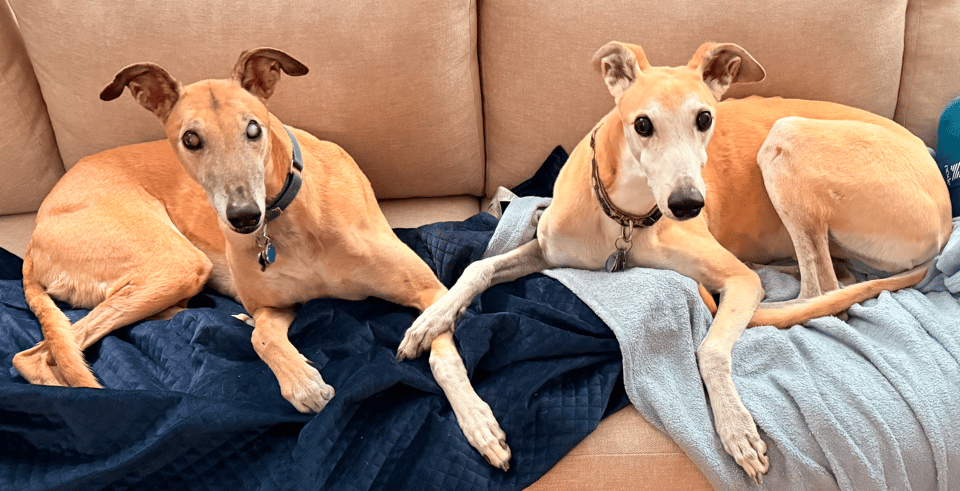
The first week of January is a big week for dogs in our household. January 4th marked the eighth anniversary of the day that we brought our first greyhound, Oberon, home. Obie was my first dog and he has trained me to be a dog person through-and-through.
January 3rd was the fifth anniversary of the day we brought our second greyhound, Wallace, home. We were thinking about getting a second dog to keep Obie company in the winter of 2021, when we spotted a posting for a blind greyhound just off the track who needed the companionship of a confident older greyhound. After a visit to Greyhound Pets Incorporated, we found that the two of them hit it off and Wally came home with us that night. Wally had a small amount of vision left when we first got him, which helped him learn the layout of the house and our neighborhood before he went completely blind.
Wally is loud for a greyhound. He compensates for his blindness by barking and leaping in the air to make himself seem big any time he’s confronted with something he doesn’t understand, which can make walks a challenge. But at home, he’s become a real sweetie. Nothing makes him happier than to be in a room with his people and Obie, and he’s prone to letting out a long, satisfied groan when he feels safe and contented.
And then January 5th marked Obie’s 12th birthday. Twelve is pretty old for a greyhound, and Obie really started to show his age last year. We’re treating him for arthritis, he pulled a muscle that incapacitated him for a while in the fall, and he most notably was hit with a bad bout of pancreatitis in the summer that probably could have killed him if the good folks at Blue Pearl emergency vet in Tukwila hadn’t put him on a course of strong painkillers that helped him survive the attack.
But aside from his regular meds for arthritis, all the big health issues have passed for the moment and Obie currently looks very healthy for his age. But an old dog is an old dog, and Obie has some occasional weakness in his hind legs that is just heartbreaking to see. And there are undoubtedly more issues to come.
But in general, owning an aging dog hasn’t been the experience that I thought it would be. It’s not as sad, for one thing. Obie is generally a calmer and more pleasant dog the older he gets, and he’s very comfortable with his role in our lives. I’m grateful for every walk we take, and I’m honored to take care of him as he ages. His trust in us feels more like a gift with each passing day.
If you’d asked me when I moved to Seattle in the year 2000, I never would have predicted that I’d eventually live in a home with two big dogs. But now I can’t imagine a life without dogs in it. Especially now, with everything feeling so incredibly bleak, sometimes these two not-so-bright retired athletes are the very best part of my day. All of which is to say that if you’re considering visiting a pet shelter and bringing home an animal, you should interpret this email as the universe sending you a sign to do it.
Thanks for reading!
Paul

 Paul Constant